
Lately I’ve been thinking about stuff.
Just over thirteen years ago I packed my stuff into a half container and had it shipped across the world. A year later, when I finally moved into a tiny flat in South West London, I can still remember how thrilled I was to have my stuff all around me again. I remember filling the drawers of my beautiful wooden sideboard with games, crockery and assorted bits and pieces and ripping into the box marked CDs to plug into some much-missed Aussie favourites. It felt like Christmas and a birthday all rolled into one.
Spending so much time at home at the moment has made me realise how much stuff I have. Most of this original shipment is still with me and my years here – and a move to a bigger flat five and a half years ago – has seen me accumulate more.
What has struck me is how it runs my life. Last week, I spent almost three hours re-staining my 5-year-old outdoor setting. It was not a fun experience and as a mucky pup, I managed to get the wood stain in all sorts of places it wasn’t meant to be. But it’s a big job that’s been ticked off the list and I’m really pleased with how it looks. Until I have to do it again…
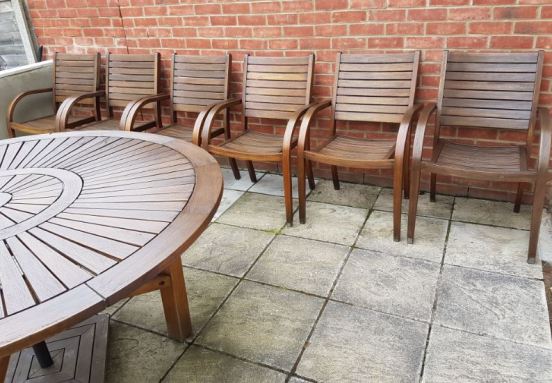
Almost 3 hours of work and it looks great. But I know I’ll have to do it again…and again.
I saw Yuval Noah Harari, author of Sapiens: A Brief History of Humankind, interviewed earlier in the year. It was clear that he’d been considering this as well.
“We did not domesticate wheat. It domesticated us.”
His point was this. Before we caught on to the idea of cultivating more wheat than we needed, we hunted and gathered only as much food as we could eat, following and staying where the food source took us. Wheat had us stop and settle, invest time and energy and resources – including the building of fences and the shovelling of sh*t – to preserve and protect it. His question is ‘do we really think we are running the show?’
My question is now, ‘has my outdoor setting domesticated me?’
Stuff is everywhere. And here in London you cannot travel far without coming across a testament to it – a museum. And it’s been in visiting some of the smaller ones recently that has got me thinking about what stuff means and why preserve it.
In the last couple of months, I’ve visited the home of wealthy industrialist, Frank Green in York, the Hampstead home of Sigmund Freud and his daughter Anna and the home of architect and collector Sir John Soane in London’s Lincoln’s Inn Fields. For me, these personal collections of antiquities, curiosities and everyday items created a much greater sense of the person’s story and time. I was especially fascinated to learn that:
- Sir John Soane was such an avid collector that he bought the sarcophagus of Egyptian Pharoah Seti I (1303 – 1290 BC) when the British Museum ran out of money after it had secured the controversial Elgin Marbles.
- Sigmund Freud was so attached to his stuff that he refashioned the study he had in Vienna in his new home in London, including THAT couch.
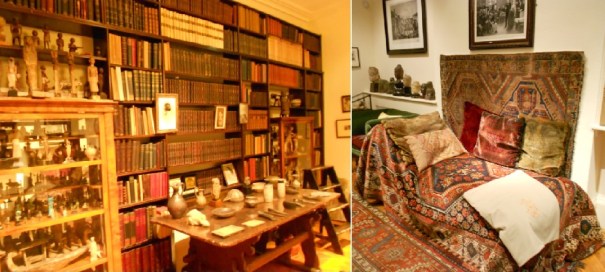
Freud lived at Bergasse, 19 in Vienna for 47 years. Before he fled to London in 1938, he had his rooms in Vienna photographed with a view to recreating them in his new home.
Without stuff, how would we get a sense of what has happened before or what life was like? And yet the physical stuff is not the whole picture.
I attended a breakfast seminar in April which addressed the question of stuff. There was a lot of talk about decluttering, connoisseurship and the trend towards spending on experiences rather than things. Research shows that the Millennial generation in particular (born between the early 80’s and the late 90’s) are tending to share and access stuff versus owning it. Perhaps this is a conscious choice about being unencumbered and financial enough to travel, attend events, concerts and festivals, eat out and, as one media pundit noted, ‘drink their £4 coffees’.
The digital discussions around music (iTunes), streaming services (Netflix/Amazon Prime) and e-books were also interesting and in the face of their continued growth, the non-digital experiences associated with all three industries are being revisited. Vinyl has become the choice of the cool connoisseur. Cinemas are providing VIP services and collaborating with live event providers eg. theatre, opera, ballet and even the annual TED Conference, to expand their audience and revenue opportunities. And books? Well, e-book share is highest in the US, having grown to 25% since 2009, yet only 7% of people state that they will read only e-books in the future. (Source: PWC – The future of e-books 2016). That seems to me to be a gap for stuff to fill…
Here at Gidday HQ, the past few months have been chequered with bi-weekly trips to the charity shop as I’ve been weeding stuff out of cupboards, drawers and wardrobes. In the words of Steve Howard, CEO of global stuff purveyor IKEA…
“If we look on a global basis, in the west I’d say we’ve probably hit peak stuff.”
…and my cupboards probably agree. But with IKEA’s sales up 4.8%, their expansion into new markets going strong and the opening of their IKEA Museum in 2016, I’d say ‘I don’t think so’.
Consider this. How often have you been trapped shopped in the IKEA Market Hall and found yourself putting a funky new toilet roll holder (that you had to have) onto the checkout conveyor next to the matching-colander-and-spatula-set (that will be very handy) and yet-another-bag of 100 tea light candles (because we might’ve run out)? And who doesn’t love a Billy bookshelf – the home for books (and most likely other stuff) that ‘loves to grow’?
No. We like stuff. We like the stories stuff tells us about ourselves – how much or little of it we have, what it all means about us. And we like to check out other people’s stuff – in museums, on social media, on the bus – and decide what we think it means about them.
So to my mind, our relationship with stuff is still going strong and digitisation is just encouraging us to get more and more of it. Case in point: My Kindle currently holds 70+ books, about what I would normally read in a year. (I also have a bookshelf full of ‘proper’ books.)
But in our world of curated content and social media profiles, the tangible and/or visible stuff only tells part of our story. I wonder what the people who will populate the centuries ahead will imagine about us based on this – the visible/tangible stuff we leave behind? I’m not talking about the impact on the environment – that’s a question that could fill several blog posts – but about the minutiae of our daily lives.
And actually, come to think of it, what will the people, the ones who will be buying my pre-loved items from the local op-shop, think about me!?


 Gidday from the UK