A moving tribute

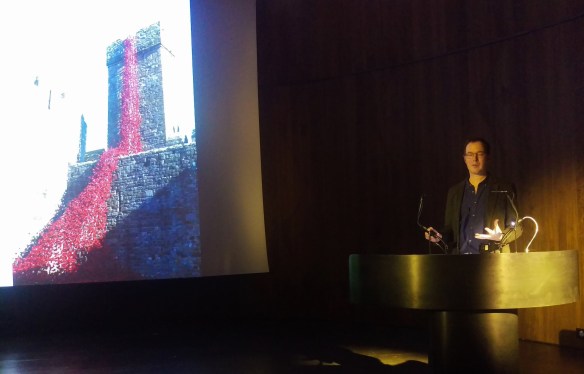
Last week I went to see Tom Piper speak at the V&A Museum. Tom is a British theatre designer who has collaborated with the likes of Sam Mendes, Kevin Spacey, Michael Boyd and the RSC (Royal Shakespeare Company). His talk covered a range of his theatrical projects and it was fascinating to hear how he has approached the transformation of theatrical spaces as well as different iterations of the same play for different directors.

However for the majority of us attending, he is most well-known for the ‘poppies project’.

In 2014, 888,246 ceramic poppies were planted in the moat surrounding the Tower of London to commemorate the 100th anniversary of Britain’s involvement in World War I.

A collaboration between Tom and Derby-based ceramic artist Paul Cummins (who originally approached the Tower of London about filling the moat with his ceramic blooms), the poppies were planted by 21,000 volunteers between July and November to create the Blood Swept Lands and Seas of Red installation. After the event, the poppies were packed into commemorative boxes and sold for £25 each with the proceeds going to the six affiliated charities: SSAFA, The Royal British Legion, Help for Heroes, Coming Home, Combat Stress and Cobseo.

imag5966

The presentation box for the ceramic poppies.

Tom shared how the project came about, the meeting of minds and synergy of different talents between he and Paul, the logistical challenges of the installation (there was a point where they ran out of poppies) and how unexpected the public response was.

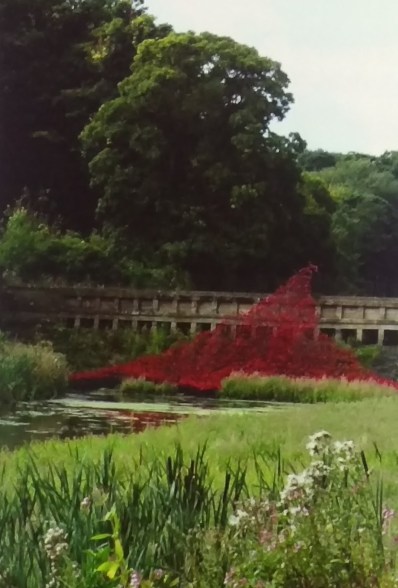
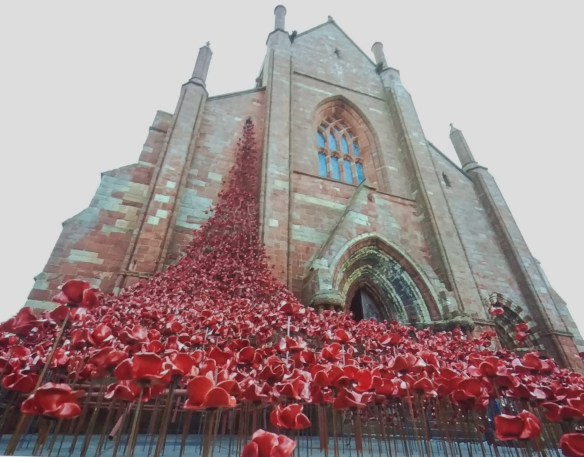
What I didn’t know was that two of the features from the installation – Weeping Window and Wave – have gone on to have a life of their own. Since their departure from the Tower, there have been a further seven installations with Weeping Window finishing its 2016 run at Caernarfon Castle in North Wales in November.

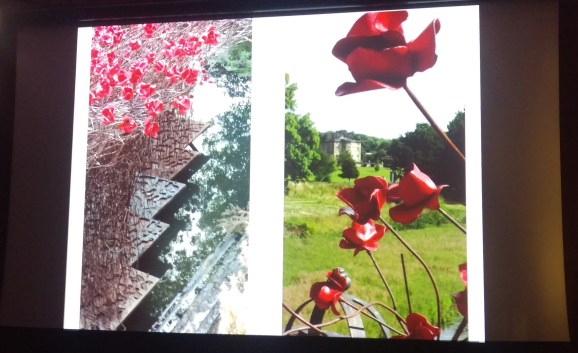
(Please excuse the quality of the images peeps – I was taking them from Tom’s slideshow!)

imag5974

Tom talks about the roadshow of Weeping Window (pictured) and Wave that continues around the UK.

imag5968

Ceramic poppies in situ


Weeping Window will visit four new locations in 2017 with Wave scheduled to be installed at a further two so if you are planning to be out and about – and you are interested – you can find out where here. From what I can see, the locations chosen are free to visit but all suggest booking so that the number of people to be accommodated can be managed.

I didn’t get to see the installation when it was at the Tower of London but I was absolutely astounded at the impact it had. Nightly news stories charted the progress in filling the moat, the visits by a whole range of dignitaries and the mounting public hysteria – with closures at nearby tube stations due to over-crowding – as the installation neared its completion and eventual dismantling.

I love that this installation continues to be so accessible. It feels a lot like street art to me – usually a combination of a ‘surprise’ appearance and a powerful statement – but on an entirely different scale and I am wondering whether I can manage a visit to any of the locations touted for next year.

War inflicts terrible losses on individuals, families, communities and society-at-large but in spite of it all, life does go on and I am so pleased that this moving tribute has been resuscitated again and again, and continues to honour those who give so much for their country.

2017: A space odyssey

There has been so much going on over the last few months that I’ve struggled to know where to start. Normally I find the inspiration for posts everywhere but it feels as if watching in silence (frequently the stunned kind) and listening (versus spouting off) has been the order of the day. Democracy has certainly shown us the power that the disenfranchised and unheard hold in their hands and the last six months has revealed the world to be a much more uncertain place than a whole lot of us thought it was.

Uncertainty prevails closer to home too. Back in June I posted about the changes at work and this week it will be my turn to say my goodbyes. After almost six years, the people and projects that have shaped a large proportion of my life will disappear and while there will be some friendships that endure, I will be left with quite a large space in my life.

(Actually what’s immediately next is a packed two weeks of pre-Christmas catch-ups before a sojourn in Thailand and a family Christmas Down Under…but I digress.)

The saying goes that nature abhors a vacuum and human nature is no exception. We are driven to achieve instead of discover, stillness must be filled with doing and silence is shattered with noise and words rather than peace and understanding.

Space – finding it and holding on to it – is a tricky thing to manage.

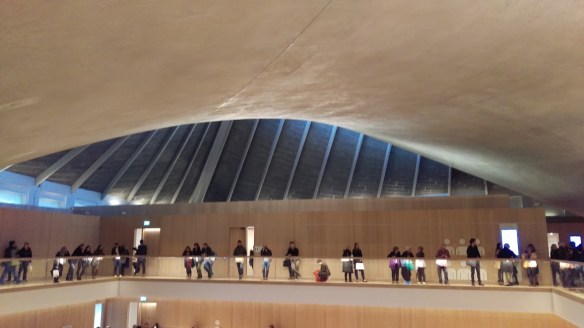
design-museum-atrium

This photograph was taken yesterday as I stood on the second floor of the atrium in the Design Museum‘s new home, the old Commonwealth Institute building in Kensington. It’s a great example of the paradox of ‘holding the space’ – the challenges in maintaining the listed hyperbolic parabaloid roof versus the striking effect of the sweeping curves of the atrium ceiling. Is the former really worth the latter?

My journey into this new space is not unexpected and for some time, I’ve had a general idea of what’s next and how I aim to build some different life choices into the next 8-10 years. Over the last year, I have been working on several things that may become pieces of this future but the really specific parts are not yet fully formed. It’s hugely exciting…and uncomfortable.

Space – and uncertainty – is scary.

When people ask me about what’s next, I feel the urge to explain it all, to define it and lay out the way forward. I jumped out of a plane about 15 years ago and it’s that same feeling – perched at the open door, looking out over the landscape sprawled below and questioning whether I was brave or stupid to be doing this. Then leaping out into the void, trusting that the agreed plan I’d learnt in my pre-jump training (as well as the parachute instructor strapped onto my back) would result in my landing on my feet again.

And I felt it when I arrived at Heathrow Airport almost 13 years ago, with nothing before me except the chance to build a new life. In both cases there was much ungainly sprawling and innumerable dents to my ego. But what an education I’ve had.

I’ve learnt that I am resilient and resourceful – over and over again. (They do say that life keeps giving you the lesson you need until you’ve learned what it’s meant to teach you.)

I’ve created opportunities to be generous and inspire others, something that really speaks to my heart.

And I’ve developed a knack for making the space to explore, to reflect, to trust that what I want is okay and to find the quiet moments (mainly during my regular swim sessions) when the voices in my head get opinionated and shout-y.

So as I say my goodbyes next week, I will be embarking on the next phase of my odyssey taking all of these good things with me. Who knows what lessons will be next but when they land and I get a little ‘stuck’, I will take myself back to a lesson from childhood and the immortal words of Christopher Robin to his beloved friend, Winnie-the-Pooh:

You are braver than you believe, stronger than you seem, and smarter than you think. 

(Please feel free to remind me of this post when things get ‘sticky’…)

Belem, two hills and a valley

The story so far: Lil Chicky and I managed a six day rendezvous in Lisbon at the beginning of October. We ate, walked, had a day out of town and took squillions of photos – here’s another installment of our adventures.

Having already booked our day trip to Sintra and our Lisbon Eats Walking Tour, we knew we had four days left to explore Lisbon itself. We are both big fans of a Hop-On-Hop-Off bus (hereafter referred to as the HOHO bus) and decided that buying a 48 hour ticket was the perfect way to get our bearings – by the end of our first day, we had managed to combine all of the things we wanted to see into some semblance of a plan.

The valley

The central districts of Lisbon are built across two main hills and the valley that lies between them. If you stand with your back to the River Tagus at Praca do Comercio, the valley lies in front of you and follows a path through Baixa, Rossio, Restauradores and the Avenida da Liberdade.

the-valley

L to R: Looking towards the River Tagus through the arch leading onto Praca do Comercio; turn around and head straight to Rossio where in the top left corner, you’ll find the gorgeous Rossio train station; a brisk 20 minute walk up the Avenida da Liberdade from the station will take you to the Pombal roundabout and this view of Praca Dom Eduardo VII.

We spent a fair bit of time here: The HOHO bus routes all start from the Pombal roundabout and stop in Rossio which itself was less than a ten minute walk from our apartment. Several times we found ourselves wandering through the streets of Baixa on our way back to the apartment and after walking for several hours each day, we were pretty grateful for this flat, easy route home.

Rossio is also the location of two of our pasteis de nata haunts – Cafe Nicola and Pastelaria Suica – and the neighbouring Praca de Figueria held a third – Confeitaria Nacional. Combined with Praca de Martim Moniz, with its cluster of food huts and outdoor tables at one end and The Mundial with its fabulous rooftop bar at the other, we had plenty of places to eat, drink and watch the world go by.

The hill on the right

Coming back to the Praca do Comercio, if you look to your right the Castelo de Sao Jorge perches atop the hill…

view-of-martim-moniz-from-castel

This is the view of ‘the valley’ from Castelo de Sao Jorge on the hill to the right. The longer stretch of green running from left to right at the top of the picture is Restauradores and the square is Praca de Martim Moniz – we stayed in an Air BnB apartment in the building where the yellow bus is. It was a great location and fabulous view of the castle from the window every morning.

…with the Alfama district cluttered busily below.

alfama-montage-1

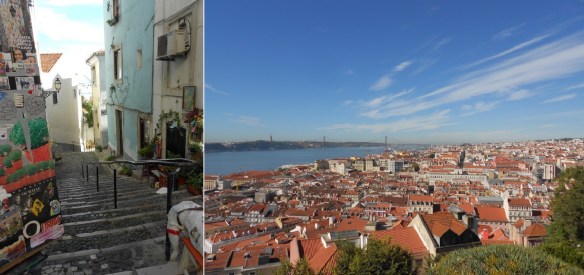
L to R: Alfama is full of meandering passages and lots of steps; the view from Castelo de Sao Jorge over Alfama – you can just see the 25th of April bridge over the river and the Christo Rei statue on the other side. 

We spent a good couple of hours up at the castle early on the Tuesday morning. The views are absolutely spectacular and you get to see Lisbon from all sorts of angles especially if you climb up and walk around the ramparts.

castelo-de-sao-jorge-panorama-4-640x255

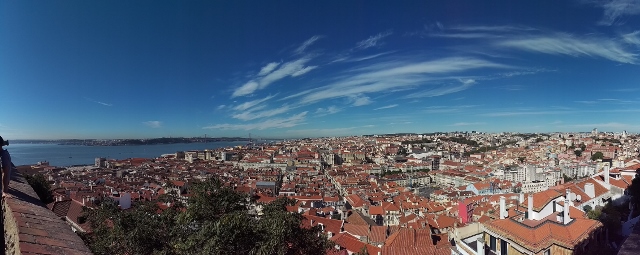
Another stunning view from the Castelo de Sao Jorge

castelo-de-sao-jorge-montage-1

Clockwise L to R: View of Castelo de Sao Jorge from our apartment; entering the fort; the ramparts; the nearby archaeological site; the main entrance to the castle is a short walk up hill from Largos das Portas do Sol.

We spent the rest of that day wandering back down through Alfama, stopping to admire the wares at the Feira da Ladra (The Thieves Market) and to visit the Panteo Nacional at the Church of Santa Engracia.

fearie-de-ladre-montage

The Feira da Ladra: My vintage handbag (bottom right) was a bargain and I managed to squeeze it into my carry-on to get it home. Happy days!

panteo-nacional-montage

Clockwise from top left: The dome of the church of Santa Engracia against a bright blue sky; interior view at ground level; another fantastic spot to capture the view; eagle eye view of the interior; a moment to rest in the shade.

The hill on the left

Looking left from the Praca do Comercio you can see Bairro Alto rising up from Chiado with the viewing deck of the Elevador de Santa Justa just visible between the roof tops.

santa-justa-baixa-montage

Santa Justa views: From Baixa at the bottom (left) and of the spot we stood from the viewing deck at the top (right).

Rather than join the queue to go up in the lift from Baixa, we took an alternative – and more circuitous – route to get to the top. We caught the #28 tram from Martim Moniz early Wednesday morning, weaving through the hilly streets around the castle and down through Alfama (much easier on the legs than all of the walking we did the day before). We got off at the Biaxa-Chiado Metro station for breakfast at the nearby Cafe A Brasileira in Rue Garrett before the short walk up the hill to visit the 14th century ruins of Igreja do Carmo.

igreja-do-carmo-montage

Top left: The magnificent entrance to the remains of the old carmelite church that remain standing from the earthquake in 1755. Right: View of the site from the viewing deck of the Santa Justa elevator.

After a couple of hours here we walked straight across to the viewing deck entrance at the top of the Elevador de Santa Justa and took in the stunning views from the other side of the valley.

santa-justa-montage

Left: Spiral stairs lead up to the viewing platform. Right: Yet another spectacular view across Lisbon to the Castelo de Sao Jorge on the opposite hill.

Then it was a wander through the streets of Bairro Alto before catching the Elevador da Gloria (a funicular running between Restauradores and Bairro Alto) back down to the valley again.

barrio-alto-montage

Scenes from our wanders through Bairro Alto and the funicular that transported us down the hill again.

We had been told that the time to really see Bairro Alto come to life is at night but it was pleasant to walk through the streets in the sunshine and take our time. We ended up at an outdoor cafe on Miradour de San Pedro de Alcantara eating, drinking and listening to a bit of Marvin Gaye under the trees.

Belem

And finally we went a little further afield and took the HOHO bus out to Belem. There’s plenty to see and do including…

…the Monument to the Discoveries – covered with scaffolding…

monument-to-the-discoveries-2-640x480

…and the Torre de Belem, where the queue was so long, we didn’t go in.

torre-belem-2-640x360

Thankfully we had better luck at the Jeronimos Monastery

jeronimos-monastery-panorama-1-640x332

jeronimos-monastery-panorama-2

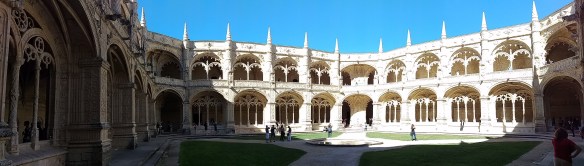
…where we spent a glorious couple of hours wandering through the cloisters, the refectory and the church where the tomb of Vasco da Gama lies. We took loads of photos here but it’s really difficult to do it justice. Suffice to say it is absolutely worth the visit but leave yourself plenty of time to see everything, perhaps taking a meander through the market as well as popping across the road to Pasteis de Belem for a custard tart.

So as you can imagine we had a pretty full four days and there were still plenty of things we did not see. But I hope in this and the last two posts, I’ve shared enough to whet your appetite for this wonderful city and all it has to offer.


Other posts in this series:

Lisbon: A big day out

The story so far: Lil Chicky and I managed a six day rendezvous in Lisbon at the beginning of October. We ate, walked, did a little shopping and took squillions of photos – here’s another installment of our adventures.

After a couple of days squeezing a whole lot of value out of our 48 hour HOHO (Hop On Hop Off) bus ticket, we decided to venture farther afield and let someone else take the reins. Cue Andre from Portuguese for a Day tours who collected us from our apartment on a bright blue-sky Monday morning and drove us to the mountain village of Sintra.

For those of you who don’t know, Sintra is a UNESCO Cultural Landscape site set amidst the cool woodlands on Serra de Sintra about a 30-40 minute drive from Lisbon. It’s the site of many royal summer palaces featuring a range of architectures and this makes Sintra a really delightful and interesting day out of Lisbon’s hurly burly.

This was Lil Chicky’s first trip so she wanted to see and learn ‘lots’ whilst I went to Sintra as part of a tour back in 2002 – our then group spent time at the National Palace of Queluz but got very little time in Sintra itself so I was keen to see something different and take a little time to relax. With Andre’s help, we got all of that and more.

After a pleasant drive, full of getting-to-know-you chat as well as discussion about the area and the day ahead, we found ourselves on a shaded winding road, climbing up the mountain through Sintra itself and onto the Parque da Pena.

The park is absolutely huge and you could spend at least a day exploring all of its nooks and crannies but our focus was the spectacular Pena Palace. This summer palace was built for Dom Ferdinand II, consort of the young Queen Maria II (and cousin to Prince Albert who married England’s Queen Victoria) and is situated over the remains of a Hieronymite monastery found on the site in the 15th century.

There’s 15 minute steep-ish uphill walk to get to the palace but it’s absolutely worth it – we walked all over it and also around it, getting some fantastic views from the ramparts.

pena-panoramas

These panoramas were taken on my phone on the way up. Inspiring, yes but I found myself wondering throughout the visit – and since – how on earth could I represent the wonderful-ness of this place.

pena-palace-montage-2

L to R: View of the entrance archway from the ramparts; beautiful blue and white tiles cover this part of the building; I captured this quiet moment on the way into the palace itself.

pena-palace-montage-1

There’s an absolute cornucopia of amazing colour and texture around every corner.

view-from-pena-palace-arches640x467

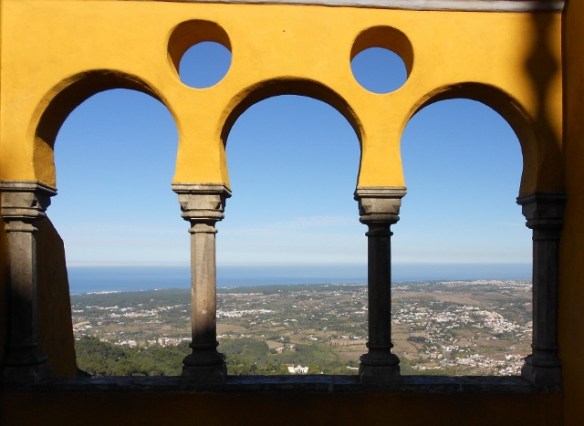
There were stunning views from everywhere but I especially loved this view of the coast through the Moorish arches.

Wandering around outside the palace is included in the park entrance fee but we also paid a few extra euros to go inside.

pena-interiors-montage

The palace interior was a bit crowded and warranted a bit more time than we had but was full of delicate detail, reflecting Ferdinand’s interest in the arts. But all of these trinkets take an awful lot of dusting…

We met Andre back at the entrance after 90 minutes and as we drove back towards Sintra, we had a chat about what to do next. But it was as we drove past Quinta da Regaleira and heard Andre’s stories about the eccentric millionaire with masonic connections who had it built in the early 1900’s that we were sold. So it was back out of the car and with map in hand, we spent an hour exploring the symbols of religion and the occult scattered amidst the web of shaded paths.

quinta-tunnels

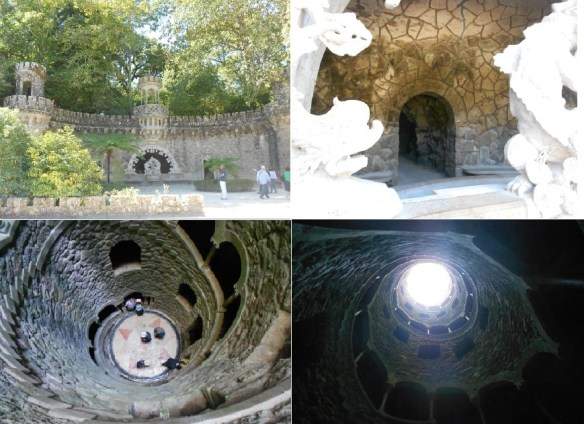
Andre had told us about the network of secret tunnels and the Initiatic Well so we headed towards the Portal of the Guardians (top left) and entered the tunnel (top right). After a short walk we emerged at the Initiatic Well (bottom left) then climbed down the narrow spiral stairs to capture the view from the bottom (bottom right).

quinta-montage

A further wander around the gardens yielded a view of the country house, or quinta (top left), many towers and turrets nestled amidst the trees (top middle and right), the lake of the waterfall (bottom right) and a grand mosaic fountain near Leda’s Grotto (bottom left).

quinta-church

Before we headed back to meet Andre, we visited the tiny chapel nestled under the trees not far from the quinta itself.

We were feeling pretty hungry after this visit so Andre took us to a great place in Sintra called Adega das Caves where we sat outside and enjoyed a beer and some local fare – my cod fritters were delicious!

sintra-main-st

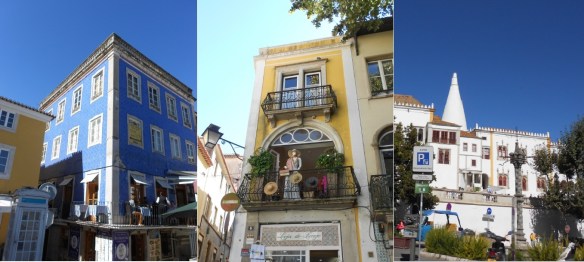
L to R: The blue tiles of the post office building – you can see the Adega das Caves entrance under the balcony; an interesting merchandising display overlooking our lunch position; driving past the Sintra National Palace.

Before leaving for the drive back to Lisbon, we stopped at Piriquita to stock up on Sintra’s claim to pastry fame (and Andre’s favourite Portuguese pastry) – the pillow-y travesseiro – so we had a little something sweet for the three of us on the way back. (I did not get any photos but there are great descriptions/photos provided in a blog post by Leigh and Lucy from their visit back in 2013.)

We started the meandering drive back to Lisbon along the coast, stopping first at Cabo da Roca.

cabo-da-roca-montage

Cabo da Roca is the western-most point of mainland Europe and lines up very nicely with New York on the other side of the Atlantic Ocean. We stretched our legs, took some photos…and had a giggle at some of the tour groups milling around.

tour-bus-at-cabo-da-roca

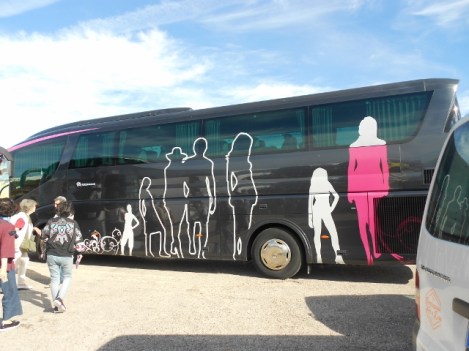
Probably entirely innocent but it did look a bit like a bus for Hugh Hefner’s Playboy Bunnies

And then it was back into the car for the drive past the beaches of Guincho and Estoril, and a 20 minutes leg stretch in Cascais before heading to one of Andre’s old haunts to enjoy a quiet moment watching the waves and savouring our travesseiros.

(As we drove in, we surprised an older couple necking in their car much to their embarrassment. Andre had told us he used to come here and drink with his mates so this was a great opportunity to tease him about what else he might have gotten up to.)

And with that the day was done and less than an hour later, we were deposited back at our apartment tired, windswept and absolutely thrilled with our Big Day Out.

me-kaz-andre-at-copa-da-roca

Andre from Portuguese for a Day Tours with his two happy customers at Cabo da Roca

Andre (and partner Filipa) are two enterprising locals running small group tours that showcase the country they love. Andre’s passion and knowledge was evident from the start and we had plenty of opportunities to shape the day as we wanted as well as relying on Andre’s recommendations about what we might enjoy. For me, it was a lovely way to revisit this area and enjoy a little local cameradie. I know Lil Chicky would join me in strongly recommending that you give them a try vs some of the larger operators offering similar tours in the area.

But don’t just take our word for it – you can also see what others thought here and if you fancy finding out more, here’s a link to the Portuguese for a Day Tours website.

And don’t forget to stay tuned for more from Chicky Tours Unlimited’s adventures in Lisbon – there’s more coming soon…once I sort more of my photos.

When a foodie goes to Lisbon

When you live so far away from loved ones, the opportunities to come together are precious and rare so when my sister told me she had to be in Europe for work/a conference for a couple of weeks, we decided to rendezvous in Lisbon for six days of sibling fun. This kind of jet-setting would have completely impressed me before I embarked on expat life – we found ourselves explaining our across-the-globe holiday planning a lot during the trip (our accents prompt a fair bit of inquiry) – and I had to keep reminding myself that it was actually ME in the story versus someone else.

Anyway Lisbon was fabulous. We had wonderful weather in the mid to high 20’s (Celsius), and we were never short of something to do, see, wander around or eat and drink. It’s a tough task to pick one post’s worth of highlights for you to peruse. So there’ll be a few posts in the series as I try and draw out the best of what was an amazing week.

My first post in an armchair tours series is not usually about food but quite frankly, I keep thinking about it and it’s like I can’t write about anything else until I scratch my foodie itch. So loosen your belts peeps, here goes…

Having never been to Lisbon before, one of of Lil Chicky’s most important introductions was to Pasteis de Nata – Portuguese custard tarts. This is a complete departure from what Australians think of as a custard tart. A pastel de nata is a small bite (well about three bites really) of flaky pastry filled with a rich buttery eggy custard. Our first one of the trip was at Confeitaria Nacional on the corner of Praça da Figueira.

pasteis-de-nata-1

It went down a treat – so much so that we made it our mission to try a custard tart from a different place each day and nominate ‘the best’ at the end.

Lisbon is a hilly place and this, combined with an average of six to seven kilometers of walking each day, meant we found plenty of reasons to stop and refuel wherever we were.

assorted-vittels

L to R: Delicious gelati (she had raspberry, I had passionfruit) at Gelateria Portuguesa just around the corner from the entrance to the Castel de Sao Jorge; caffeine kept us going and the Portuguese make pretty good coffee; our first Caipirinha was sipped from the rooftop bar at The Mundial on Martim Moniz with excellent views across to the castle.

Most evenings, we either wandered down to the food huts on Martim Moniz or grabbed some snack-type vittels and wine from the supermarket at the bottom of our building. We did try the Time Out Market on Sunday night with mixed results – Chicky’s meal was delicious but I was served cold, stringy and partially-cooked fries with my fish which the vendor refused to swap (that’s how we do it, I was told). Luckily the wine was good and Chicky found some freshly-made churros to ease my disappointment.

A few nights later we thought we should try some traditional cuisine. On the recommendation of a local, we snaffled an outdoor table at Cervejaria A Lota in Restauradores and to the cacophony of a strident spruiking battle between a couple of the restaurants in the street, we enjoyed a(nother) Portuguese red wine, grilled sardines and a mixed bill of mains.

a-lota

Far right: My delicious fish and rice ‘stew’ (monkfish, shrimps, clams served with rice in a tomato and herb broth) is in the foreground. Chicky got adventurous and went for the wild boar (in the background) which she said was okay – game-y and quite salty.

Our final day was one abridged by departures (Chicky to her conference hotel and me back to London) so we booked a foodie walking tour with Culinary Backstreets. We spent several hours with Celia (our guide) and a Brazilian couple (just off the plane from Sao Paulo) learning about and tasting Portuguese food. It started with a wander around the Time Out Market (it’s also called the Mercado da Ribeiro) with Celia explaining the elements of traditional Portuguese cooking and introducing us to a few familiar and unfamiliar ingredients…

mercado-di-ribeiro

…before settling us at a table for our first eating and drinking of the tour – some ‘toasties’ filled with local ingredients, a platter of fresh figs and amazing sheep’s milk cheese and a glass of Vinho Verde.

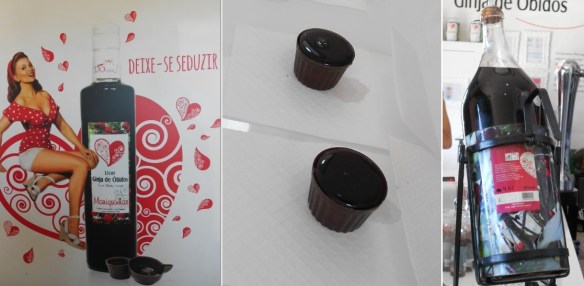
Next we moved to a little store next to the market selling Ginja, a Portuguese digestif made from sour cherries. Celia explained that one way of serving it was to sip it from a dark chocolate cup followed by eating said chocolate cup. Oh well, when in Rome Lisbon and all that…
ginja

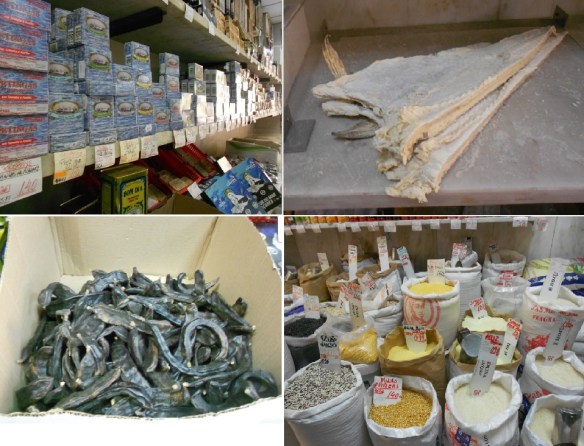
Next it was a short walk to visit to a traditional grocery store where we were introduced to a number of ingredients essential to Portuguese cuisine. We also tried muxuma, a dried and cured tuna that tasted a lot like bacon to me. Quite delicious!
grocery-shopping

Clockwise from top left: Tinned fish is everywhere and there are so many brands; dried and salted cod or bacalhau which is soaked for at least a day before using it in any of a variety of dishes; pulses and grains are a big part of the Portuguese diet; carob pods.

Our next stop was the Cantina das Freiras which is linked to a charity dedicated to helping women in trouble. We entered a nondescript building in Chiado, took the elevator up and walked through the dining hall to be greeted by an amazing view of the Christo Rei across the River Tagus. We had a brief stop here to enjoy a cold glass of gazpacho and a home-made cod fritter in the sunshine.

charity-begins-with-a-view

Our next stop was for lunch at Restaurante Vicente at the bottom end of Rua das Flores. We had an array of Portuguese dishes to try along with a(nother) bottle of red wine. I loved the delicate flavours in the octopus salad and I think everyone nominated the tempura green beans as a favourite.

We were pretty full by this time but Celia promised us that the walk up the hill to our final stop – for pasteis de nata – would be worth it. So off we waddled.

We made an unscheduled stop on the way at By The Wine – about halfway up Rua das Flores – for a cheeky glass of Portuguese muscat. Celia explained that this was not normally on the tour but as Chicky and I had originally booked for the tour on the Sunday evening prior and the guide had cancelled due to illness, this was by way of an apology from Culinary Backstreets. Apologise away I say!

muscat-by-the-bar-lisbon

Top: The arched ceiling is lined with over 3,000 bottles Bottom: Gloriously golden muscat – when in Rome Lisbon…oh wait, I already said that…

Then we arrived. A tiny door led us off the bustling Largo de Camões into a narrow shop with a very special window into heaven…

manteigaria

Manteigaria fabrica de pasteis de nata make only Portuguese custard tarts and we stood at the window watching the staff cut the dough, form the bases, make and pour the custard and pop those little cups of delicious-ness in the oven….whilst sipping espresso and munching on the best pasteis de nata of our trip – by far! Celia said something about them using butter whilst most use margarine…but I barely heard and have already recommended this place to a number of people since I’ve been back in London including a colleague who is married to a Portuguese fella. She gave me a few recommendations before the trip and it gave me great joy to return the favour – she’s keen to check out this paragon to pasteis for herself when she’s there for Christmas with the family.

And with that (and before I exploded), the tour ended so we got some final recommendations from Celia (anyone been to Taberna do Mercado in London?), hugged good-bye and poured ourselves into a cab for the dash back to the hotel/airport.

So in summary, Lisbon is a foodie paradise. No matter whether you stick to a budget, embark on a culinary discovery tour or lash out at the top end (the latter I didn’t not experience directly but I overheard some people enthusing about this on the flight back), you could do a lot worse (and I have) travelling throughout Europe. And don’t worry about all of those pastries for breakfast/lunch/with coffee, you’ll definitely burn some calories walking around…and up…and down.

I’ve included some links below to help you with your foodie planning (don’t say I didn’t warn you) and I’ll be back with more of our Lisbon adventures soon.

——————————————————–

Our rooftop Caipirinha was at The Mundial, Praca de Martim Moniz

Our pasteis de nata trail: (from least to most favourite):

You’ll find information on our Lisbon Eats walking tour at https://culinarybackstreets.com/
Caffeine connections

September turned out to be a packed month and given we are mid-October already, you may all rest-assured that I have plenty to post about over the coming weeks. It’s been a run of reminiscing as I have bounced around between regular catch ups and lots of old friends that I have not seen for absolutely ages.

The month started with a work alumni event. I posted earlier in the year about the changes at work and this has meant that many people who worked in the same office as I do have left. In an effort to maintain connections, one of the leavers set up an Alumni Group on LinkedIn and so on the first of the month, on a rather warm and pleasant evening, sixteen of us gathered on board the Tattershall Castle for a tipple or two. Some of us are still working out our notice, some were on the verge of beginning new jobs while others were revelling in the time and space they’d had to do nothing but enjoy their Summer. It was great to see everyone and at the same time, observe life moving on…and at quite a rapid clip!

The following week I caught up with an old boss of mine from almost eight years ago. We could not believe it had been so long and we spent a couple of hours reminiscing about our ‘battles’ in the travel industry and what we’d each achieved ‘back then’ as well as the people we’d worked alongside and continue to stay in touch with. This was also a fantastic reminder of the kind of work I did at this company, the kind that I love to do, and it was such a timely and valuable prompt for me to stay ‘true to my course‘ in navigating the uncertain times ahead.

The next week, I managed to get a gig for breakfast at the fabulous Shoreditch House. This particular friend of mine started out as an agency contact which then segued into a few social, theatre-type outings every few months and we’ve since decided that this hanging out together from time to time is a pretty good idea. She’s great company – one of those well-connected yet down-to-earth types with loads of stories and chat – and works right on Shoreditch High Street. So on a clear Thursday morning, I skedaddled in from the hustle and bustle of the main street and up to the 6th floor to enjoy some poached eggs and avocado on toast with a view over East London on one side and people having a leisurely morning dip in the House’s rooftop pool on the other. (I mean seriously, don’t these people have jobs to go to?)

Towards the end of the month, an Australian friend I hadn’t seen for over six years was in London so I booked us into Ceviche, one of my favourite restaurants. It’s in Soho and while it is on the hubbub of Frith Street, it is so unassuming it’s easy to miss as you weave along the narrow footpath. We spent four and a half hours nattering over cocktails and delicious Peruvian tapas plates before launching into a decadent chocolate dessert…each. (No way were we sharing that!)  It was great to see her well and happy with her life back in Oz.

And then I ended the month by flying to Lisbon (the one in Portugal) to spend a week with Lil Chicky – the ultimate catch up! We were there for six days so I have plenty of fodder for a few posts which will seriously whet your appetite and make your feet itch!

In between all of this, there was a little reflection on trust, a return to yoga and the I-almost-missed-the-whole-of-2016 discovery of the wonderful Prudential Series at The China Exchange. I also consumed an inordinate amount of coffee across my regular catch ups and many other connections keen to chat about my what’s next.

coffee-l

And what’s next on Gidday from the UK I hear you ask?

Well peeps, keep your eyes peeled for a few glimpses of what Chicky Tours Unlimited got up to in Lisbon. It’s coming soon…

On balance

After a hiatus of more than six years, I have returned to yoga.

I have been wanting to supplement my twice weekly swimming with some core strength and flexibility work for a while now. I did a lot of Bikram yoga before I left Australia and for a year or so after I arrived in London and have dabbled in yoga of the cooler (by that I mean non-hot) variety and pilates as well. I have always loved the intensity and mindfulness of these types of activities as well as the centered feeling that comes afterwards.

A bit of googling a few weeks ago yielded a great yoga/pilates studio walking distance from Gidday HQ so for the last three weeks, I have relinquished my unscripted and lackadaisical Saturday mornings in exchange for this:

  1. The alarm goes off at 8am – I know…on a weekend. I lie there for 15 minutes wondering why I am doing this to myself.
  2. Stumble bleary-eyed to the bathroom and, avoiding eye-contact with the mirror, splash my face with cold water.
  3. Brush/flatten ‘bed hair’. My bed hair is a remarkable feat of vertical engineering that occurs every single night.
  4. Put one load of laundry in the washing machine on the express cycle. I’m up, may as well be productive (so I can be lazy later).
  5. Have vegetable juice and a yoghurt. Sounds noble but it’s really all I can manage first thing/pre-exercise. Don’t worry, I make up for this later.
  6. Get dressed.
  7. Transfer essentials from my handbag into my backpack.
  8. Hang the wet washing on the airer.
  9. Walk to the yoga studio (25 minutes).
  10. Groan and sweat for one hour at the same time as working out how to actually ‘switch on’ [insert name of muscle I have never heard of]. It’s multi-tasking at its best peeps.
  11. Walk home (25 minutes – again).
  12. Shower. It’s a surprisingly sweaty business this yoga (and no I’m not doing Bikram or hot yoga.)
  13. Eat!

And that peeps, is my new Saturday morning.

I’ve followed this new routine for three weeks and on balance, the news is good:

  • Morning backache has disappeared and I’m feeling longer, stronger and looser-limbed than I have felt for years.
  • I’m breathing – deeply – again. And given my easily distracted disposition, I hope that I’m also reaping the benefits of a few meditative moments at the start and end of every class practice (and re-learning the lingo).

You may have noticed that I said ‘on balance’ and that is my struggle. Tree pose was never my forte and my balance, unlike a fine wine, has not improved with age. But I do my best to spread my toes and draw up and yet I wiggle and lurch about, falling on my a**e at least once a class practice. It is somewhat chastening but yoga is supposed to be about letting go of ego and let’s face it, a little less ego never did anyone any harm.

Coming down to earth – literally – also reminds me to pay attention to what I am doing, feeling and ‘switching on’.

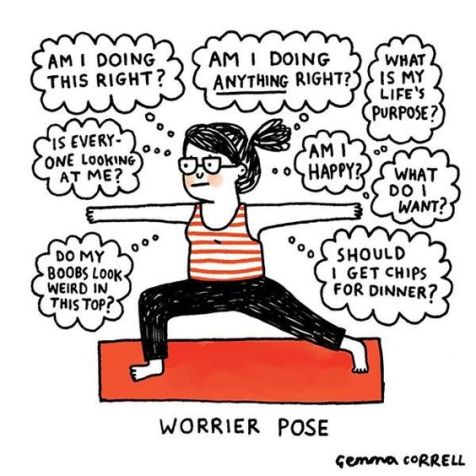
worrier-pose

I actually fell out of Warrior pose yesterday trying to work out what to ‘switch on’.

But I am hooked and have booked next week’s class practice already – there is something about actually booking a place that makes me go rather than succumb to more than 15 minutes of wake-up wondering after the alarm goes off – and I’m hoping to bring a little balance and mindful breathing into the week ahead.

Wishing you all a peaceful and mindful week.

Namaste

No accounting for trust

I’ve been to a couple of events this week that have got me thinking about trust.

The first was called No Dust and was billed as an evening of conversation around the referendum outcome, admonishing us not to let the dust settle on Brexit. It was an evening of two halves with the first given over to the feelings the result evoked, high points (for me) being:

  • Annie King-Ferguson, a 16-year-old poet – she played an original song conveying her frustration at her ineligibility to vote and have her voice be represented in the outcome;
  • Andra Sonea, a Romanian technologist and blogger living in the UK who shared some parallels between the Brexit movement and what has played out in the country of her birth.

The second half was shorter with the best part being the three speakers who explored post-Brexit possibilities. This included reconstructing government and looking to digital technologies to define new paths for democracy. Both of these were with the aim of getting the entire nation to be part of an ongoing conversation about the future, not just whenever a referendum is called.

The evening felt quite unbalanced with litanies of stories and ‘evidence-producing’ over-running in the first half because people wanted to finish ‘their say’ regardless of time which left me pretty low on energy and enthusiasm for the remainder of the evening. It also left me wondering just how much was true, how much selective editing was involved and if there was actually anyone, anything or even anywhere I would trust to give me the whole story.

The second was a networking event and forum later in the week where we asked whether it was possible to rebuild trust beyond the lies and scandals that have become our daily news fodder. The evening covered war, big business and finding purpose and the three speakers were invited to give a ten minute perspective before questions were invited from the audience. The pursuit of trust has become a vocal ambition for politicians, business leaders – in fact anyone with a public platform – and as with all big questions like this, there was no clear answer.

Add to this our tendency towards self-diagnosis rather than trusting the advice of the medical profession, our tut-tutting at Punch-and-Judy politics whilst hearing only the loudest or most familiar voice/s in the argument and our smug self-righteousness over stories of ‘privilege gone wrong’ (e.g. Ryan Lochte) like we all knew better than to believe his story. It seems that society’s latest scion is cynicism.

I don’t think that this is a bad thing. The amount of information available to us across a myriad of channels, apps and devices gives us unprecedented access to facts (and a whole lot more) right at our fingertips, letting us discover as much or as little as we wish to in the moment of our ‘burning question’. And a healthy questioning of the status quo seems to do some good. But how do we really know whether the information is accurate and/or complete…and when enough information is enough?

Which leads me to my question about trust.

The Oxford Dictionary defines trust as:

Firm belief in the reliability, truth, or ability of someone or something

But where does this firm belief come from? It seems to be a result of our past, coming from what we have experienced before and what we think we know. But it also seems to come with conditions.

I trust different people in my life for different things – to do this or be this or provide this and they no doubt trust me for some things and not others in return. For example, I trust some people to be on time while others I ‘know’ will always be late.

I also trust repetition. I trust that I’ll get paid each month yet given there have been times in my life where this wasn’t the case, what makes me trust this now, like it’s some kind of inexorable truth? For the most part it has to do with the fact that this event has been repeating itself every month for the last five and a half years.

I think trust is conditional and of the moment. I trust certain magazines and news sources but am not surprised when fault lines appear. I do not see trust as some universal panacea to righting the world’s ills. I am a cynic – or a realist – and my trust needs to be earned over and over again.

So we assign trust and the conditions that go with it as we define and refine our relationships with the world: With our family and friends, our colleagues, the organisations we work for and deal with and our paragons of both virtue and villainy.

But I’m still left with a question of accounting. Who or what should we trust in a world that provides more data and arguably more transparency than ever before but struggles with being accountable for telling the truth?

And how on earth do we judge when enough is enough – when it’s time to stop the fact-finding and trust that it will all turn out?

Much ado in July & August

The advent of the August Bank Holiday in the UK heralds many things. Holiday-makers return home sporting skin ranging from gently flushed to glowing bronze to fire-engine red. School starts again albeit in fits and starts depending on where you are and how much you pay. And the British Summer ends, folding its wings away to let September take flight.

I missed my July out and about update, overtaken as I was by my birthday-ing in Geneva at the start of August. As sharing July’s gadding about is well overdue, this post will bring you a double dose.

Let’s start with a Gidday First.

I had my first open air theatre experience at Morden Hall Park seeing a performance of Much Ado About Nothing. A beautiful summer day had segued into a lovely evening as we shared a picnic supper, made our way through a bottle of wine and watched a full male cast give their multiple roles and catchy ditties a hefty dose of ribald fun. It was full of hilarious moments and I felt that this was how Shakespeare was meant to be performed, to an appreciative audience in the open air without all the smoke and mirrors of modern theatre. I absolutely loved it.

Staying with the Bard, I also saw a live screening of Kenneth Branagh’s staging of Romeo and Juliet starring Lily James (you may remember her as Lady Rose from Downton Abbey). It was my first experience of the stage version versus reading the play/story or seeing it on film – interestingly Branagh’s interpretation had a black and white cinematic quality (nothing to do with being a live screening!) lending the story a 1950s feel. Lily James was an extraordinary Juliet and simply outshone the rest of the cast but for all that, I was reminded why the play, with all of its melodrama and outpourings of eternal love, was never my favourite.

Speaking of favourites, the return of the fabulous Paco Pena to Sadlers Wells with Patrias was quite different from the high energy flamenco shows I’d seen before. His tribute to the impact of the Civil War in Spain was reflective and haunting and I left the theatre incredibly moved by the beautiful music and poignant story-telling.

I returned to Sadlers Wells a few weeks later to see Vamos Cuba!  I was looking forward to being energised by sexy Cuban rhythms but instead of a slick high-octane show, it was bland and limp and actually felt a bit under-rehearsed. I was bored through most of it and struggled to stay engaged – unusual for me. It was very disappointing.

I had a musical foray of a completely different kind with the Sacconi Quartet, a chamber music group who manage to pierce my heart and capture my imagination every time they play. They were as brilliant as always, playing with their usual passion and intensity. However, they had a male soloist join them after intermission and I felt like that got in the way of the music. I experienced the same reaction earlier this year with another quartet I like so I suspect it’s more to do with my preference for ‘unaccompanied’ chamber music rather than the quality of the singing.

I do like a great female protagonist so I took myself off to see the movie Maggie’s Plan starring two fabulous women – newcomer Greta Gerwig and Oscar winner Julianne Moore – and the rather fabulous-looking Ethan Hawke (forgive my objectification peeps but really…*sigh*). Gerwig plays Maggie, the woman with the plan, as adorably gauche while some of the film’s most hilarious moments come from Moore’s world-weary Georgette. The movie wasn’t on wide (or long) release but it’s an absolute delight so if you get the chance, I’d recommend you see it.

I was also thrilled to snap up a Bank Holiday deal to see Sheridan Smith in the musical Funny Girl (see my reaction  here). It was extraordinary and wonderful and all of those great things.

And last but certainly not least, I discovered Divergent. After a run of average-to-good reads over last few months, I was overdue to be blown away and I fairly inhaled Veronica Roth‘s dystopian tale of rebellion and belonging. It follows a similar plot to The Hunger Games but I liked Divergent more, particularly the use of the factions – Amity, Abnegation, Candor, Dauntless and Erudite – and the underlying thread that a little bit of each is the key to humanity. I’ve heard mixed reports about the movie but I’m much more interested in seeing if the second book, Insurgent, is as unputdownable as the first.

So that was July and August and as we leave the heady ‘hot’ days of British summertime behind, September beckons with promises of coloured leaves, cooler mornings and the hope of an Indian Summer. I’ve got a few interesting things booked but like always I’ll be working hard to make the most of whatever opportunities appear…and keeping my fingers crossed for a deal or two.

Have yourselves a fabulous September.

Boudicca

Real-life female protagonist Boudicca overlooks the River Thames from her chariot (in the shadow of the tower of Big Ben).

Funny girl with star power

I went to see the West End version of Funny Girl last night.

For those of you who don’t know, it’s the semi-biographical rags to riches story of American actress and comedian, Fanny Brice. I’ve long been a fan of the movie starring the inimitable Barbra Streisand and ever since this latest run in London was announced, I have been keeping an eagle eye out for a deal.

So yesterday, I battled the Saturday evening throng to take my seat at the Savoy Theatre (itself a Gidday first).

Savoy topiary (360x640)

Savvy (or should that be Savoy) topiary on arrival.

I felt excited and wondered whether the show and its star, Sheridan Smith, would live up to the hype. And boy oh boy, it did!

Darius Campbell played the smooth yet hapless Nick Arnstein sympathetically – he filled the theatre with rich, sonorous tones like velvet. And the rest of the cast were brilliant but it was Sheridan Smith who stole the show.

I’d seen Smith previously in a couple of television dramas – The Accused: Stephen’s Story in 2012 and The 7.39 in 2014 – and had been seriously impressed by her acting chops but I had no idea just how far her talent stretched.

Smith filled the stage with her presence, flinging her tiny frame into the gauche mannerisms and Brooklyn twang of the unpolished Brice. Her timing was impeccable and, ably partnered by her cast mates, she gave us plenty of laugh out loud comedy moments. She played Brice as the pushy, domineering, larger-than-life character that I remember as being really irritating yet she gave Brice a heart-melting pathos in the second act as she faces the price of her success.

In addition, let me tell you tha this pint-sized lady has a serious set of pipes. Taking on songs made famous by Streisand – People, Don’t Rain on My Parade and I’m the Greatest Star – is no mean feat and Smith was absolutely magnificent in making them her own.

The show finished, the cast emerged for their bows and Smith, clearly emotional, got a standing ovation. It takes something quite special for me to leap to my feet at the end of a performance and I clapped and clapped and clapped until the stage finally emptied.

As we all flooded out onto the street, the signature tunes and Smith’s showstopping voice stayed with me with the defiant strains of Don’t Rain on My Parade playing over and over in my head all the way home.

Funny Girl is playing at the Savoy Theatre in London until 8th October so if you want to see this musical marvel for yourself, I’d advise you to get a wiggle on