Bitter Sweet

It’s been over a month since my last historic meander so I am pleased to report that yesterday I spent a couple of hours weaving through the City’s streets in an effort to discover more about London’s connections with slavery.

We all know it happened and movies like 12 Years a Slave and The Butler have raised the public consciousness in recent years. But these have been portrayals of slavery in America and the Caribbean. When you look at these depictions and think about the inter-continental trading relationships that underpinned this industry…

…a picture of Britain is noticeably absent.

So yesterday I met with Museum of London guide Mike (yes he of my Roman fort tour earlier this year) and along with about twenty others, embarked on Sugar and Slavery, a two hour walking tour around the key British institutions involved the slave trade.

Here’s how it went.

From our meeting point at the museum, we walked down Noble Street, pausing opposite the Goldsmith’s Company for Mike’s introduction to the slave trade, before heading down Gresham Street to Guildhall Yard.

The Guildhall Yard (site of Roman ampitheatre (640x360)

Entering Guildhall Yard from Gresham Street – the Yard is built on the site of the old Roman amphitheatre.

The guilds were organisations that represented the wide variety of trades – and as such controlled the various industries – operating in the City of London. In the 17th century, Guildhall was the central seat of justice for the guilds and many a legal battle was fought in Guildhall itself.

The Guildhall (640x360)

The Grade 1 listed Guildhall

Guildhall continues to be the administrative and ceremonial centre for the one square mile that constitutes the City of London. I remember watching Stephen Fry’s Key to the City a couple of years ago where he explored what it meant to have been awarded the ‘Freedom of the City’. He also attended a banquet here – it still seemed full of tightly-held traditions and much pomp and ceremony.

We headed out onto Lothbury Street, turned down Princes Street…

Bank of England (640x359)

The Bank of England, taken from the corner of Lothbury Street and Princes Street

…to reach Bank Junction where we stopped outside the Royal Exchange. The Threadneedle Street entrance to the bank loomed above us on one side and Mansion House, the official residence of the Mayor of the City of London stood across the traffic circle in front of us.

Mansion House (360x640)

Mansion House, official pad of the City’s Lord Mayor. No that’s not Boris Johnson – he’s the Mayor of Greater London which does not include the City. The current – and 688th – Lord Mayor of the City of London is Jeffrey Evans.

Royal Exchange (640x360)

A pause outside the Royal Exchange

The Royal Exchange, founded by Thomas Gresham in 1565, operated much like today’s stock exchange – albeit without the technology – with traders and the city’s financial pundits going at it hammer and tongs from the opening to the closing bell. However, there was a point when it was suggested that business dealings should be negotiated outside the Exchange and so the emergence of coffee houses began.

You may be wondering what this all has to do with slavery – well, everything.

Slavery underpinned the British economy and pretty much allowed rich men to get even richer. Mike told us about one such man, David Lyle, an ‘absentee’ plantation owner who was also, by all accounts, a cruel master. It is recorded that Lyle pistol-whipped one of his slaves, Jonathan Strong and left him for dead on a London street. Strong was found by Granville Sharp – one of the first campaigners in Britain for the abolition of the slave trade – who nursed Strong and offered him work.

Legal battles ensued between Sharp and Lyle (once the latter learned that Strong was alive) with the Lord Mayor eventually pronouncing that Lyle had no claim as Strong was not ‘property’. This was the very same institution who legislated that slaves on ships could be thrown overboard – like possessions – should the captain believe his crew were in danger (eg. of starving due to provisions running out) and also supported the traders’ insurance claims to redeem losses from such activities.

But I digress.

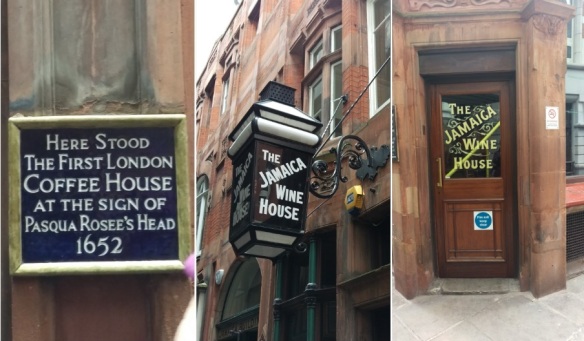
The buying and selling of slaves moved out of the Royal Exchange (officially) and into coffee shops.
Jamaica Coffee House

The Jamaica Wine House (nee Coffee House) stands on the site of London’s first coffee house.

The importation of raw materials such as coffee and sugar flourished with this rise of informal ‘trading houses’ and a young West African could have his or her horrific fate sealed over this bitter brew sweetened with sugar.

We paused on Lombard Street near the Church of St Mary Woolnoth to hear about John Newton who, after years of trading and torturing slaves, reformed and became rector here in 1780. He gets a mention from me because along with poet William Cowper, he composed a book of hymns in the 1770s – the most famous of these ‘Olney Hymns’ was Amazing Grace…and I cannot tell you how many times I played that as a child when I started learning each of the recorder, clarinet, flute and violin.

We headed on past the Monument (that’s the one to the Great Fire of London) and down to the riverside by Old Billingsgate, Mike continuing to paint a picture of the sickness and fear that these men, women and children who’d been torn from their loved ones, faced firstly on-board the slave ships then upon their arrival, where they’d be poked and prodded like animals before being sold, and finally in being ‘seasoned‘ on the plantations of Barbados and Jamaica.

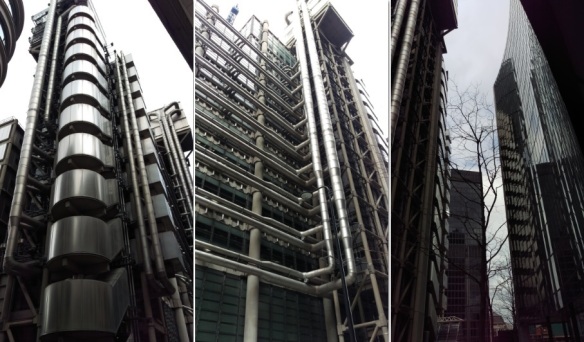
Our next to last stop was Lloyd’s of London, a towering metal edifice of power and money.
Lloyds of London

The original Lloyd’s of London was a coffee house in Lombard Street and as well as playing host to the wheeling and dealing of London’s businessmen, became known as a place where one could obtain marine insurance – much like it is today. That the slave trade was conducted across the Atlantic suggests that Lloyd’s too has its roots steeped in the horrors of human trafficking.

Just down a nearby alley stands the Gilt of Cain, a memorial to the abolition of the slave trade in 1807 that was erected in 2008. It was a fitting way to end the tour.

Gilt of Cain (360x640)

I walked thoughtfully back to the tube station, comparing what I’d seen in movies with the stories of the people who perpetrated, fought and suffered that I’d just heard. There was so little humanity and dignity in each of the different stories that Mike had shared. Some of this I recalled as I walked but in essence, it felt like a fraction of the full story.

There’s a part of me that wants to learn more. While I’ve seen 12 Years a Slave – and found it viciously confronting – somehow each tale told over the two hours of the walking tour left more of a mark. I’m travelling to Liverpool next week, the largest of the old slave trading ports and home to the International Slavery Museum so it is a perfect opportunity.

But it also feels a bit raw – I feel appalled, my belief in the human spirit dented a little so while I will make the most of the educational opportunity that Liverpool will afford, it may be a little while before I venture into anything more.
Patio sessions

It is a gloriously blue sky day here in London and I’m out on the Gidday HQ patio catching up on a spot of reading.

Sun (640x563)

Whilst Aussie-K came over for a coffee  yesterday – the day seemed too good to waste so we chatted about life’s trials and tribulations and scoffed some millionaire’s shortbread bathed in gentle sunshine – today was the first real patio session of the year. The cushions have been dusted off and placed on the chair and I have a few magazines and a bottle of water at my elbow. It’s only 10 Celsius but sheltered from the wind, it feels warmer so I’ve stretched my luminous winter legs out onto the chair in front of me.

Patio feet (360x640)

I miss my patio time over the winter months and as soon as it’s warm enough, I spend my weekend hours out here. As I read my latest issue of Intelligent Life – now with the new moniker 1843 – the washing dries in the sun, the birds twitter and squawk and the neighbour’s ginger cat ventures over to investigate.

1843 (360x640)

I love my patio. It has played host to celebrations with friends and visits from family. There have been Saturdays full of brunches, lunches and catch up coffees and many solitary Sundays spent trawling through the magazine reading that lapses a little over the winter months. I always promise myself I’ll do it during the week but I can’t help but flick open my kindle for just one more chapter of whatever happens to be my latest commuting addiction as I drop into my seat on the tube.

But most of all it’s my haven and today’s session has invigorated my mind, calmed my soul and given me a little respite from the hurly-burly of life. So I’m hoping that we may have turned the corner into the early stages of Spring and with a few more days like today, I might get on top of the reading pile…

reading (640x360)

…eventually.

February: Firsts, facts and fine things

I know. It’s almost a week into March but I promised in January to review each month’s gadding about and February has been every bit as jam-packed as January. So hold on tight and here we go…

There have been a few firsts this month. I’ve already posted about my first filling and my first visit to the British Library. I also attended my first Monash University Alumni event. It’s only taken 24 years and a move across the world to do this and I did turn up wondering what this Global Leaders Network was all about. I had a great evening hearing about the university’s plans for alumni engagement around the world and sharing expat stories with like-minded Australians. How nice it was to enjoy some straight-talking Aussie banter, the room humming with that laconic Aussie twang.

Speaking of university, I have a psychology degree from Monash so I’m really interested in the mindfulness conversation that’s happening at the moment. I saw Ruby Wax interviewed on Sunday Brunch and so went to see her show, Sane New World. Not only is she a comedian but is qualified in psychotherapy and has recently completed a Masters in Mindfulness-based Cognitive Behavioural Therapy at Oxford. Her show was a frank and funny look at our pace of life, mental illness and how our bodies – and in particular our hormones – are trying to cope. I really admire her philosophy in getting ‘off your a**e and doing the work’ – she’s set up free mental health walk-in sessions throughout the run of her shows with the aim of creating a network of walk-in centres across the UK.

February has also been a month for some of the finer things in life.

I attended a talk at the V&A Museum where Francesca Cartier Brickell, granddaughter of Jean-Jacques Cartier, took us on an enthralling journey through the Cartier family history introducing us to the three brothers – Louis, Pierre and Jacq – who started it all and their commitment to innovating whilst maintaining the essence of Cartier design. She also shared many personal anecdotes, one of these about finding the Cartier history in an old suitcase full of letters in her grandfather’s wine cellar. The many family moments she shared made this talk more intimate – less like a lecture and more like a lovely conversation albeit with more than a hundred of us in the room.

It also inspired me to visit The William and Judith Bollinger Gallery at the museum. We were herded briskly through this collection of stunning jewellery on the way to the auditorium and a couple of weeks later, I turned up early for a V&A book club evening to have a wander through. However, it transpired that the gallery was only open during the day so I killed the time I had by visiting the delightful stained glass gallery nearby and also enjoyed a meander through the just re-opened Europe galleries once book club was finished.

VA

The V&A Museum on a drizzly winter evening; killing time in stained glass

I also attended a book launch at the Institute of Directors. Peter Frankopan is director of the Centre for Byzantine Research at Oxford and over coffee and croissants he talked about his new book, The Silk Roads: A New History of the World. His contention is that we are taught about history through the lens of a very small number of countries and believes that we have a lot to learn through the stories of other cultures and regions, particularly Russia and Iran, the latter having been the wellspring for language and religion more than a thousand years ago. I left unsure as to what these regions could offer but it did make me realise how uneducated I am about these areas of the world. I’m now waiting for the paperback version of the book to come out (ever tried to read a hardback on the tube?) so that I can broaden my historic horizons.

And speaking of fine things, I also saw Ralph Fiennes in Henrik Ibsen‘s The Master Builder at The Old Vic. Being able to see actors that I’ve loved on screen performing on stage is one of the absolute joys of living in London and despite being in the vertiginous cheap seats, the power of the performance still remained. It’s the second Ibsen play I’ve seen – the first being A Doll’s House which I studied at high school – and there is something fascinating about the way he explores the roles of women and how they use their personal power in a male-dominated society.

IMAG4300 (640x360)

The view from the cheap seats at the fabulously refurbished Old Vic theatre in London

Personal power also underpinned the speaker themes at the opening session of the TED2016 conference which was live-streamed into cinemas on February 16th. Whether it was 10-year-old Ishita Katyal’s opening talk, the performance from musical phenomenon AR Rahman or Riccardo Sabatini‘s vision for personalised medicine (my favourite talk of the night), it was an inspiring and thought-provoking evening and all for the price of a cinema ticket.

February also had me moved by music. My annual pilgrimage to the Flamenco Festival at Sadler’s Wells was a testosterone-fuelled performance by brothers Farraquito and Farruco which had me on my feet at its conclusion. Over at Kings Place, the Brodsky Quartet’s performance of George Gershwin’s little-known Lullaby for Strings was exquisite.

And with all of that going on, I found some time to imbibe in a well-deserved drink

watering holes

A couple of new watering holes near Holborn Station to add to my ‘let’s meet up’ list. L: The Princess Louise  R: The Ship Tavern

So that was February, filled to the brim with firsts, facts and fine things.

Phew!

Now for March…

Finding Wonderland

It was wet and grey in London yesterday and if it hadn’t been for some existing plans I would have been perfectly happy to curl up at Gidday HQ on the comfy couch. But the British Library beckoned and so just after lunch, friend Aussie-K and I stepped out for some literary loitering.

IMAG4268 (640x360)

It was our first visit to the library. Yours truly has been here twelve years and until yesterday, had only managed a passing acquaintance last year by way of a talk at the conference centre next door. Given how much I love literature and reading, I am delighted to have ticked this visit off my London bucket list and to have moved from ‘I must’ to ‘I have’ at long last.

And what, I hear you ask, made me get off my backside and go?

Well, Wonderland of course!

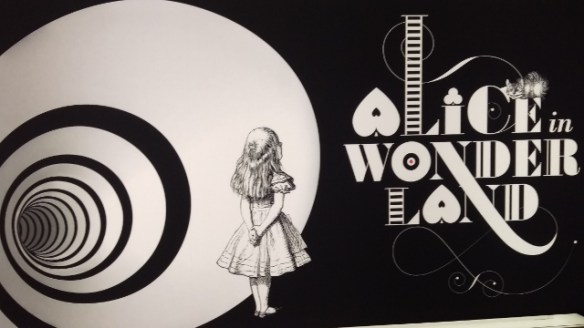
2015 was the 150th anniversary of the publication of Lewis Carroll’s Alice in Wonderland. It’s a story that’s been told in a myriad of formats and iterations over the years, its other-worldly characters and trippy plot making it the subject of much interpretation and debate. I saw Robert Douglas-Fairhurst interviewed about his biography on Carroll – The Story of Alice – last year (which I am currently reading) and the Library has been running a temporary free exhibition which closes in April. So we entered the fray and hustled – with what felt like hundreds of half-term families – along the cabinets and displays.

IMAG4270 (640x360)

The front part of the exhibit was taken up with a series of twelve (or was it thirteen?) decorated mirrors featuring quotes from Alice in Wonderland whilst in a rather cramped section at the rear, there was an opportunity to learn about the author himself, his real-life Alice (who happened to be a brunette rather than the blonde we’ve come to know and love) and see the ways in which this famous story has been communicated over the last 150 years. It was interesting – however the area was poorly-lit with little opportunity to linger and I found it difficult to read all of the information and look at the details of the books and manuscripts on display. I’m not sorry that I spent the time to shuffle through and see it but it’s just as well it was free otherwise I might have been a little put out!

It seemed a shame to leave after such a short visit and as it was still raining outside, we meandered across to the Library’s permanent exhibition, Treasures of the British Library.

Now THIS was my Wonderland and I spent quite some time poring over…

…drawings & notes from Leonardo da Vinci and Michelangelo…

…musical scores from as early as 1050 and from geniuses like Mozart, Debussy, Chopin, Beethoven, Bach (just to name a few) as well as a page of Puccini’s scribbled stage directions for his opera Madame Butterfly and a touch from the modern era, a burst of scrawled lyrics for The Beatles’ hit ‘Help’…

…pages and pages of penmanship from literary giants: 16th century greats like Shakespeare, Marlowe and Jonson, acknowledged classics like Jane Austen’s Persuasion, Charlotte Bronte’s Jane Eyre, Charles Dickens’ Nicholas Nickleby and Thomas Hardy’s Tess of the D’Urbervilles and even a little something from Ian Fleming, the man behind James Bond – who you could argue is one of the 20th century’s most iconic literary creations – and his short story, The Living Daylights…

…sacred texts, beautifully illustrated, from as early as the 4th century and from a  variety of religions including Judaism, Hinduism, Islam and Buddism…

…and one of the four Magna Carta documents dating back to 1215 which was sitting right alongside the original papal bull that annulled it just 10 weeks later.

It was absolutely awesome – in the true sense of the word – and these were just the highlights.

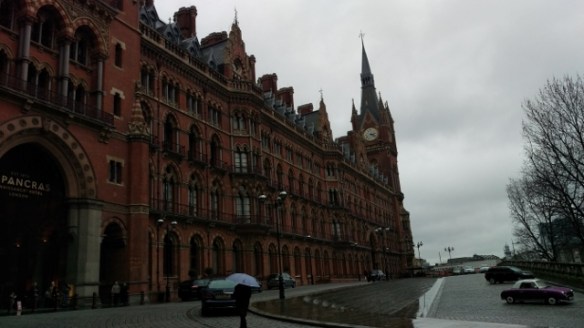
And after such a deluge of inspirational history, it was time to venture back out into the real weather, make a damp and concerted dash past St Pancras Station…

IMAG4277 (640x360)

…and around to the YumChaa Cafe in Granary Square for a warming hot chocolate and a slice of apple and apricot loaf…

IMAG4280 (360x640)

All in all, it turned out to be the perfect way to spend an inclement February afternoon in London.

The perfect tonic

Those of you who are Gidday regulars will know that I like a walking tour. I got into them in earnest last year, thinking they’re a great way to indulge my passion for history.  We were also doing the Get the World Moving challenge at work and one’s step count, and increasing it, became the currency of water cooler and photocopier conversations for about three months.

Yesterday I joined Museum of London guide Bridget and twenty committed tipplers for a damp and chilly trawl through London’s links with gin. Here’s how things went.

We began outside the Dominion Theatre on the corner of Tottenham Court Road and New Oxford Street, the site of the old Horseshoe Brewery and the great beer flood of 1814.

IMAG4196 (640x360)

Apparently a large vat of porter burst and flooded the area. With many of London’s poor living in nearby tenements and cellars – Bridget quoted 102 people living in 8 rooms – it’s remarkable that only eight people died. That six of them were at a wake brings new meaning to the saying “drowning one’s sorrows”.

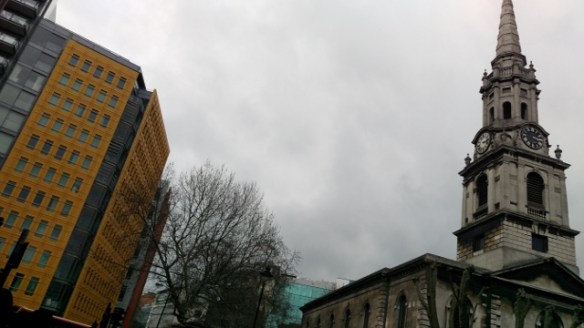
Our next stop was Denmark Street – London’s music mecca – Central St Giles (designed by Renzo Piano, the architect behind the Shard) and the church of St-Giles-in-the-field.

IMAG4205 (359x640)

IMAG4208 (640x360)

Here the enormity of gin’s impact on London really took shape. Gin, or jenever, came to London from Holland, introduced by William III who had seen its invigorating effects on his troops in the face of battle. Ever heard of the expression Dutch courage?

In any case, gin was easy to make and accessible to the poor and at one stage, every man, woman and child was consuming 500 gallons per year – that’s more than 2,270 litres if you are metric – or 6 litres per day. As such gin became the root of many social ills, some of which were illustrated by William Hogarth in his etchings below.

IMAG4216 (640x348)

Thuggery, thievery, disease, suicide and murder were all part and parcel for the gin drinker (right) while on the left, beer was being positioned as having a less deleterious effect on the health (see the better dressed fishwives at the front of the picture). The ‘powers that were’ agreed – after all, without the poor masses, who would serve them and fight their wars – and passed several Gin Acts in an effort to stem, not always successfully, gin’s rapacious tide.

We continued around the back of the church and down to Seven Dials, originally the nexus for just six streets rather than the seven of today.

IMAG4221 (360x640)

The area was laid out by MP Thomas Neale in the 1690s to maximise the space available for his housing project. He commissioned Edward Pierce to build a sundial to stand in the intersection but this was destroyed in 1773 in an effort to stop the site, which was showing the effects of the residents’ heavy gin consumption, being a meeting place for ne’er-do-wells. In the late 1980s, it was rebuilt in line with the original plans and in keeping with our Dutch association, it was Queen Beatrix of The Netherlands who attended its unveiling as part of the year-long William and Mary celebrations in 1989.

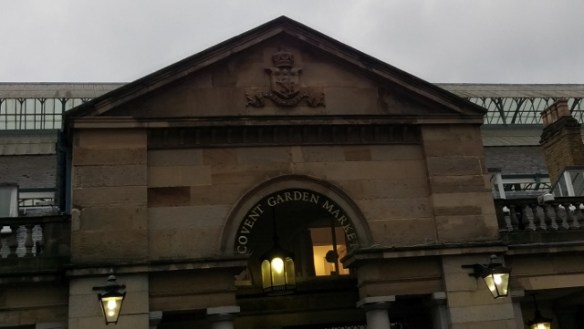
We set off down Earlham and then Neale Streets to find ourselves at Covent Garden.

IMAG4225 (640x360)

IMAG4226 (640x361)

We paused by the back entrance to the Royal Opera House to learn about Harris’s List of Covent Garden Ladies. The list was published between 1750 and the mid-1790s and detailed the attributes and services of each ‘lady’ available in Covent Garden alongside her picture – at one point, 8000 copies were in circulation.

Much business was also done under the portico of the church opposite, the site of Tom King’s coffee shop which was a place not only for coffee but for gambling and drinking as well. It was said that gentlemen emerging from their clubs could ask Tom (and later Moll King) for the services of lady from Harris’s list. A messenger would be despatched and the lady brought to the coffee shop to meet said gentleman.

We walked around the block and into Bow Street – I’ve only ever entered the Opera House from Covent Garden so I was delighted to acquaint myself with its front.

IMAG4229 (640x360)

The BAFTAs ceremony for the film awards – said to be an indicator of Oscars success – is held here every year on February 14th so there was a lot of work going on to prepare the ‘red carpet’ for tonight.

IMAG4228 (640x360)

We turned into Broad Court and paused again to hear more about Henry Fielding, his brother John and the Bow Street Magistrates Court where people like CasanovaOscar Wilde, suffragette sisters Emmeline & Christabel Pankhurst and author Jeffrey Archer have appeared.

IMAG4232 (360x640)

Henry Fielding also established England’s first police force, originally a group of just six men nicknamed the Bow Street Runners, in 1749.

The end of Broad Court brought us out onto Drury Lane, where many gin palaces emerged during the 1800s. These ‘palaces’ employed the latest inventions of the 1830s – gas lighting, silvered mirrors and paned glass windows – to create a brighter and more genial environment to enjoy a tipple although without seating, patrons drank until they could no longer stand. Literally.

Taverns (where beer was served) already had seating so watched, learned and called on the same improvements to provide a much more comfortable environment for their patrons. So the public were drawn back into the taverns and away from gin until the first half of the 1900s when in the roaring 20s and then again during World War II – when it was Churchill’s tipple of choice – gin’s public profile rose again.

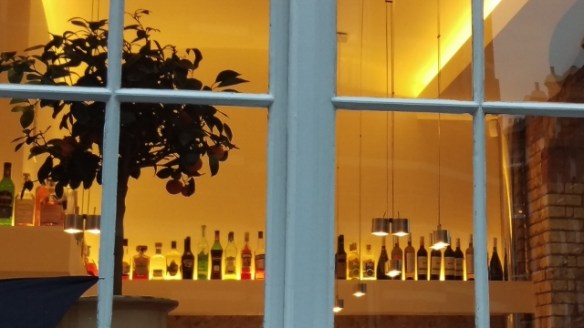
We’d been going for about an hour and half at this point and with the promise of a glass of gin at the end of the walk looming, I found my attention taken by this view through the window of restaurant Barrafina…

IMAG4238 (640x360)

…but there was still one more stop to make before our promised refreshment.

Bridget led us along Great Queen Street and up Newton Street to admire the Princess Louise…

IMAG4243 (640x360)

…and encouraged us to duck into the side door to have a quick peek at how the taverns of the 1830s (and onwards) might have looked.

While it was just a short peek, it was really beautiful and inspired me to find a reason to come back for a drink with friends.

Just as well that our final stop and gin-watering hole was not far away.

IMAG4250 (360x640)

And so our tour ended at The Ship Tavern, tucked away behind Holborn Underground Station, with a rather lush gin, grapefruit and coconut concoction.

IMAG4254 (360x640)

For those of you wishing to wander this area for yourselves, here’s a map of our route…

Mother's Ruin route

…but these streets really came to life yesterday with guide Bridget’s extraordinary knowledge and skillful storytelling, only a fraction of which I’ve shared with you here.

The museum runs a number of themed walking tours like this so if you are interested, check out the website. The next Mother’s Ruin tour looks like it’s on March 13th so if I were you, I’d get your skates on (another Dutch reference – see Hans Brinker) and book your place.

It’s bound to be the perfect tonic.

The hole truth


My name is Kym Hamer, I am 46 years old and I have just had my first filling.

Yes it’s true. I have just returned from the dentist numb-cheeked after said filling (plus a fluoride treatment on two other culprits) and am under strict instructions not to eat or drink for the next two hours.

So I thought I’d fill the time by telling you all about it. Hooray I hear you say…not. Nevertheless here goes…

I’d never been to Smile Cliniq until a couple of weeks ago…and it had been two years since my last checkup elsewhere so you can probably appreciate there was quite a bit of scraping and polishing to do. And then there was the unwelcome news of a cavity in my lower right molar and early signs of decay in two other teeth so my lapse is likely to be the cause of today’s drill ‘n’ fill session.

But Chet (the dentist) was great, explaining everything clearly beforehand and checking in throughout that I was okay. He warned of ‘a little scratch’ before the injection which I did not feel and aside from my inability to rinse without dribbling at the end (making me giggle…which made things worse), I emerged relatively unscathed in under 30 minutes.

Chet’s really passionate about his profession and we got chatting today about a seven year study carried out in Sydney to prove the benefits of adding fluoride to the water system. The lack of dental fillings at my age has often been referred to as a result of being part of the fluoride generation and Chet mentioned today that in Birmingham, early tests around adding fluoride to the water have yielded further evidence of its benefits, particularly in preventing tooth decay in children.

Even better in my book is the application of fluoride treatments on signs of early decay which may actually mean a future devoid of fillings. Imagine that in only a generation or two from now, the concept of have a filling may be as alien as walking on the Moon was to us a century ago.

In any case, my drill ‘n’ fill was nowhere near as traumatic as I had envisaged but I am in no hurry to have another. So I will continue my twice-daily brush, floss and (mouth)wash and be more vigilant in heading back for some professional attention every 6 months. Being a week into February, it’s a little late for a New Year resolution but given the literal hole I made for myself by waiting so long, I’m off to add a checkup reminder in my calendar for August. In the meantime, I’ll leave you with this reminder from English poet Pam Ayres as to the moral of my story:

Look after your teeth peeps!

———————————

Oh I wish I’d looked after me teeth

Oh, I wish I’d looked after me teeth,

And spotted the dangers beneath

All the toffees I chewed,

And the sweet sticky food.

Oh, I wish I’d looked after me teeth.

I wish I’d been that much more willin’

When I had more tooth there than fillin’

To give up gobstoppers,

From respect to me choppers,

And to buy something else with me shillin’.

When I think of the lollies I licked

And the liquorice allsorts I picked,

Sherbet dabs, big and little,

All that hard peanut brittle,

My conscience gets horribly pricked.

My mother, she told me no end,

‘If you got a tooth, you got a friend.’

I was young then, and careless,

My toothbrush was hairless,

I never had much time to spend.

Oh I showed them the toothpaste all right,

I flashed it about late at night,

But up-and-down brushin’

And pokin’ and fussin’

Didn’t seem worth the time – I could bite!

If I’d known I was paving the way

To cavities, caps and decay,

The murder of fillin’s,

Injections and drillin’s,

I’d have thrown all me sherbet away.

So I lie in the old dentist’s chair,

And I gaze up his nose in despair,

And his drill it do whine

In these molars of mine.

‘Two amalgam,’ he’ll say, ‘for in there.’

How I laughed at my mother’s false teeth,

As they foamed in the waters beneath.

But now comes the reckonin’

It’s methey are beckonin’

Oh, I wish I’d looked after me teeth.

Source: www.pamayres.com

January’s bucket list

I’m not one for New Year’s resolutions. My resolve tends to scatter across the year and is generally underpinned by my penchant for exploration and variety. However I do love moments, snatches of time when I am completely caught up – and sometimes out – by intense feeling, largely a mixture of delight, wonder, melancholy, outrage and curiosity. I carry this image of a bucket in my mind and I often imagine putting a particular moment into it. Somehow they all combine into a life that inspires me.

I was checking something in my calendar earlier and it occurred to me that while I share about particular experiences, I don’t often reflect on all of the things I’ve done. Fellow blogger, author and longtime Gidday follower Jack Scott commented recently “you do get about” so I thought that it would be interesting – for me anyway – to end each month this year by checking out what’s ended up ‘in the bucket’.

So here goes.

This month it all started with a new chapter in an old story and I absolutely loved Star Wars: The Force Awakens. I then moved into a Kenneth Brannagh double bill: All On Her Own, a maudlin 25 minute 3-stars-from-me soliloquy, and the hilarious 4-stars-from-me farce, Harlequinade.

A trip back in time with the Museum of London and a tour of an old Roman fort inspired my historic sensibilities so much that the Museum became a new Friend. Five days later I joined hundreds of women at the Central Methodist Hall in Westminster to listen to the Women’s Equality Party and left non-plussed and suprisingly uninspired: lots of valid and important messages but the whole thing was a bit ‘rah rah’ for me.

A decidedly French tone emerged in the second half of the month with the NY MET’s performance of Bizet’s opera The Pearl Fishers and the National Theatre’s production of Les Liaisons Dangereuses (Dangerous Liaisons) being live streamed at the Phoenix Cinema just a ten minute bus ride away. When I was raving about the latter in the office the next day, I was informed by a young French colleague that the book continues to be part of the literature curriculum in French schools and is considered “a classic”. By the way, both productions were ‘magnifique’.

I’ve also read six books this month and rated three of them a mighty 5-stars, an excellent 50% hit rate. March Violets by Philip Kerr and A Town Like Alice by Nevil Shute were my first dip into these respective writers and my return to Stephen King (and introduction to his criminal mastermind Mr Mercedes) was the recommendation of another Gidday follower, author Charlie Wade. (Thanks Charlie!)

In between all of this I embarked on some new cooking adventures with a foray into pastry (albeit frozen) as well as ‘cooking with beetroot’ and I managed catch up dinners with three different friends, one long overdue.

I also inadvertently fell across London’s Lumiere Festival on the face of the Abbey…

IMAG4146

…and delighted in the lighter mornings on my walk to work.

IMAG4130

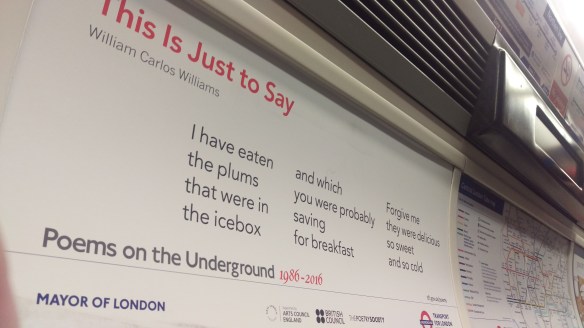
Speaking of commuting, this gem really lifted my tube ride home one night.

IMAG4157

It also snowed…

IMAG4150

…and I celebrated twelve years in London.

So Jack was right and January was full to the brim with moments that were both planned and completely surprising. (And that’s doesn’t include what happens in my job.)

In any case, I’ve quite enjoyed this retrospective approach to bucket list-ing and am curious to see what reflecting on February might bring.

What would a look back at your January moments yield?

The Pearl Fishers

Let me start by saying I am not an opera buff. I had never been when I lived in Australia and up until about a year ago, I had seen only The Magic Flute and Tosca in the 11 years I’d lived in London. I did enjoy them (more so The Magic Flute) but did not really fall in love with opera and the high ticket prices made me question whether I was really up for exploring more.
However opera has gotten savvy and has been reaching out to woo new audiences with Live Screenings. Streaming from the English National Opera at the London Coliseum or Glyndebourne on England’s South Downs, local cinemas have become the new place to experience opera and at a far more accessible price. Aside from getting a fantastic ‘close-up’ view, there are usually introductions to the story, interviews with the stars and creative team and subtitles throughout so it is a gently educational experience as well. I’ve become a bit of a fan and have enjoyed Mozart’s The Barber of Seville and The Marriage of Figaro, a Ravel double bill – L’heure espagnole and L’enfant et les sortileges – and Gilbert & Sullivan’s The Mikado.
Last night I paid a visit to my local cinema, The Phoenix in East Finchley, and added another to my repertoire: The Pearl Fishers. Les Pecheurs de Perles was composed by Frenchman Georges Bizet and was first performed in Paris in 1863. It’s a love triangle set in ancient Ceylon (now Sri Lanka): The story of two pearl divers, Nadir and Zurga, and the consequences of their love for the priestess Leila. Bizet had some public success when this opened but critics were not so enamoured – in fact, Bizet struggled to reach any sort of critical acclaim in his career until Carmen, which opened ten years later.

Last night’s performance was by the MET Opera in New York. It was beautiful – a visual feast with an intricate tiered set, spectacular lighting and video effects and cast with a clamour of ‘villagers’. The opening score was accompanied by the most breathtaking ‘underwater’ sequence…two pearl divers, swimming in soft blue and lit from above to replicate the sun on the water – this stunning piece of choreography really set the tone for the rest of the production.

Musically it was glorious too. The score washed over the auditorium, ebbing and flowing much like the waves lapping the shores of the village, and voices were exquisite. The three lead roles comprise a soprano (Leila), a tenor (Nadir) and a baritone (Zurga). The Friendship Duet sung by Matthew Polenzani (Nadir) and Mariusz Kwiecien (Zurga), the pearl fishers, was full of poignant promise and as Leila, Diana Damrau played her soprano more like an instrument than merely a voice.

During the intermission, there were interviews with the three stars and the conductor as well as a look at how the stunning opening sequence – those underwater pearl divers – was created including a chat with the divers themselves. In the past, I’ve felt a bit put off by opera’s diva reputation but the interviews revealed passionate, everyday and extraordinarily talented people.

After two and a half hours, I made my way home feeling completely delighted by the whole experience. The Pearl Fishers has become my favourite opera and I would never have discovered it if the only route open to me was the traditional, opera-house visit. It put me in two minds, the first being wanting to see more and so this morning I booked to see the MET’s live screening of Elektra in April. But the second is that last night has inspired me to visit the traditional – I would love to experience The Pearl Fishers live.

So opera – by making access to its artistry local and affordable – has managed to tap a potentially richer seam in this patron’s future pockets.

Clever, clever opera.

IMAG4148

A fitting venue …waiting for the show to begin at the Phoenix Cinema in East Finchley

The wall

Last September I ventured below London’s bustling surface to visit the site of a 4th century Roman bath and house. Back then the Museum of London were opening these archaeological sites as a trial to see if there as enough interest from the public in  getting up close and somewhat personal with London’s history.

There are now a whole raft of opportunities listed on the museum’s website so it would appear that the answer was yes.

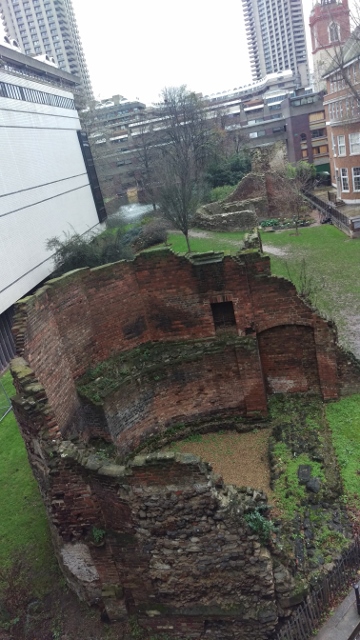
Yesterday I spent an hour visiting another site from Roman London, the ruins of the fort lying underneath the busy city street of London Wall that runs outside the museum itself. I had seen this view from Bastion High Walk on previous museum visits…

IMAG4091 (360x640)

IMAG4095 (640x360)

…but had never dreamed that there was any more to see. After spending an hour with Museum of London guide Mike, I was proved wrong.

Here’s what happened.

We started up on Bastion High Walk just near the museum entrance with an overview of the site. This is Mike…IMAG4093 (360x640)

…and here are a couple of pictures from our handout. The left-hand picture shows the fort at the top left within the wall surrounding the City of London. The right-hand picture is the layout of the fort itself – the area we explored is in the middle of the outside left wall.

We headed down the stairs and along the slip road to examine things more closely. I love how these old sites are tucked in between London’s more modern buildings. IMAG4096 (640x360)

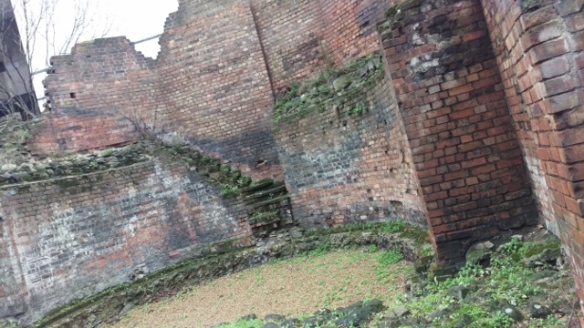
Up close we could see more of the detail – the soot blackened walls, the wear on the steps from the boots of the soldiers.IMAG4097 (640x360)

Mike pointed out this line of Kentish ragstone running along the front. This is the oldest part of the structure dating from the 4th century AD.
IMAG4099 (640x360)

Can you see the two parts of the ragstone wall? The lighter-coloured part at the front would have been built first with the darker grey section added afterwards for additional fortification.

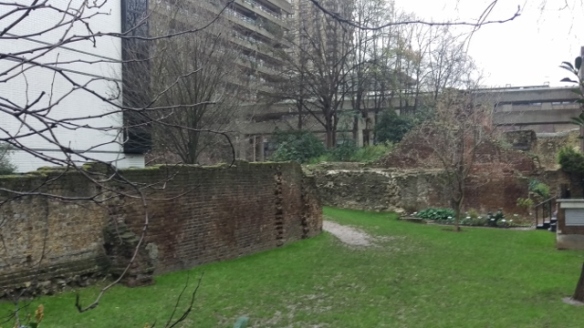
The rest of the site dates from about the 14th century when, in typical London fashion, new buildings were simply built over the top of what was already there, the previous city being abandoned at the beginning of the 5th century. I wonder what will be built on top of us?

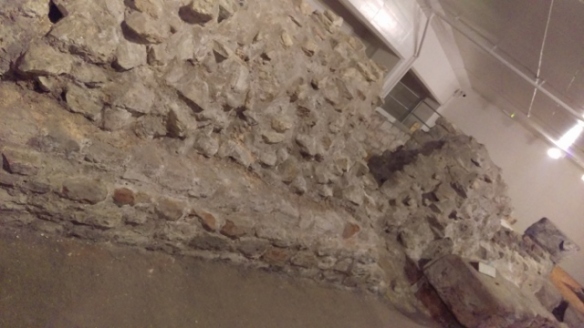
We then headed through a non-descript door next to the London Wall car park to visit the fort remains that are kept under ‘lock and key’ by the museum. Here’s a model of what this site – the West Gate of the Roman fort – would have looked like in its ‘hey-day’.

IMAG4104 (640x320)

Mike explained that this gate was probably more administrative than military. Gates around the wall – Bishopsgate, Cripplegate, Aldgate to name a few – aside from being defensive usually served as revenue-raisers, collecting taxes from those passing through. That this gate was un-named suggests it was less likely to support such functions.

Here are a couple of photos of the site discovered by William Grimes in 1956.

IMAG4102 (640x360)

North turret and guard room.

IMAG4105 (360x640)

The north gate

The area we visited covered only the left-hand section of model I showed previously – the guardroom and north turret, and the north gate – from the 14th century. Mike spent about 15 minutes helping us visualise the way the site would have looked, pointing out various details which archaeologists have used as the basis of their assumptions about life at the fort hundreds of years ago.

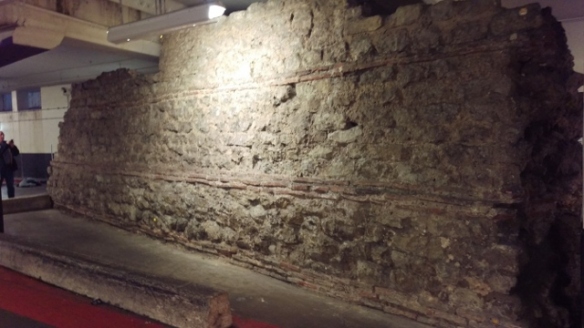
The official tour drew to a close after about 40 minutes but there was more to come. Mike mentioned that there was a piece of 4th century wall in the public car park next door that we could take a look at. I envisaged something quite small but after a brisk 10 minute walk, I was absolutely astonished to see this.

IMAG4116 (640x360)

The detail was extraordinary. You can see in the photo how the wall has been constructed for strength, stepping inwards with each row of levelling tiles (these tiles are the red lines you can see). You can also see the difference between the dressed stone on the outside and the rougher packed stone behind it.

IMAG4114 (640x360)

IMAG4113 (360x640)

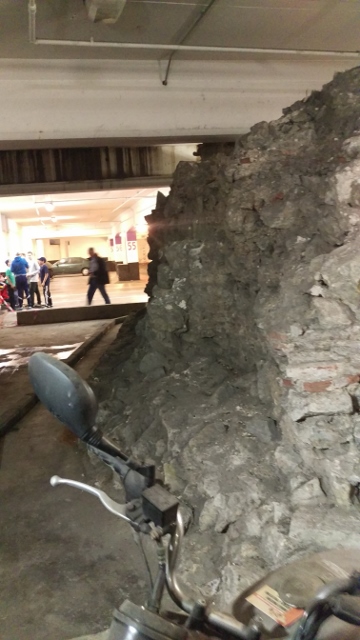
In London, archaeological sites are the responsibility of the land owner. Rather than being owned (and looked after) by the Museum of London, the car park is owned by the Corporation of London. It is a public space and so this historic site is at the mercy of exhaust fumes, human hands and unsympathetic modern additions.

I was really delighted to be able to see such an amazing piece of history up close (although at Mike’s request, we did not touch it – after all it is 1600 years old). But I felt irritated by its casual treatment.

A group of young skateboarders were gathered right next to it and several times I saw them lean on the wall, with some actually running into the wall itself. Granted they probably don’t understand the historical importance of this pile of stones or even if they do, appreciate it. When I think about my fascination with history, I realise that I’ve become more awestruck and humbled by it – in equal meaures – over the years. This is probably a result of my own ‘maturing’ in combination with moving to London from Australia (with its relatively shallow roots in European history) over a decade ago.

However, there was no excuse for the rubbish strewn around it by car park users and seeing the steel girder that had been inserted left me both sad and horrified.

To this end, I posted…okay, had a little rant on Instagram as I was reflecting over a post-tour coffee back at the museum. Paying for the tour itself (£5 is pretty amazing value given the expertise people like Mike provide), buying a book at the museum shop afterwards and even my new Friend membership feels like a tiny drop in an enormous ocean. Hopefully as I continue to explore what the museum offers, I will find more ways to support their work.

In the meantime, all I can think to do is to encourage you to visit these extraordinary sites – if not in London then wherever you are – to reflect on the history of humanity, how our society has evolved and perhaps consider how the story of our time might appear to the future generations.

Let’s make it a good one

Here we are at New Year’s Eve again. The year’s gone by so quickly and it doesn’t seem that long ago that I was trying to stay cool last New Year’s Eve Down Under. Time flies doesn’t it? And speaking of fun, I’ve managed quite a bit of it over the last 12 months.

After returning from my bi-annual pilgrimage to Melbourne (and a fab top-up visit from Lil Chicky) in January, travelling-for-work was much less frequent this year but I managed to find some cash and conquer some new frontiers. Ten days in Seattle with Seattle-A heralded my first trip to Canada, I spent four fabulous days in Stockholm at the start of August and then jetted off for a week of sun, sand and a whole swag of reading in Mauritius in November.

Speaking of reading, I smashed my book-a-week target by 25% (I read 65) and 8 of them got a Gidday 5-star rating (that’s 12.5%). I discovered Henning Mankell recently and will be reading more of his Kurt Wallander series next year. And while it doesn’t count in 2015’s quota, I am in the middle of my first Philip Kerr – March Violets with protagonist PI Bernard Gunther – and if things continue as they are, the new year looks set to start with another big fat 5 star rating. Awesome.

There have been many theatre outings over the year, Death of a Salesman being one that I studied at high school yet hadn’t seen and the most recent being Hangmen which featured a cracking ‘noir’ plot and really great characterisation. I’ve also been back to Sadlers Wells to be swept away by the Rambert Dance Company and transported to Spain at the opening of the London Flamenco Festival.

I’ve upped my Live Screening ante enjoying some new (well new to me) Shakespeare – Love’s Labors Lost, Othello and The Winters Tale – and several operas including my first Gilbert and Sullivan operetta, The Mikado. Live Screening also delivered a theatre highlight – Man and Superman – and a new crush, Ralph Fiennes. When seeing his face alight with joy in taking the final bows, well I may have had a little weak-at-the-knees moment…okay maybe not so little.

I’m finishing the year with a two week staycation. Christmas was spent with friends in SE London and aside from an outing to Borough Market and Southwark Cathedral with another friend yesterday, I have just enjoyed being at home. I’ve still got five days off before I go back to work so plenty of time of time to complete my Christmas jigsaw puzzle, finish March Violets and catch up with friends for a little Star Wars, drinks and dinner.

It’s almost midnight here, Bryan Adams is rockin’ it out on the telly and before long, the crackle of fireworks will be heard overhead as those locally organised start the new year with a bang. All that remains is for me to wish you the very best for 2016…

FB_IMG_1451605786209

Let’s make it a good one.