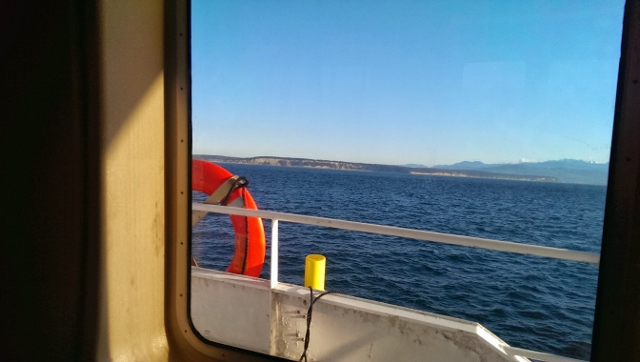
The window

Let me start this by saying I had an awesome Saturday last weekend. It was filled with some of the things I love best – literature, history, discovery and most of all, London.

I had spent a fascinating hour at the old Roman House and Bath on Lower Thames Street right opposite the Billingsgate Fish Market. The City of London is an area I’ve explored over the last few years through walking tours (In Shardlake’s Shoes) but it’s not on my way to any frequent haunt so adventures tend to be a result of turning left instead of right, peering around unbidden corners and just venturing into open doors.

With some time to kill before heading to the Kings Place Festival, rather than head directly back to Monument Station, I let myself meander aimlessly along cobbled lanes admiring the architectural mix of old next to new.

IMAG3435 (360x640)

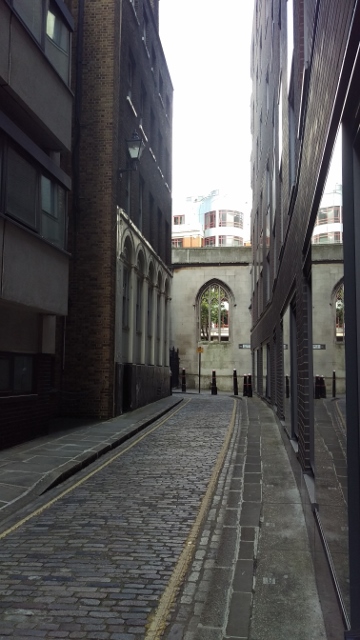
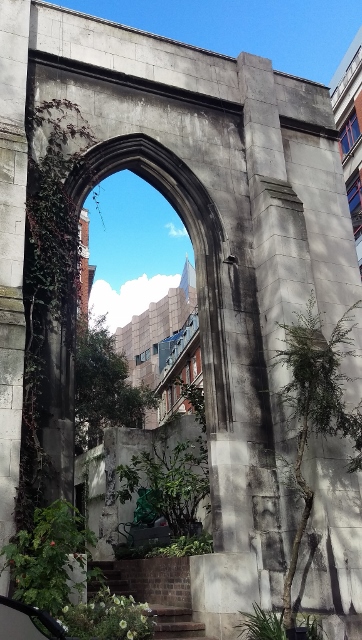
I had ambled up St-Mary-At-Hill toward Eastcheap when I saw this off to my right.

The window (small)

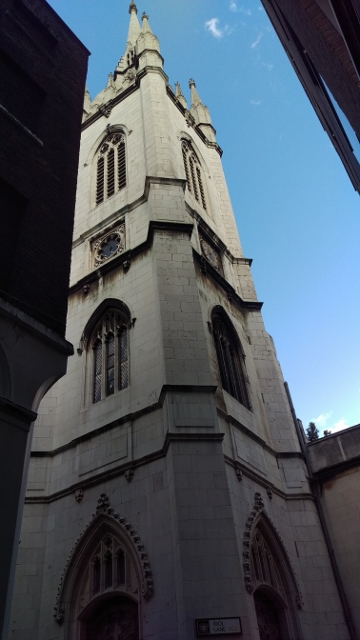
Intrigued, I headed towards it, the street silent and shaded against the warm afternoon sun. As I drew closer, I looked up and spied a steeple chalked against the blue of the sky.

Tower (360x640)

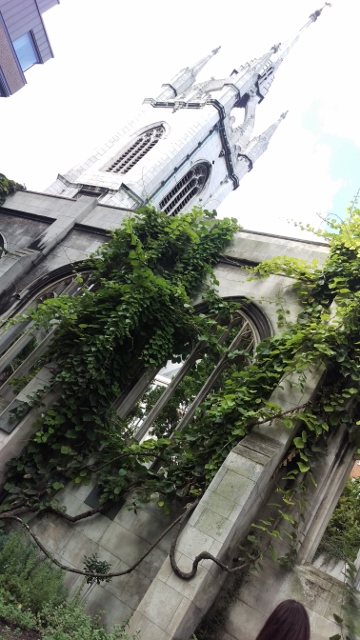
The sunlit window beckoned and as the cobbles turned left into Idol Lane, it became part of something much bigger. The tower in front of me rising up to unite the disparate parts of steeple and window into one glorious whole.

IMAG3397 (640x360)

IMAG3413 (360x640)

St-Dunstan-in-the-East – all sweeping curves and delicate green. A little piece of history tucked just a few steps back from the dust and traffic on Lower Thames Street. I smiled and I could feel the warm anticipation of discovery growing inside me. The black iron gate was open so I edged through, curious and quiet, as though not to disturb the peace of the garden.

IMAG3430 (360x640)

IMAG3401 (640x360)

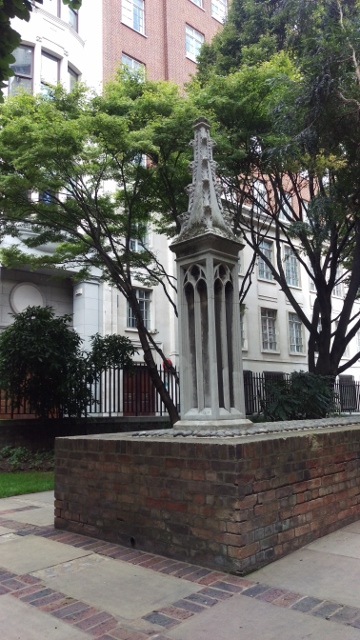
I wandered along the leafy paths drinking in the beauty of this patch of nature and history entwined. Each turn revealed a stunning view, each door a different aspect to behold.

IMAG3415 (362x640)

IMAG3426 (640x383)

IMAG3423 (360x640)

IMAG3424 (640x360)

The delicate shapes of the old walls reached up amidst the modern cut of the City, softening its edges and somehow showcasing the modern skyline. There’s a mix of old and new that I love about London – the way that each seems to compliment, even enhance, the other. I don’t think anywhere does it better.

IMAG3416 (640x360)

My breath caught over and over again as I gazed around me. I was moved, wanting to absorb each moment and imprint it into my mind. At the same time, I wanted to share the fullness of it. I found myself retracing steps, phone in hand hoping somehow to capture a fragment of what I was feeling in order to pass it on.

I typed my first draft of this post an hour later, sitting on the floor of Kings Place waiting for the event I’ve booked in for to start. It was a download I couldn’t stem, a rambling deluge of words and feelings for such a short space of time that had become so large and urgent in my memory.

Now I reshape it, ordering it, adding the photos which speak to my heart the most. There’s joy in revisiting the photos I took. They return me to places I stood – the central garden where the wiry black boughs framed by gothic arches were misted with emerald leaves, the far reaches of the path where I could see the red piped curves reaching from the bricked corner of the building next door – and the things that I felt – the warm sun on my face, the cool sweat on my back that made my t-shirt cling to the place that my backpack had been.

IMAG3429 (400x640)

And I smile again. It feels like the same smile as when I first set eyes on that black iron gate. And I feel grateful – for the moment, for the discovery and for the opportunity to live in this magnificent city I am lucky to call home.

To my mind, that’s not bad for a Saturday.

Not bad at all.

Under foot

The Museum of London is my favourite museum. When I first arrived in London, I spent a too-short couple of hours sheltering there from the January cold before a meeting-over-a-drink on London Wall and over the years I have visited several times, not just for new events but also to revisit the permanent exhibition. It’s the patchwork of all of London’s faces through history that I find so endlessly fascinating.

Anyway, the Museum is trialling a series of Archaeology Archive events over the next few months, opening up sites for the public to visit and to learn more about what went on here well before we were a twinkle in anybody’s eye. So at 2.45 yesterday afternoon, I entered the nondescript door at 101 Lower Thames Street and followed our Museum of London guides, Joe and Nicola, down the short flight of stairs to the Roman House and Bath.

The house and bath is thought to be from the period leading up to 400AD – the story of the site came to life under Nicola’s passionate telling: the building and its abandonment – probably around the late 4th/early 5th century when Rome withdrew its support from Londinium – the unusual layout of the bath house and why it might have been built that way, and how archaeological evidence – or absence thereof – plays its part in refining the story. There still remains some debate as to whether this was a mansio – a ‘stopping point’ – or a family home but that in no way diminished the impact of what we saw.

The tour began with a look at the east wing, what was thought to be the furnace room and the remains of the hypercaust heating system beneath the floor.

East wing with hypercaust tiles (640x360)

The east wing – you can see hypercaust tiles to the right. The furnace room is on the other side of the walkway and links through a series of channels under the floor to circulate warm air throughout.

We then spent some time looking at the bath. Comprised of a frigidarium cum change room in the centre, the tepidarium (warm room), caldarium (hot room) and plunge pool, Nicola’s narration took us back over 1600 years, introducing us to the family who may have lived here.

bath layout (640x360)

You can see the layout of the bath here. The frigidarium was the flat area in front, to the right you can see the site of the caldarium (hot room) with its hypercaust tiles and the furnace that you can see just on the outside of the wall). The family would have walked through a small connecting room to the tepidarium (warm room) on the other side (left side of picture).

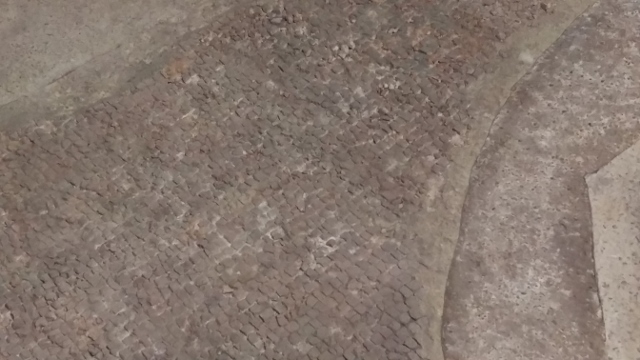
They may have trodden the tessellated floor of the frigidarium to change, walked through to the tepidarium to acclimatise to the heat, then visited the caldarium  for a short time before returning to the tepidarium to relax, chat and receive the cleansing ministrations of various experts (scraping the skin with a strigel was a common method of removing the dust and grime of London).

tessalated floor (640x360)

Remains of the tessellated floor of the frigidarium

IMAG3374 (640x360)

The tepidarium – you can see the remaining floor level tiles sitting above the the hypercaust pillars

And let’s not forget an invigorating dip into the plunge pool before leaving the bath.

IMAG3366 (640x360)

The plunge pool was located at our backs as we looked over the frigidarium. It’s not huge – just enough for a dip in and out.

Just under an hour later, our small group headed back up the stairs and, after signing the visitors book, emerged onto the sunlit street. I still find it quite hard to believe that all of that fabulous history lies beneath an unassuming office block opposite the imposing Billingsgate Fish Market on a roadwork-strewn City street.

The Roman House and Bath is a Scheduled Monument which means that it is registered as one of Historic England’s 5627 important archaeological sites. It also means that it is a legal requirement of the owners/occupiers of the property to protect the site. The Museum of London plays a big part in this with teams of historians, archaeologists and conservators overseeing preservation efforts.

This trial – the opening of their Archaeological Archives – is an effort to raise public consciousness about London’s history and encourage visitation albeit, with a small fee, in the hope that there will be support and funding for a permanent programme.

If you are fascinated by history and/or London and have an hour one weekend to visit the Roman House and Bath – or any of the other openings in this year’s trial – please do it. Being able to stand beneath the street, to see this and listen to the expertise and passion of people like Nicola and Joe from the Museum of London is an absolute privilege.

It would be a shame if the doors were closed again and the conservators were left to appreciate London’s past alone.

———————————————————–

For more information about this special programme, visit; http://www.museumoflondon.org.uk/london-wall/whats-on/adult-events/archaeology-events/

4 days in Stockholm: Changing the world

DSCN6077 (640x479)

This is the Nobel Museum, housed in the old Stock Exchange building right in the shadow of Storkyrkan‘s baroque steeple. It is right in the heart of Gamla Stan, looking out over the cobbles of Stortorget just a short walk up the dappled lanes from Vasterlangaarten. In the bright morning light of my last day in Stockholm, it stood still in the quiet of the square, understated with hardly a hint of the inspiration within.

I entered the cool dark hall, the gentle flow of past laureates above my head and glowing pillars forming a gentle arc around the atrium to honour this year’s winners. Come November they will join the parade of banners overhead to be replaced with a new batch of those deemed to have made the most significant difference over the last twelve months.

The original ideas man

Alfred Nobel was born in Sweden in 1833 and had a well-travelled life. He spoke four languages even as a child and throughout his adult life, spent his time most notably in St Petersberg, Stockholm and Paris. He was a descendant of Swedish scientist Olaus Rudbeck and it would appear that invention flowed down the bloodline with Nobel’s father, Immanuel being the inventor of modern plywood and an alumunus of the Royal Swedish Institute of Technology. Alfred himself had a mind that constantly sought solutions and he had 350 international patents awarded in his lifetime, the most famous of these inventions being dynamite (1867), gelignite (1875) and the predecessor to cordite, ballistite (1887).

Nobel+dynamite

His legacy is twofold. He built an international business empire with interests as far-reaching as Australia, Japan and North and South America as well as closer to home in Europe and Russia and it lives on in numerous companies world-wide. (Heard of chemicals giant Akzo Nobel?) Needless to say, Alfred Nobel left a considerable estate upon his death in 1896.

The Nobel Prize was defined and instructed through Alfred Nobel’s last will and testament. His vast fortune was to be held in secure investments and used to fund five prizes each year celebrating…

“…those who, through the preceding year, shall have conferred the greatest benefit upon mankind.”

The five prizes, in areas that held the most fascination and interest for Nobel, were to be awarded by the institutions he held in the greatest esteem. The Nobel Prizes for Physics and Chemistry were to be conferred by The Swedish Academy of Sciences, the Nobel Prize for Physiology or medical works by the Karolinska Institute in Stockholm, the Nobel Prize for Literature by the Swedish Academy and the Nobel Peace Prize by the Norwegian Storting.

However these organisations were unaware of Nobel’s final wishes and it took the creation of the Nobel Foundation and a further five years before the first prize was awarded in 1901. In 1969, a sixth prize was awarded – the Sveriges Riksbank Prize in Economic Sciences in Memory of Alfred Nobel – but while conferred by the Swedish Academy of Sciences at the same ceremony as the other prizes, it is funded by Sweden’s central bank and is not deemed a Nobel prize.

Nobel endeavours

I wandered from room to room, watching interviews and footage of just a small number of prize winners. Between 1901 and 2014, 567 prizes have been awarded to 889 laureates who, in leaving their particular legacy, have allowed mankind to continue to fashion its future. The soft click overhead heralds the breathy release of a prize winner’s banner on the cableway –  each glides noiselessly around the ceiling of the exhibition hall before joining the others again. It’s an ingenious way to make sure that every laureate can be honoured here yet with plenty of space for those still to come. A video installation, shrouded in diaphanous white folds, explores the future with 19 laureates – what is their hope? – and the importance of passing something on.

Exploring ideas has laid foundation after foundation for the discoveries of today and underpins our society’s progress and it is an awesome thing – that one man’s passion for ideas and his belief in human creativity more than one hundred years ago lives on in celebrating those who exemplify his credo in their work, their commitment and in the people who inspire them. My two and a half hours here left me feeling humbled and moved by people’s extraordinary-ness and I emerged from the cool semi-lit hall into the afternoon sun quiet and contemplative.

I sat in an outdoor cafe, reading the small booklet about Alfred Nobel that I’d purchased on my way out and as I finished and moved to close the back cover, I noticed the words that lay below the image of that legendary golden medal:

IMAG3204 (557x640)

The Nobel Museum – ideas changing the world

Long may it continue, I thought.

Long may it continue.

4 days in Stockholm: Photo tour

My recent city break to Stockholm has resulted in plenty of amazing photos. It is always a difficult thing, choosing the best to share without me clogging up your respective internet pipes. Many pictures evoke quite vivid memories of the moment itself which, while having special significance to me, may be lost on those who have not been.

So in creating this photo tour, my hope is for you to enjoy some breathtaking views of this beautiful city.

If it inspires anything more, that’ll be a bonus.

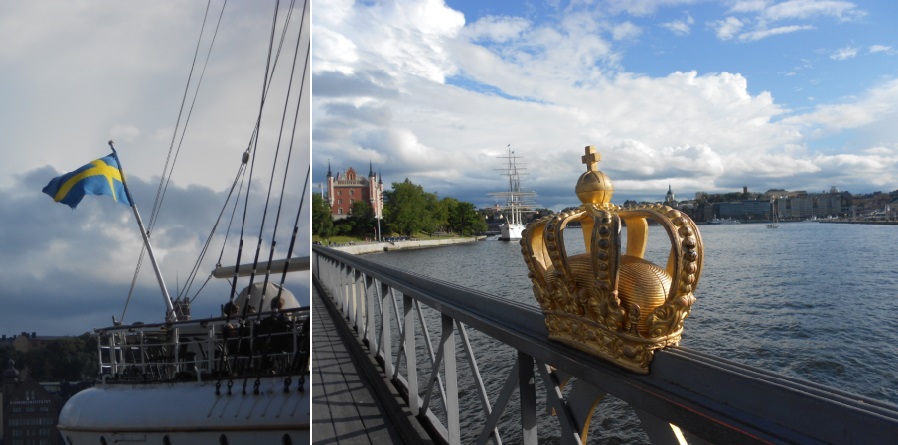
Symbols

Left: On the way to Djurgarden  Right: Crossing the bridge from BlasieHolmen to Skeppsholmen

Royal palaces

Top: Kungliga Slottet (The Royal Palace) in Gamla Stan Bottom: Palace of Drottningholm on Lake Malaren

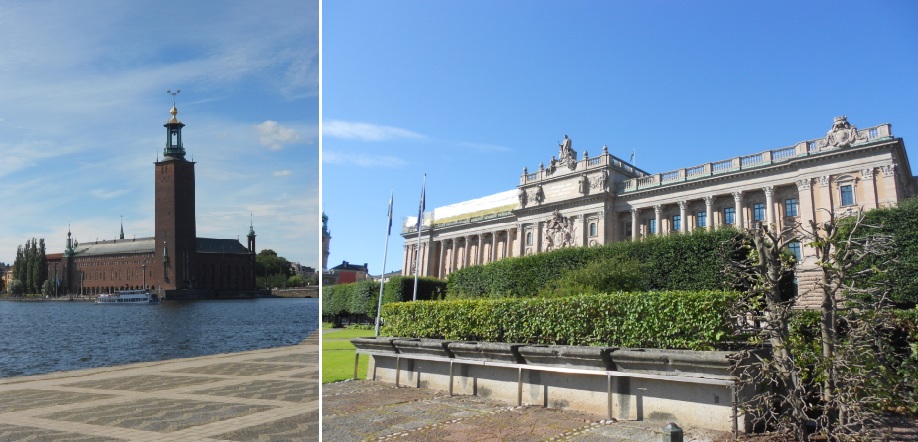
Admin

Left: Stadshuset (City Hall), Kungsholmen  Right: Riksdagshuset (Parliament Building), Gamla Stan

Bikes

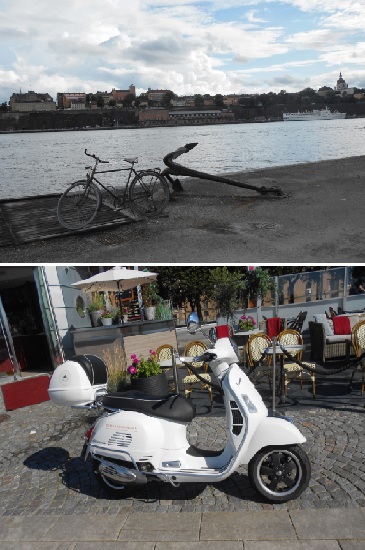
Top: From Kastellholmen  Bottom: Waterfront between Blasieholmen and Djurgarden

Boats

Left: Old boat moorings, Skeppsholmen   Right: Skeppsholmen Church and moored freighter, af Chapman – built in 1888 and serving as a youth hostel since 1949

Rooftops

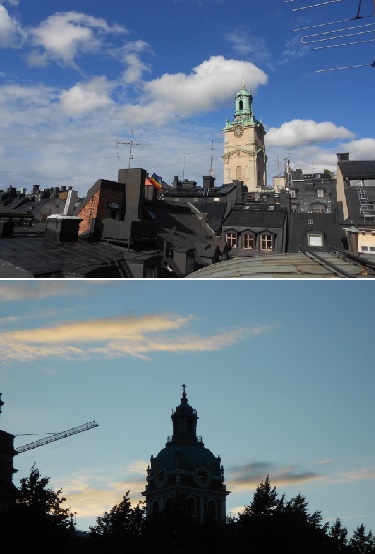
Top: View of Stokyrkan (Stockholm Cathedral) from the rooftop deck at the Lord Nelson Hotel, Gamla Stan   Bottom: Adolf Fredik Kyrka, Norrmalm

Streets

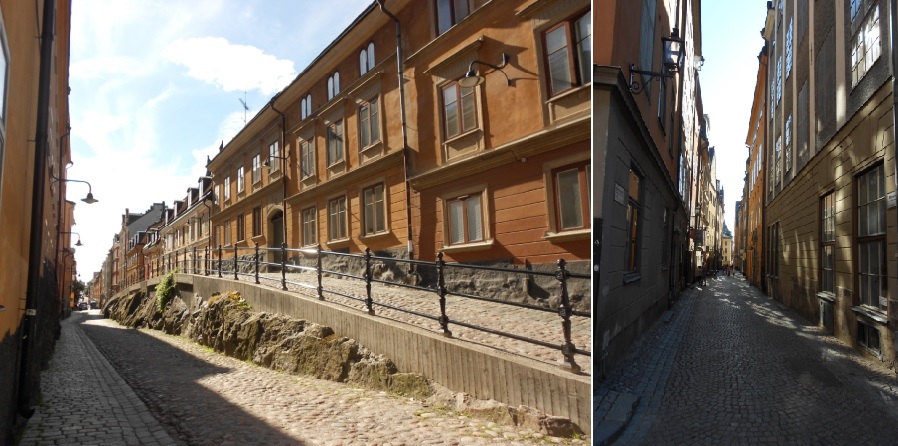
Left: Hilly streets in Sodermalm   Right: Dappled lanes in Gamla Stan

Colour

Left: View of Riksbron from Norrbro   Right: Jacobs Kyrka, consecrated in 1643, Norrmalm

View from Sodermalm

View of Gamla Stan from Monteliusvagen, Sodermalm

4 days in Stockholm: Celebrating me

Earlier this month, I spent 4 days welcoming a new city to the Gidday repertoire, Stockholm. It was also my birthday so you could say that my Stockholm city break was essentially a big fat Happy Birthday to me.  And after my arrival and check-in in the heart of Stockholm’s Old Town (Gamla Stan) and some wandering and a canal cruise to get my bearings the afternoon prior, said birthday dawned bright and sunny and the delights of Djurgarden were beckoning.

After an invigorating 40 minute stroll from Gamla Stan along the water’s edge, my first official stop was the Vasa Museum. Everyone I mentioned my upcoming trip to recommended this and so at 10am on a Saturday, I joined the unexpectedly short queue and walked into the museum to see this…

Vasa 3 (640x480)

Yes, it’s so big I could not fit it all into the camera frame. I had another go later with my phone…

Vasa 1 (640x360)

The good ship Vasa is a warship that was built in the 1600s. It was the largest ship ever built at the time, able to carry 64 cannons (over 2 decks) and 450 people, and was commissioned by King Gustav II Adolf to bolster his aggressive campaign to bring the Baltic region to Sweden’s heel. If this was not through force then the sheer awe/terror inspired by the Vasa’s size and splendor was intended to intimidate his enemies into submission. The ship set sail from Stockholm Harbour on 10th August 1628…and capsized just off the southern tip of Djurgarden, a voyage of about 1300m.

Just to put this into perspective, I swim further than that – 1600m – each ‘dip‘.

Our animated guide Stefano explained it all very clearly. While the ship had been built to be taller (and more intimidating) than any before, its width had remained the same and when combined with 2 levels of open and fully loaded gun ports, all it took was a ‘puff’ of wind to send it toppling over. This is the view of the stern looking up from the water line – yes the water line, not from the bottom of the ship – I couldn’t fit all of that in.

Vasa 2 (360x640)

So Sweden’s most glorious and expensive PR campaign of the age sat at the bottom of Stockholm Harbour for more than 330 years before its rediscovery (in 1956), salvage and conservation. The museum was opened in 1990, less than a nautical mile from the site of the disaster.

This museum is definitely one of my Stockholm highlights. There’s loads to see and do from the numerous viewing platform levels around the reconstructed Vasa itself (98% original), videos of the salvage and conservation as well as free guided tours and visits to the recreated gun deck and showcases of items retrieved during the salvage operation. It was also my first decent wi-fi access since my arrival so whilst watching the salvage film in the auditorium, my phone was inundated with a veritable deluge of lovely birthday wishes (and thanks to those of you who sent them).

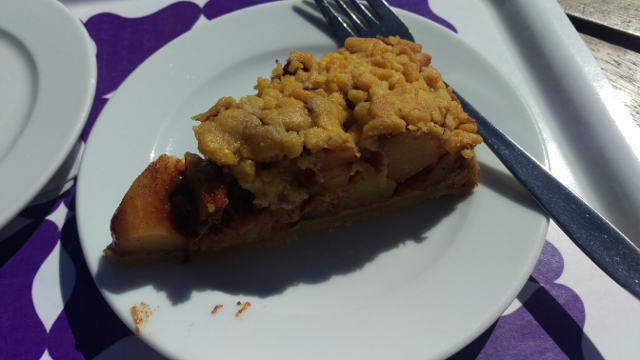
After 2 and a half hours, I emerged into the warm sunshine to meander a little further along Djurgarden’s main drag in search of sustenance (including some pretty delicious Swedish apple cake)…

Cake (640x360)

…and a blast from my past: Benny, BjornFrida and Agnetha – ABBA!

ABBA montage

You could make The ABBA Museum quite an interactive experience if you like that sort of thing. You can record yourself belting out an ABBA tune in the sound booth or make your own music video. You can even sit in the ABBA Arrival helicopter  or perform on the ABBA stage alongside Benny, Frida, Bjorn and Agnetha.

For the record, this wasn’t what what I was up for. Instead I spent a couple of nostalgic hours here, listening to the myriad of interviews with the band themselves and to all of the songs I sang along to as a child (as well as the questionable-sounding results of a couple of young fans in the non-sound-proof sound booth). It was great fun and really fantastic to see the important part that ABBA’s Australian record label, RCA, played in building their fan base and huge success Down Under.

With a few more hours of daylight still ahead of me, I decided to venture a little further along the road to visit Skansen.

Skansen montage

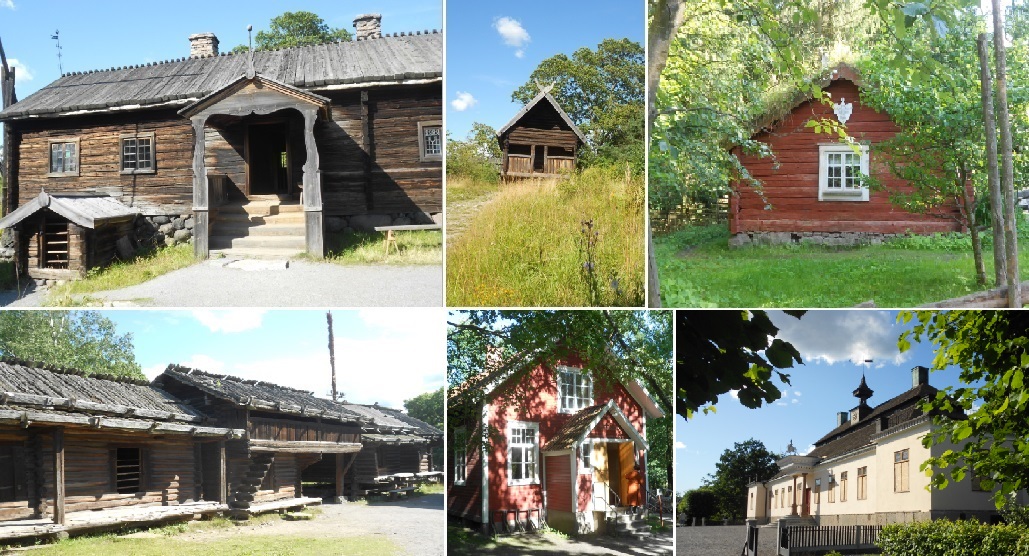
Skansen is in open-air museum and zoo that has been in operation since 1891. It combines history – 150 buildings from different eras from all over Sweden have been re-assembled here…

Skansen Buildings montage

…with fantastic views…

Skansen view 1 (640x480)

…and an opportunity to play ‘Spot the [insert relevant animal]’…

Skansen animal montage

After a few hours of wandering around Skansen’s 75 acres and a celebratory ice- cream (after all, it was my birthday) it was time to head back to the hotel and put my feet up for an hour or two before heading out again for dinner.

Bistro Pastis, a tiny French affair, is tucked away on a cobbled street running down from Stortorget in Gamla Stan and in spite of it being a busy Saturday night, I managed to nab a table outside. The food was absolutely delicious – a warm beetroot and goats cheese salad followed by a fillet of shark (my first) in a champagne sauce – and all washed down with a divine glass of bordeaux. And as the Swedish twilight stretched well into the evening, spending a relaxed dinner enjoying both the view and the gentle flirting from my lovely waiter was the perfect way to end a day designed to mark the beginning of yet another year.

Happy birthday to me and may the year ahead be filled with many more moments like this!

—————————————————-

Entry fees (in case you are interested!)

Vasa Museum – 130 SEK

ABBA Museum – 255 SEK

Skansen – 170 SEK

And 2 courses, wine and coffee at Bistro Pastis came to 389 SEK. This was after the 25% discount my waiter offered because ‘he was so busy and I had to keep waiting’ (And he didn’t even know it was my birthday!) This girl’s still got it….

Beyond Lovers Walk

I have been stepping out at work as part of a campaign called Get the World Moving. This is a global initiative that targets employee well-being in businesses, getting companies to sign up and submit some employee teams in order to encourage more activity on a day-to-day basis. The short story is the ‘target’ is 10,000 steps each day for 100 days and I am just below that at an average (at day 52) of 9,585, a substantial  improvement on where I started.

Wearing a pedometer and recording the results each day is really fascinating with even the fit freaks amongst us (you know marathon runners, triathletes and the like) uniformly horrified at how sedentary our daily lives are. Whilst my activity is reasonable during the week, walking on my daily commute with one or two swims to top this up (each of my 1,600m dips adds 7,600 steps), it has particularly inspired me to do some sort of walking activity on the weekend whether this is just walking further to do errands, or even a walking tour or two. You see I do like to disappear into Chez Gidday on the weekend and though I might be busy, if I don’t leave the house I am flat out reaching 3,000 steps.

So armed with my Walkit app, I set out in yesterday’s mild sunshine and discovered some more of Finchley’s hidden gems.

I started by turning off the main road into the rather whimsically named Lovers Walk. As I ventured further away from Ballards Lane, the houses seemed to recede until it felt like a woodland path rather than a suburban shortcut.

Lovers Walk

I crossed the railway bridge, made a quick dog leg across Nether Street and continued beneath the leafy canopy to find a trickling stream – Dollis Brook to be exact…

Stream 1

…and a lovely patch of green sprawled under a cotton-cloud sky.

Open Space

Turning left I continued along the Dollis Valley Greenwalk, the path patchworked with summer sunshine and  dappled shade.

Path Montage 1

The brook continued its calm, rhythmic tinkling beneath the trees and I breathed in the lush green loveliness. At the same time I was in state of disbelief – had I really only just discovered this little slice of peace and quiet so close to home?

Path Montage 2

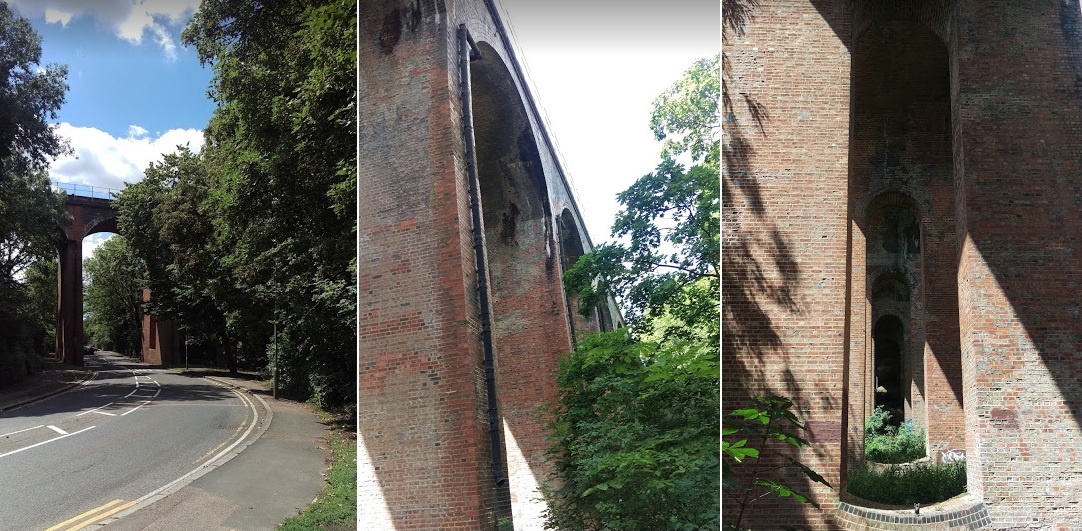
The path emerged on to Dollis Road, just near the viaduct.

Aqueduct 1

The viaduct was completed in 1867 as part of the old Edgware, Highgate and London Railway and today carries Northern Line underground trains between Finchley Central and Mill Hill East.

Aqueduct montage

Crossing beneath the arches, I followed the footpath around and turned left heading back up towards the main road again. After a little over 10 minutes, I found myself standing on Dollis Avenue.

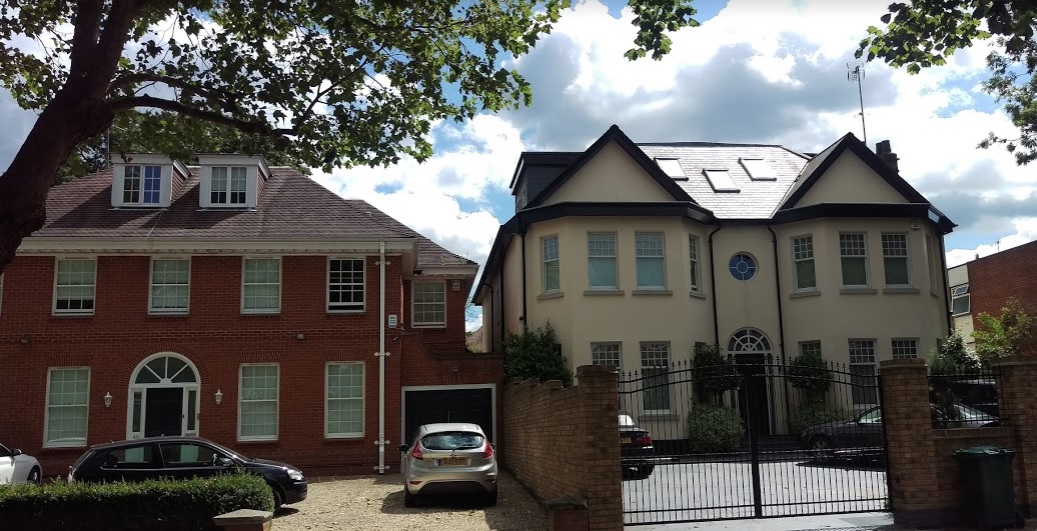
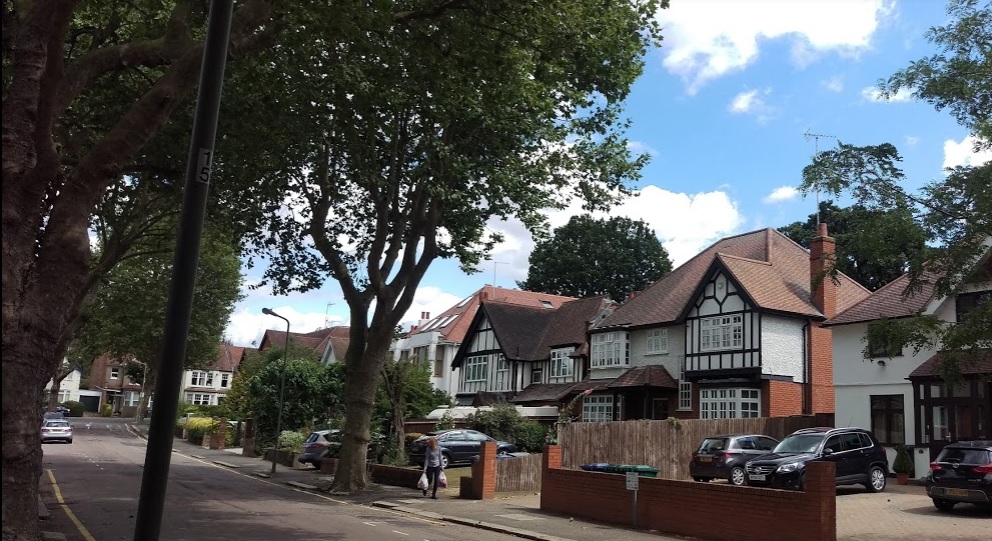
Dollis Avenue houses

Dollis Avenue

The avenue curves around to the right and meets back up with Regents Park Road – I had previously ventured about 150 meters down the avenue from the main drag to the Royal Mail collection office and had never noticed much beyond the grey commercial buildings. So I was open-mouthed with surprise to find such salubrious accommodation no further than a 5 minute walk away.

Dollis Park

Soon I was back amidst the hustle and bustle of Finchley Central but not before I copped myself an eye and nose-full of this delicious lavender…

Lavender

All up I spent just over an hour wandering about 2 miles and it was great way to get out of the house and enjoy the discovery of something new. The funny part is that when Lil Chicky was visiting in January we geocached around the viaduct so it meant I could join up some geographic dots – and found a much prettier route to the viaduct as well.

The Greenwalk is actually 10 miles long and connects Barnet Gate Wood (the Battle of Barnet in 1471 was one of the final battles in the War of the Roses) with the northern extension of Hampstead Heath. I’m not so inspired that you’ll find me covering the entire 10 miles – that’s 16km – in one go but it seems I’ve found a good halfway point and the only decision required is really whether to turn left to the Heath or right towards history.

Who knew that Lovers Walk would yield all of that?

The hole in the ground

‘Refuse collection day’ in my borough falls on a Friday and lately, as I have begun my daily commute with its regular 10 minute walk to the station, I’ve noticed that the local recycling trucks have had a bit of a spruce up.

barnet recycle truck

You might think that this is a weird thing to notice but recycling is something that’s close to my heart and it’s come a long way since my arrival in London more than eleven years ago. Back then, I was shocked by the absence of the kerb-side collection infrastructure I had been used to in Melbourne, where I happily separated my rubbish into separate bins and blithely ‘left it out the front’ for weekly collection.

When I arrived in New Cross in 2004, there was no kerb-side recycling in place and for the year I lived in Brentford, I spent much of the time cleaning up the ‘burst’ rubbish bags from the pavement right outside our front door (the efforts of either foxes or patrons of the pub down the road). My six and a half years in Kingston-Upon-Thames saw the arrival of a ‘recycling bank’ at the local Sainsbury’s supermarket (which would have been bit of a nuisance without a car) followed by the gradual introduction of a kerb-side service, the footpaths on ‘rubbish day’ becoming cluttered with all manner of bins and bags (with about five different containers supplied to separate all of the different materials in). 

In England we recycled, reused or composted just 43.5% of our waste in the year up to November 2014, a measly 0.3 percentage point increase over the prior year. That means that more than half of what we throw away ends up in a big hole in the ground (aka landfill) and if the new truck livery is to be believed, Barnet (my local area) has been behind the pack at 40%.

So it was a heartening sign for me to see the commitment to a significant 25% improvement from the Borough. But it’s not just the council who has to stack and separate the myriad of recyclables from week to week but all of us who live in the community. And that’s why I am loving the smart simplicity of their message.

I saw the ‘50% by 2016’ on a street poster by the tube station entrance earlier this year and then snapped the trucks – out and about on local streets week after week – about 7 weeks ago. And then this week, walking home from the tube, I saw this on the main road…

Barnet recycling street poster July 2015

Granted, this only addresses the rubbish at home and I am struggling to remember where I’ve seen any bins for separating rubbish ‘types’ while out and about but to my mind, a concerted effort in any area can only contribute towards lessening that big hole in the ground.

In checking out the current statistics Down Under, I noticed that Australia’s recycling rate of 64.2%, one of the highest recycling rates in the world (in Europe, Austria leads with 63%) has plateaued over the last couple of years so even our best is still leaving more than a third of the waste we generate for the planet to ‘deal with’.

There’s quite a lot of noise around Zero Waste (to landfill) initiatives in the business world and given the stats I’ve looked at as background to this post, I’m not sure how on earth we’d ever be able to extend that philosophy out into the general community. But this truck that trundles down my street each week has reminded me that every little bit makes a difference and I have resolved to renew my efforts in not just recycling what I use, but also to look at using ‘less’ in the first place.

If street art ruled the world

Yesterday I went on a street art walking tour through London’s East End.

Inspired by the discovery of Hosier Lane in Melbourne during my visit with loved ones Down Under, I’ve been keen to explore more on this side of the world since my return in January.

At 10am on a lovely sunny Saturday in London, about twenty-five of us met our guide, Dave, at the Goat Statue at Spitalfields market. This is the goat, not Dave…
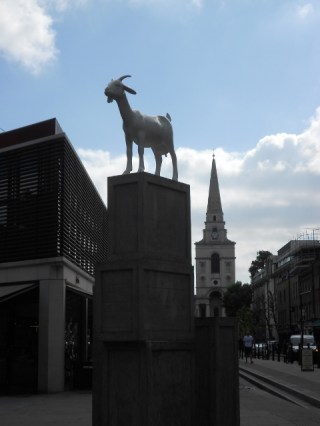
The Goat Statue

As we meandered towards the church, Dave gave us a bit of an introduction to street art/graffiti and the emergence of London’s street art culture. He also explained that given the temporary nature of street art, the myriad of stickers on lamp posts and other street furniture can serve as a handy guide as to who’s been contributing to the urban art scene in the area at any particular time – a bit like passport control for those in the ‘street art’ know.

The example below shows the iconic winged figure of well-known artist D*face in sticker form in Brushfield Street and then his installation in the Old Truman Brewery Complex.

DfaceWe turned right at the church then took a left into Fashion Street and that’s when things really started to happen…here’s Dave introducing us to three different styles and artists – more on some of these later.

Dave in Fashion Street

I did find the bike image stenciled onto the road particularly amusing in this picture – the urban art scene rails against the things that the establishment tells us we must do (like staying in the bike lane?).

This is probably a good point to address the questions of ‘what is street art’ and ‘how is it different from graffiti’.

According to Dave, the definitions are many and varied but for him, graffiti (below left) is created for the appreciation of the urban art community who can, for example, really appreciate the intricacies of a tag. Street art (below right) is created with a wider audience in mind – Dave told us to “think of images you might consider being on a t-shirt or as a piece of art in your home”.

temporary

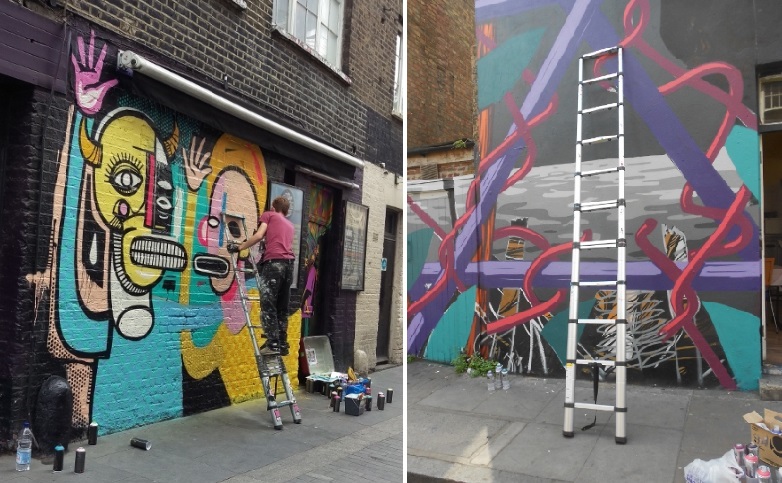
Both might consist of painting, stickers, paste ups or other types of ‘installations’  and both can be done with or without permission. But after seeing a few works in progress, I was left with the over-riding premise of street art/graffiti being both temporary and accessible in nature despite permissions granted – check out the works in progress below.
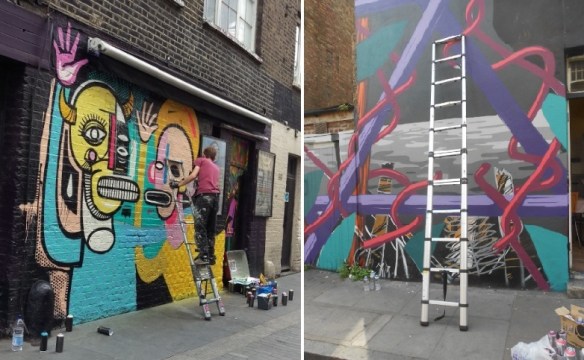
WIP

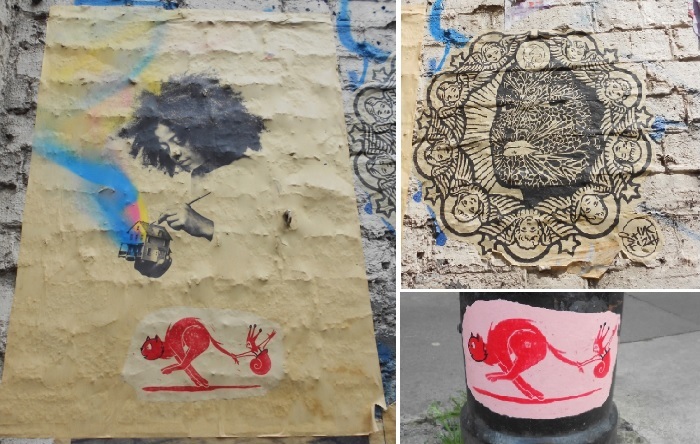
We wandered along Fashion Street, learning about different techniques as we went. Below are some examples of paste-ups – where the artist has completed the image elsewhere prior to pasting it on the walls. The top left image was created using screen printing for the main image with the coloured smoke added in situ.
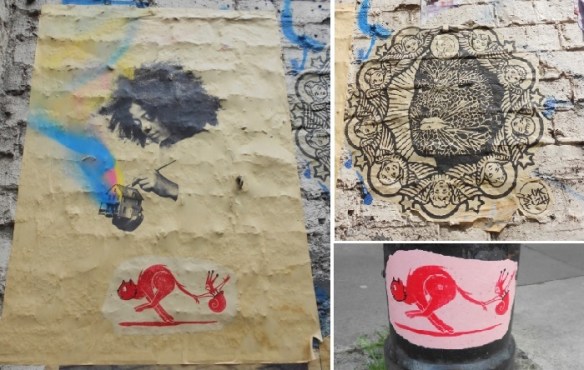
Paste Ups

You can also see the temporary nature of urban art at work here with the later addition of the ‘cat chariot’ to the bottom of the original piece, a practice we saw a lot throughout the tour. Another common practice is for artists to spread their work in an area to make their mark – we saw two more of the ‘cat chariot’ further along Fashion Street and more scattered along our walking route.

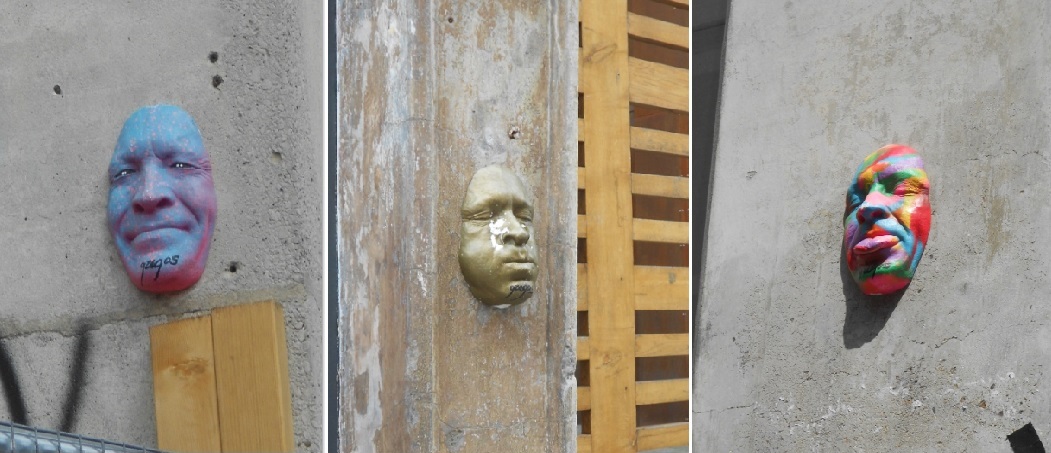
An artist currently distributing himself throughout the area is Gregos. He’s a French sculptor who creates painted molds of his own face. He has installed two batches of these in London so far.

Gregos

We saw these three on our route, ‘stayers’ from his last batch of fifty earlier this year. (Dave assures us that having met Gregos, this really is his face.)

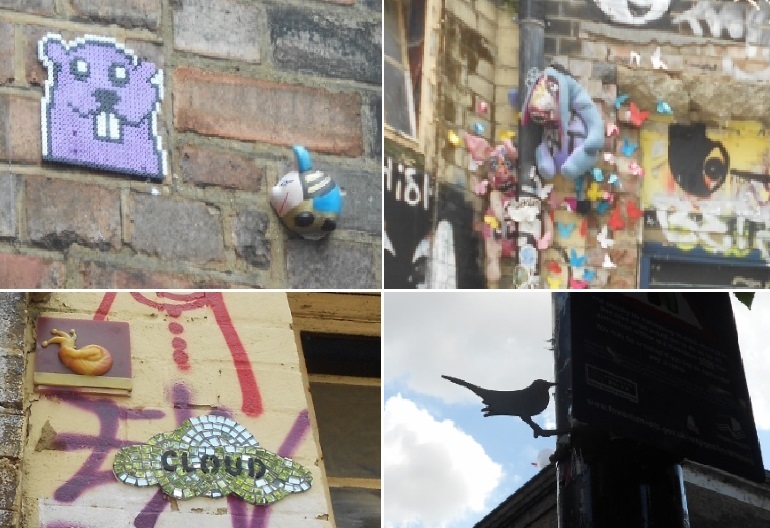
Speaking of sticking things on the wall, there were loads of other things to find if you kept your eyes peeledStuck on

The piggy you can see in the photo top left is part of a series by Love Piepenbrinck. We found them in all sorts of places and while we thought they were cute, it would appear that the urban artists themselves are quite enamoured of this idea. We found a number of works had been created around the little sculpture, leaving the ensconced piggy right where it was – maybe Piepenbrinck’s piggies will mark an era of (semi-) permanence?

The other pictures are just different examples that appealed to me: Eeyore perching gloomily amongst a frenetic background, the mirrored cloud that changed depending on my angle of reflection (pardon the pun –  couldn’t help it!) and the urban tweetie attached to a council sign.

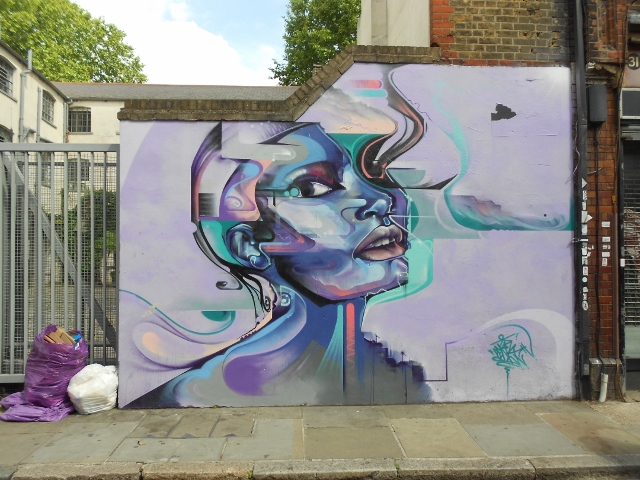
This next image was quite stunning and really struck me with all of its purple and turquoise hues. Dave confirmed here that the artist had been granted permission (by the owner of the wall, not the council) to paint here.

Purple woman

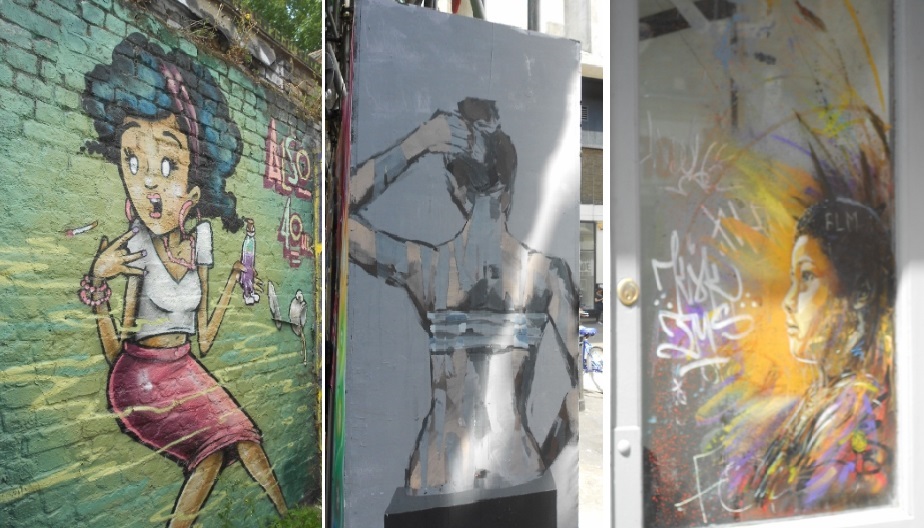
However, what was even more amazing is that this was all painted with spray cans. Can you imagine trying to create this kind of delicate imagery with a set of spray cans? (I probably couldn’t even manage it with a paint brush). It gave me a new appreciation of the talent of these artists. Here are some more ‘girls’ I particularly liked…

Women

One of the elements of street art is the speed and ‘furtiveness’ required as most is completed without permission. One of the techniques used to aid this is stenciling (Banksy is a well-known exponent of this). The image on the right is painted on the door of a barber shop and so whilst the artist had probably obtained permission, this intricate portrait was still created using a whole series of stencils.

We saw some great commemorative art as well. Joe’s Kid (below left) actually runs the coffee shop that owns the wall and Charlie Burns (below right) ran the business whose shutters are right next to his image.
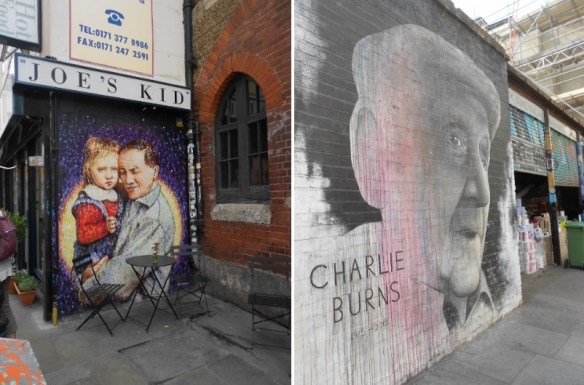
generations

The Charlie Burns image also embodies the dripping effect evident in much street art – let’s face it, if you’re trying not to get caught, you don’t spend time dabbing at the drips! In this case the artist, Ben Slow has used it to effect on the left hand side of the image and then merged into photo-realism as he moved towards the right.

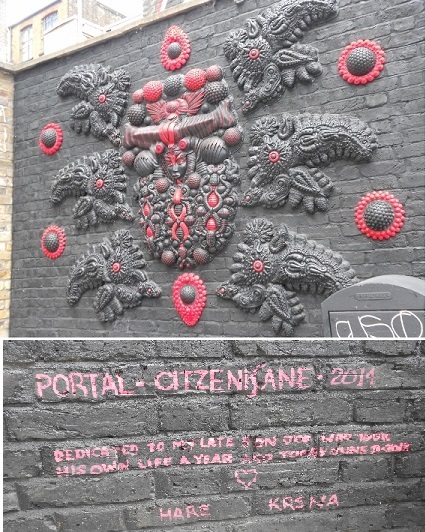
And the piece below – just off Bethnal Green Road – is by Citizen Kane (CZK) and commemorates the suicide of his son in 2013.

Citizen Kane

Street artists are also known for their strong anti-authority philosophies and these next two are great examples of taking a humorous and well-aimed poke at the establishment.

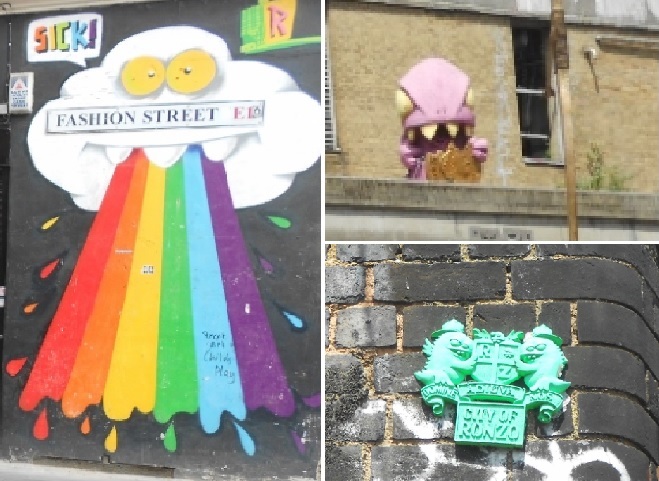
Ronzo is a German artist and his style is typified by the bulging eyes and the tombstone teeth of his monsters.  We saw the rainbow image earlier in Fashion Street. On the right you can see Crunchy, The Credit Crunch Monster, Ronzo’s mascot for the global financial crisis, in the Old Truman Brewery complex while the City of Ronzo crest was on the railway bridge at the top end of Brick Lane. This guy gets around…

Ronzo

Frenchman Clet Abraham is another exponent of thumbing one’s nose at authority and uses his witty imagery on existing ‘displays of authority’ (street signs) to make his particular mark.

street signs

Nathan Bowen is yet another using his art to make a statement. Using marker pens in his signature style, he makes this plea for peace in Syria below.

Nathan Bowen

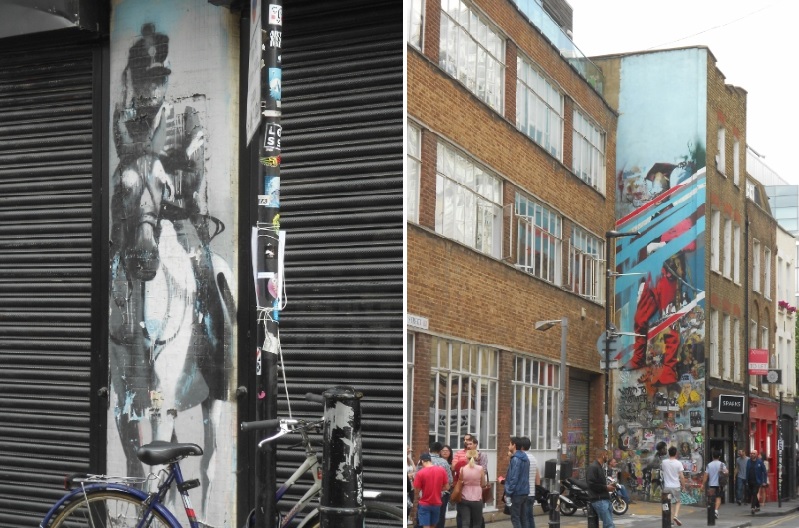
Conor Harrington‘s work also appeared in a couple of different places along the way…
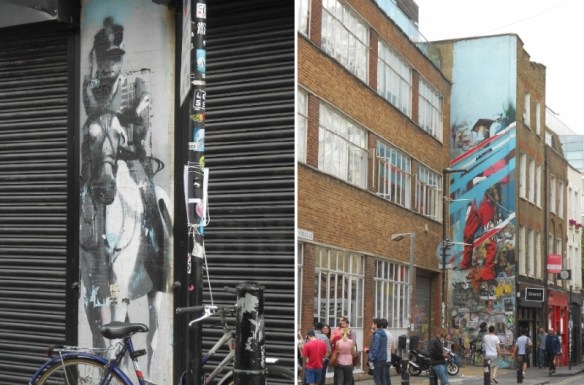
Conor Harrington

…and he also worked with U2 on Crystal Ballroom, part of their Songs of Innocence project. (He’s the artist in the video.)

No street art tour – of London anyway – would be complete without Banksy so we snuck through the gates of Shoreditch nightclub Cargo to see this…

Banksy

Yes, it is behind perspex but while not in the temporary and accessible spirit of street art, I’m pretty glad I got to see a real Banksy. And yes, his real identity remains a mystery, even to Dave. (There’s more street art in Cargo – even another Banksy so might be worth popping down to Rivington Street.)

There was so much more on this almost 4 hour tour and it gave me a new appreciation for both this pocket of East London – about which I knew very little – and the urban art scene – about which I knew even less. I didn’t like everything – probably only half of what I saw really appealed to me but it’s interesting how with a little bit of background, the whole genre opened up and became absolutely fascinating.

And let’s face it, if street art ruled the world, there’d be a whole lot more of this…

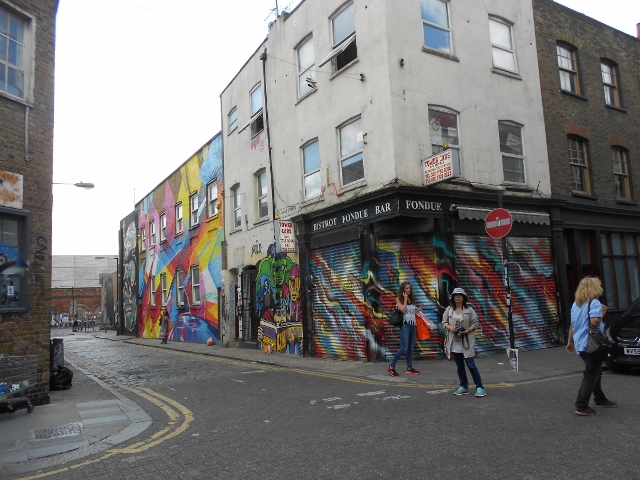
Coloured walls

…and for my part, that just adds some welcome colour to a day.

If you are in London and fancy a bit of urban art for yourself, check out Shoreditch Street Art Tours – Dave is obviously a guy ‘in the know’ and for just £15, it makes for a pretty cost-effective and entertaining education!
Play time

Since my visit Down Under for Christmas last year, I must confess to a renewed addiction for jigsaw puzzles. I’ve always loved them and a big part of family holidays when I was growing up was commandeering some large flat space, spreading out a thousand odd pieces and then hunching over them between sun-kissed beach sorties or for a whole day at a time if the rain was drumming a monsoonal metre on the roof.

But like most things in this day and age, jigsaws have moved on-line and I have developed a bit of a penchant for finding an hour or so to puzzle on my tablet.

I do love a puzzle. As a child travelling between parents and grandparents, a crossword/puzzle book was always tucked alongside my ‘book of the moment’ and these days, between a spot of Lumosity brain training or Words with Friends on my daily commute and a more leisurely pen-in-hand meander through The Times MindGames on a Saturday, it would really seem that puzzling has become the habit of a lifetime – well mine anyway.

This week, in scanning through some business reading at work, I came across another childhood habit that seems to be storming into the pantheon of grown-up amusements – colouring, or more specifically colouring books.

Euromonitor reports that sales of adult (no not THAT adult) colouring books are soaring and no longer content to dip into the annals of their offspring, grown-ups are looking for our own expression of creativity…and a little bit of stress-relief. The Secret Garden colouring book has sold more than 1.5 million copies and with the likes of Crayola, Bic, Faber-Castell and Staedtler coming to the party, Euromonitor postulates that this may become a phenomenon to rival the juggernaut that was – and is – Harry Potter.

And the nostalgic play trend doesn’t end there. Tonight, Channel 4 (UK) will feature a behind-the-scenes look at Lego. Yes those building blocks of childhood are every bit (see what I did there – every bit?) as ubiquitous today and one could argue that Lego’s position at the top of the toy-maker league table has been a result of an ability to extend their appeal beyond the young to the young-at-heart.

There are many studies and opinion pieces out there about the benefits of creative play for kids but as we get older, downtime like this is valued less and less (although one could argue that the absence of it in our lives makes us value it more – just consider how excited we get about going on holiday to ‘relax’ and ‘do nothing’).

But just as we might train physically to improve our muscles, puzzles and creative pursuits build different muscles, those of the brain. Brain training company Lumosity talks about its approach being grounded in neuroscience and more particularly neuroplasticity, explaining how the brain is ‘built’ to rely on previous patterns of behaviour (or neural pathways). Without challenging these patterns, our brain can lose its power to adapt.

I am no scientist but as we’ve already established, I do love a puzzle and luckily at the end of each of my commuting brain ‘trains’, there’s a little top scores list and an overall brain summary to chart my progress and offer any encouragement in improving the lower scoring areas.

One such example is that of spatial awareness. I maintain that Australia has so much space per person that the development of this ability in my early life was somewhat moot but in London I have developed a reputation for falling over (without the influence of alcohol) or pondering when exactly I bumped into something to produce an emerging ‘mystery bruise’.

Over the years I’ve done a lot of dancing and yoga which has helped this but indulging in a bit of sashay step or downward dog on the tube each day will probably raise a few eyebrows…and definitely tread on some toes. So Lumosity’s Penguin Pursuit continues to be my nemesis but as long as my scores improve, I will continue to work on it and enjoy the few minutes of fun that my three different games each day affords me on my commute.

So finding space to play, to ponder, to puzzle appears to be gaining momentum in a society seeking mindfulness and balance. And I think it’s a good thing. The watch out will be if it becomes a chore, another should in the long list of things we should be doing to have a happy and balanced life.

So let’s create, build, run amok, let loose and blow those cobwebs off our childhood…and just play.

Victorian vista – part two

A quick recap – I went to Seattle to visit my friend, we decided to nip up to Victoria (the one in Canada) on the clipper and spent our first afternoon wandering around Butchart Gardens and eating ice-cream. We then returned to our hotel for a little rest and reconnoitre while contemplating this view…

From the Inn at Laurel Point

We had a great dinner that evening at 10 Acres Bistro, a local bar and bistro where the menu is based on what’s available from the farm, the 10 acres of the name, on the Saanich Peninsula. The portions were huge and delicious and it was just as well we had a 20 minute stagger back to the hotel to help digest it all.

But this was just the beginning.

The morning dawned, cool and blue-skied and it was time to tackle our second culinary milestone: breakfast at Blue Fox Cafe.

Blue Fox Cafe

This had consistent rave reviews wherever we looked and we were not disappointed – it was fresh and scrumptious both in the decor and the dishes. We made our way through a couple of enormous plates (almost), picked at the fattest slab of French toast we’d ever seen (smothered with gorgeous local maple syrup of course) and chatted with a local couple at the next table who had been coming to the Blue Fox for years. (We found ourselves at the effect of many conversations with locals that started with ‘oh I just love your accent’ over the two days.)

This was by far the best meal of the trip (the others were fabulous so this is high praise indeed) and I would absolutely recommend you getting yourself there – apparently it’s crazy busy on the weekend but at 10.30-ish on a Wednesday morning, we only had a ten minute wait.

Absolutely stuffed, we headed back towards the harbour, stopping along the way to a) buy a loaf of the honey, apple and raisin bread to take home (it came with my omelette and we both fell in love with it – disappointingly we were informed that it was only made on Friday’s…sob!) and b) check out some of the local beauty services on offer.

Frilly Lily

Our next stop was the Royal BC Museum (or Royal Museum of British Colombia)…

Museum of BC

…where we spent a couple of hours wandering around the myriad of exhibits on Natural History…

woolly mammoth

…and Human History.

Native fashion

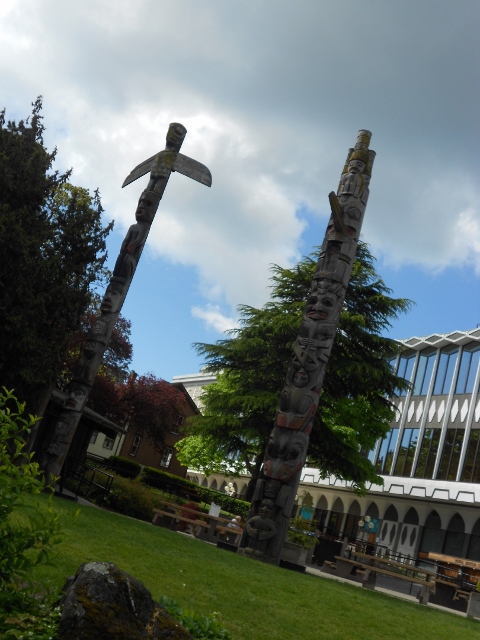
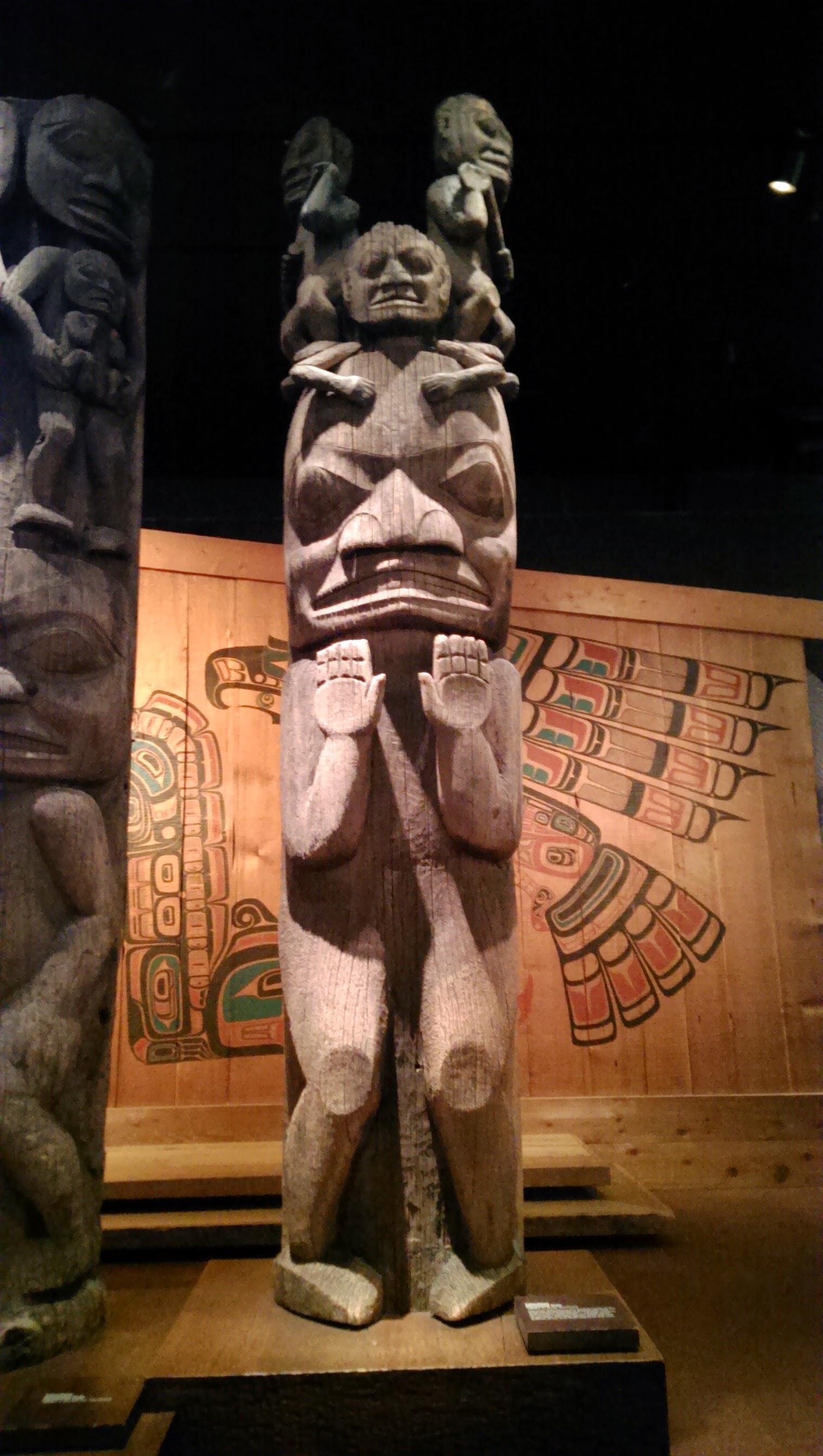
Totem

Human History

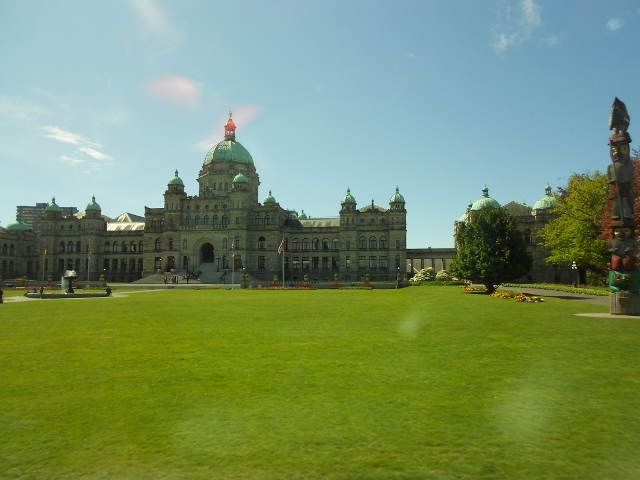
To coin a local turn of phrase, this was awesome. The exhibits were really interactive and atmospheric and it seemed that around every corner there was a new way to immerse ourselves/learn something. Since our return, a lot of people I’ve spoken to have a) admitted that they did not visit it and b) recommended the Legislature Building tour but we were both so thrilled with our visit that I haven’t yet felt that we should have spent either less time there or spent it somewhere else.

Next it was time for some general wandering to admire the sights.

Said Legislature Building…

The Empress overlooking the harbour. The most famous hotel in Victoria and advertised purveyor of excellent afternoon teas. We did not stop as we had other foodie pursuits in our sights.

The Empress

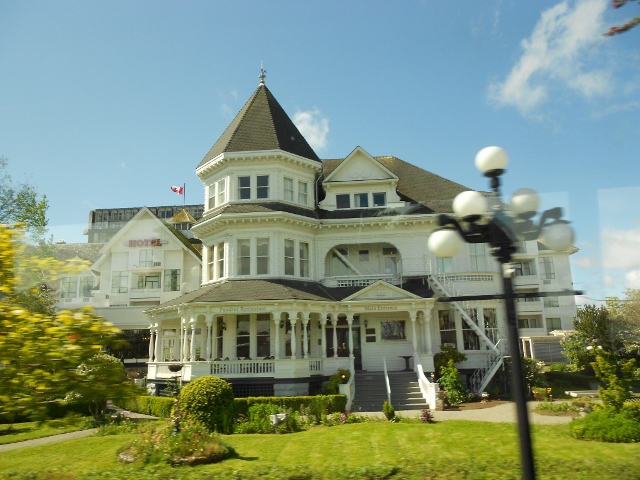
There was traditional architecture galore along the harbourside walk to our hotel – this guest house was my favourite.

Victorian architectureAlong the waterfront stands a statue of Captain James Cook – yes the same one that foundered on Endeavour Reef off the NE coast of Australia in 1770. Clearly not put off, Cook continued his explorations and in 1778, was looking for the entry to the North West Passage when he stumbled across Victoria Harbour. (This guy really got around.) It took another 65 years for the Hudson’s Bay Company to build their fort on this site in 1843.

This mini Empire State Building also stands on the waterfront but atop the Tourism Bureau…for the life of me I cannot remember its significance but the photo does confirm that we were blessed with gorgeously sunny almost-t-shirt weather.

A mini Empire State Buiding

We also indulged in a spot of shopping and added shoes, little dude apparel and for Seattle-A, a selection from local chocolatier of note, Rogers.

Chocoholics Heaven at Rogers

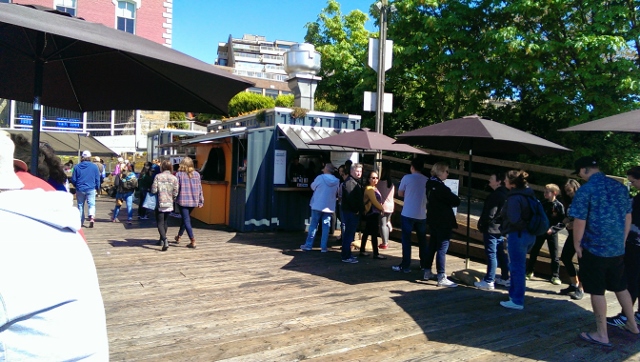
With the afternoon advancing, it was time to tackle foodie milestone number three, a spot of fish and chips at Red Fish Blue Fish (a spot of Dr Seuss always adds a little something to a day). At 3pm, the wait was about 25 minutes so Seattle-A held the line…

The lunch line at 3pm

…while yours truly snagged a couple of seats with a view.

Harbour view from lunch stop at Red Fish Blue Fish

Needless to say we made short work of things – falling-apart fish, lightly battered pickles (a Pacific North West specialty), crunchy golden chips – and washed it all down with a craft brewed ginger ale from Sparkmouth.

Post scrummy fish and chips carnage

So with our last supper under our belts, it was time to loosen things a notch, collect our bags from the hotel and head to the clipper terminal for the trip back to Seattle.

Time to go home

We had such a great time together, enjoying both the discovery of somewhere new and blazing a culinary trail together and in pulling together these two trip posts, I was reminded – somewhat appropriately – of this quote from Seuss’ One Fish Two Fish Red Fish Blue Fish which seemed to sum up our northern adventure…

Dr Seuss Today was fun.And that, my friends, was that!
————————————————————-

Helpful website if you are visiting:  http://www.tourismvictoria.com/

Things to do/restaurant sections were great reference points for us. That it all links through to Tripadvisor also means that you can see what people really thought and it was the Tripadvisor rating that drove us to choose the Royal BC Museum over everything else.