It’s Oh So Quiet…

It’s July. The schools are starting to close for the summer break and thousands of families are packing their bags for their annual holiday. Many flee to sun themselves and swim in warmer climes although the UK’s recent burst of gloriously sunny weather may have also inspired some vacation-ing closer to home.

At this time of year, an email is circulated at work, encouraging us to be safe and take care over the months ahead. There are the usual admonishments to drive safely, to stay vigilant outside our normal routines both in and out of the work environment. This year’s message really struck a chord for me.

The new captain jumped from the deck, fully dressed, and sprinted through the water. A former lifeguard, he kept his eyes on his victim as he headed straight for the couple swimming between their anchored sportfisher and the beach. “I think he thinks you’re drowning,” the husband said to his wife. They had been splashing each other and she had screamed but now they were just standing, neck-deep on the sand bar. “We’re fine, what is he doing?” she asked, a little annoyed. “We’re fine!” the husband yelled, waving him off, but his captain kept swimming hard. ”Move!” he barked as he sprinted between the stunned owners. Directly behind them, not ten feet away, their nine-year-old daughter was drowning. Safely above the surface in the arms of the captain, she burst into tears, “Daddy!”  Source: http://mariovittone.com/2010/05/154/

It would appear that drowning is not the waving, splashing, attention-getting event that we think it is. It is quiet, insidious and quick. It can happen in less than 60 seconds…while we watch.

Mario Vittone oversees the development of maritime safety and security products for VLinc Corporation and is a leading expert in drowning, sea survival and safety at sea. He consults and writes on water safety and in 2012, he published the article referred to above, painting a vivid picture of the risks we run as a result of our misconception about what drowning looks like.

In the 1970s, Dr. Francesco (Frank) Pia Ph.D discovered The Instinctive Drowning Response shown in the video below.


The misconceptions remain some 40 years later.

I grew up in a culture where swimming is taught if not in parallel with learning to walk, then at least as part of every primary school’s Phys.Ed. curriculum. And we learnt not just to swim but also to rescue and perform CPR as part of the higher swimming competency certificates in later years.

There is also a legacy of swimming in my family with my grandfather and uncle being swimming coaches and Mum swimming at State level for many years during her teens. Growing up we had pools in our various back yards and seaside holidays galore with many hours spent frolicking in the surf with Mum or Dad close by. My sister and I competed at swim meets both in and out of school and as I grew into adulthood, I spent many weekends with friends water-skiing and swimming in bays, rivers and lakes around Victoria.

Yet I carried the same misconception as many of you probably do. I never knew what drowning really looked like.

So with the Summer months gaining momentum in the northern hemisphere, it’s vital to get this message out there, to wave my virtual arms and make some noise on behalf of those who can’t.

Drowning is a quick and quiet killer and by knowing what to look for, you just never know whose life you might save.

So please share this post or any of the additional material below with as many people as you can. 

The life you save may even be yours.

———————————————–
Additional material:
Drowning doesn’t look like drowning
Instinctive Drowning Response – video
Mario Vittone Facebook page
On Scene p14. – It Doesn’t Look Like They’re Drowning
Midsummer Magic…

Today the Summer Solstice occurs and we in the Northern hemisphere will get our longest day of the year courtesy of the sun reaching its northernmost point in the sky. Stonehenge was awash with 37,000 worshippers at sunrise this morning and all manner of celebrations will take place throughout the world. 

Today also marks Midsummer in Sweden, a festival as important to the Swedes as Christmas is to me and mine. It’s a time of family and food, dancing and drinking and the Swedish contingent at work are pretty much out of contact during this holiday period.

Which brings me to a little Midsummer moment of my own, this week’s visit to Skanor med Falsterbo.


It’s actually my fourth visit to this lovely little part of Sweden. Our European division holds its mid-year sales meeting here, a nod to a time when the company (or part of it anyway) was Swedish and management would leave the conference to travel to their respective holiday homes in the area for Midsummer. In any case, it’s not your run-of-the-mill conference choice – and that’s a good thing.

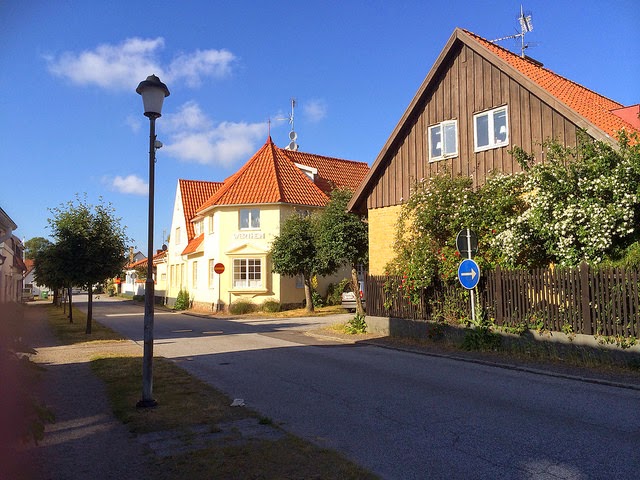
Skanor med (with) Falsterbo are twin medieval towns situated 28-30kms south of Malmo on the Falsterbo peninsula. It’s a quiet place with a population of less than 7,000 and the area is filled with quaint, wonderfully kept houses and surrounded by pristine beaches and glorious stretches of sea and sky. This year we were blessed with warm mid-20s temperatures and I found a little time to take a stroll to the beach and to soak up a bit of Midsummer magic…

Like a row of quirky sentinels, tiny beach huts line the foreshore. 


Unfortunately the magic of Midsummer was not quite enough to keep Australia from departing the FIFA World Cup…in spite of this, last week still found this little Aussie more than happy with her lot.

Welcoming The World…

In my last post, I took you on an armchair tour around my pre-work weekend in Rio de Janeiro, where I climbed mountains, strolled along the beach, ambled around the lagoon and sauntered through markets and gardens. And I must say that throughout the trip, I kept thinking to myself ‘I am in Rio. Who gets to live this kind of ridiculous (in a good way) and surreal life?’ Apparently that would be me.

Standing on Arpoador with Ipanema beach stretching away behind me.

But for all its easy amiability, there’s another side to Rio: More than a million of the city’s poor live in favelas, or shanty towns. Over 900 favelas perch on the hills around Rio, hundreds of delapidated shacks clustered amongst the green slopes rising from alongside Rio’s most affluent communities.

This is a view of Copacabana from the Arpoador Fort – you can see the favela lights stretching up into the hills to the left of the lamp post.

There has been significant investment to improve conditions and reduce violence and general crime since 1994 and I am told this continues in earnest as next month’s FIFA World Cup and more particularly, the 2016 Olympic Games will focus the world’s eye on the city. A police presence has been installed in a number of favelas and construction projects like the cable car system for the Complexo do Alemeao are being designed to facilitate workers’ ability to earn a living. The cable car has also made the favela itself something of a tourist attraction (although reports of occasional outbreaks of violence and drug trafficking was enough to deter me).

The favelas have attracted many artists. The towns themselves are well known for their brightly painted shacks and are popular subjects for local painters with dozens of colourful canvasses on display in local markets.

One of a myriad of favela art collections on sale at the Feira de Artes de Ipanema 

While I didn’t visit any favelas, they were easy enough to see, one of the largest climbing the hills behind Ipanema and Copacabana whilst the Complexo do Alemao and its cable car were clearly visible from the main road leading from Barra de Tijuca to the airport. I found myself bemused by this glamorous portrayal of Rio’s slums and I wondered how many tourists pay eagerly for their ‘authentic’ souvenir, oblivious to the abject poverty and danger that these people live with every day. I felt like the proceeds should somehow go towards further improving conditions in these communities.

In any case, most of the colleagues I spoke to would never dream of venturing into one of these areas yet were complimentary of programmes to improve conditions and safety. What was also interesting was their surprise at my catching a local bus service from Cosmo Velho (near the station whose train takes you up to Christ the Redeemer) back down to Ipanema on Saturday afternoon – surprised that I actually worked out how to manage this and pleased that I felt safe enough to do it. 

That’s the thing – I felt safe. Shoulder to shoulder with locals, the bus whizzed through suburb after suburb and I felt like I saw more of the ‘real’ Rio in that 40 minute trip. And despite the lack of English speaking amongst local storekeepers and waiters, everyone was friendly and willing to help – so with the aid of a very limited ‘Lonely Planet’ vocabulary and some pretty impressive (if I do say so myself) charades, I managed to feed, water and generally navigate myself around this great city…

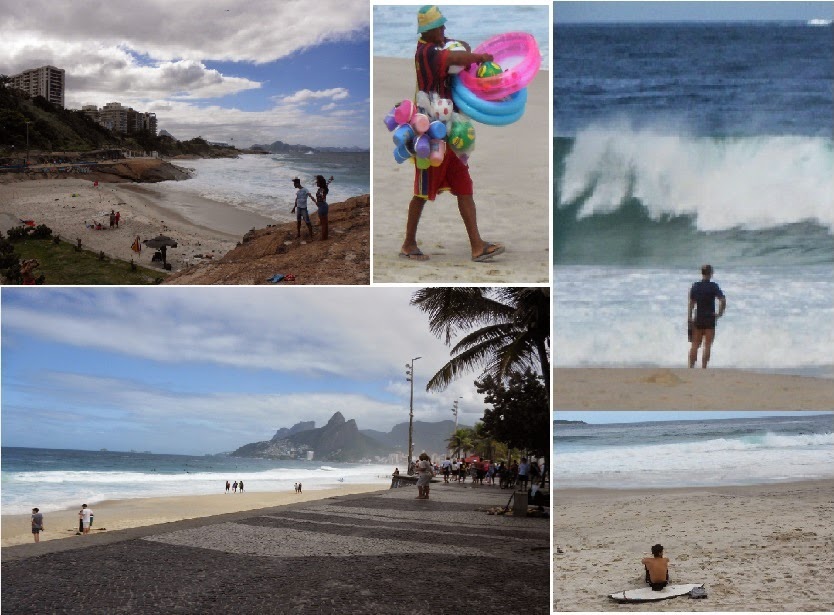
…walking along Ipanema Beach, I watched the cariocas (residents of Rio) play, at one with the sand and the sea…

Top left is Praia de Diabo (Devil’s Beach); the rest were taken on Ipanema Beach

…admiring the easy yet watchful opportunism of the local traders, whether on the beach, in the market or simply capitalising on a captive audience…

Clockwise from top left: opportunistic selling on the ride up Corcovado to Christ the Redeemer; bikinis for sale on Ipanema beach; one of the most popular drinks in Rio is coconut juice; a bit of carnival spirit at the Hippie Fair; local art on display; sarongs for sale.

…and ambling along tree-lined streets with their colourful apartment blocks, wondering who might live there.

Top row; Ipanema
Bottom row L to R: Leblon, Ipanema, Laranjeiras

Rio is a city tucked cosily around its mountainous surrounds and retains the easy intimacy of a cluster of villages rather than the hustle and bustle of a metropolis of more than 6 million people. It is surrounded by extraordinary natural beauty and spectacular scenery and the natives – or cariocas – are outdoorsy, easy-going and hugely welcoming. You might argue that I’ve only scratched the surface but I think the world will enjoy its first Olympic soujourn in South America.


Let’s hope that Rio will be able to put its best foot forward.

Memories of Nanjing

Memories are funny things aren’t they?

We gather so many millions and millions of them throughout our lives and somehow they all get stored away in our mind’s filing cabinet. Some things we want to remember – a couple of mine include standing awestruck in the empty chamber in one of Giza’s great pyramids or for something more mundane, just remembering the name of the person I met half an hour ago. Others we’d rather forget. Most retreat and end up buried beneath the constant and never-ending deluge of our life. Yet sometimes, like yesterday, they pop up when least expected.

Blogger (and published author) extraordinaire Linda Janssen writes Adventures in Expatland and I was over there yesterday checking out the latest piece in her Expats A to Z series, C is for Committed. The post was pretty much what I’ve come to expect from Linda’s writing: thoughtful, insightful and generous. But what I didn’t expect was the evocation of a memory so powerful, it took me right back to a summer’s evening in a Nanjing street almost nine years ago.

I had been in my own version of expatland for about 18 months. It had been a hard induction – initial expectations of money, home and job had fallen well short and my family and friends watched from afar – concerned, helpless and confused – as I struggled with both the practical and emotional minefield of building a new life. And whilst I knew deep down that here was where I was meant to be, there was another little voice in my head whispering, ‘What are you doing? Why are you doing this to yourself? You had a good life, it would be easier/far more sensible to give up and go back to Australia.’

At this point in time, I’d found myself in a job that promised so much and fairly quickly became a huge disappointment but I did get a couple of amazing opportunities to travel in the ten months I was there and one of these trips was to Asia.

I’d spent a week with our local rep visiting suppliers in Taiwan, China and Hong Kong. We’d managed a casual evening in Macau, another more digestively challenging evening as guests of a supplier in Shanghai, had visited villages and great cities and had been flown and driven around for six days. On the final day, we crossed the Yangtze River for our final supplier meeting and then spent the afternoon heading towards Nanjing in order to get on our respective flights home the following morning.

With the pressure of the week finally over, my colleague suggested a stroll through the city and a ‘local’ dinner so fortified by a drink at the hotel bar we set off. Nanjing was full of colour and life and my local took great care of me, showing me the sights and encouraging me to share several local dishes at a tightly packed restaurant filled with the curious clacketty-clack of Chinese chatter.

As we wandered back towards the hotel, I felt a whole world away from my troubles back in the UK.

We passed a few art and craft stalls and finally stopped where a small crowd had gathered. Drawing closer, I could see a young woman surrounded by rolls of bamboo parchment, an array of small ink pots before her: she was finger-painting these extraordinary Chinese scrolls and selling them for about £10. I stood and watched her for a while, fascinated by her complete immersion in her task, wanting to imprint the moment of simplicity, purity and happy endeavour firmly in my mind.

Eventually, I asked for one to be painted for me and as I looked on, a delicate picture of ebony branches with tiny bright red flowers came to life beneath her deft fingers. It was beautiful and I was so delighted at the prospect of taking this little piece of Nanjing home with me. But even more poignant was her explanation as she presented me with my finished scroll – the tree she had chosen to paint for me was one that slept and struggled through the cold dark months of winter and then would blossom in a vivid testament to its commitment to both survive and thrive in spite of the elements.

It hung on my wall in my tiny Kingston flat for six years before getting irreparably damaged during my move to Finchley. But Linda’s post yesterday brought it back to me, as vivid and delicate as the night it was created. And when I shared this story in response to her post, she asked me to share it with you.

I’ve built a life I absolutely love here in London and it feels like the seed that was planted ten years ago has finally blossomed. But I will never forget that moment in the dim light of a Nanjing street when, in fractured English, I was inspired by the recognition and acknowledgement of all my heart was feeling by a complete stranger.


Literary London…

For those of you who keep an eye on my literary forays – whether through The Book Nook or on Good Reads – you’ll know that my Year in Books has gotten off to somewhat of a prolific start. Having set my yearly target at 54 books (that’s one a week then bumped up to match last year’s tally), I am already reading #24. That’s right – three shy of the halfway mark and only 25% of the year gone. 

So I was walking up to North Finchley last week and noticed this street poster for CityRead London.


Intrigued I came home, googled and found out about this wonderful initiative.

Launched in 2012, CityRead London is an annual literary festival held in April each year which is designed to have us read a little something about London…together. Then throughout the month, the book is brought to life with literary events and talks in borough libraries all over the capital. This year it’s Louisa Young’s My Dear, I Wanted To Tell You, a love story set during the first World War. Released early in 2011, this book was short-listed for the Wellcome Prize, the Costa Novel Award and The National Book Awards that same year.

There has been a plethora of authors eager to showcase London and all of its charms over the centuries (think back to Charles Dickens in the 1800s who actually wrote part of Martin Chuzzlewit just up the road here in Finchley). So the choice must have been a challenging one with so much to choose from but for all its accolades, I had not heard of Young or this particular book.

I love reading about this wonderful city: its history, its place in the modern world or simply as a backdrop to a cracking story. One of my very favourite books of the last few years is John Lanchester’s Capital so with all of this London literary love in mind, I have Amazon One-Click-ed Young’s war tale to Audrey‘s lovely e-pages. 

What an inspired and clever way to promote reading (and to get me to download yet another book to my kindle this week).

Bean Reminiscing…

I was travelling to Pilsen with a colleague this week and having only met before very briefly, we took the opportunity to chat en route…in the taxi, on the Heathrow Express, in the airport lounge. You get the picture…lots of finding ways to make the time go faster while getting to where we had to be. 

Anyway, we were chatting about my living in the UK and the invariable questions came up: Why did you leave? Will you go back? and What do you miss most?  Nothing unusual.

But this time the last question really made me think. What do I miss most?

It goes without saying family, family, family. And usually at this time of year, I would have answered something about really feeling the lack of sunshine and daylight hours during London’s winter months. But we’ve had a mild winter which in the last few weeks, has merged into a lovely Spring – beautiful blue skies, double digit (celsius) high temperatures and patches of colour everywhere as London’s parks, gardens and suburban streets are transformed by a riot of daffodils, crocuses and cherry blossoms.

And I’ve just come back from my Vitamin-D top up in Abu Dhabi so I’m missing the sunshine much less than usual.

So the question gave me pause. What do I really miss?

And then I thought back to my last trip Down Under and I knew…the coffee. Great, great coffee. Creamy lattes, foaming cappuccinos and pungent espressos with velvet-y golden crema.

I have not enjoyed coffee anywhere nearly as much as I have in Melbourne. Not even in Italy, the self-proclaimed mecca of coffee.

And it would seem that the voters on website booking.com agree, with 301 of them nominating Melbourne as having the best coffee in the world (followed by Vienna – 187 and Rome – 116).

It’s not the first time I’ve waxed lyrical about coffee here at Gidday from the UK and I have found a treasured favourite or two serving sensational shots here in London but there’s no hunting for these rare gems in Melbourne – great coffee is everywhere.


So I’ll be booking myself a Christmas Down Under this year to get me a fix!

Oh and Sydney? Sydney got 20 votes in the survey. Not that I’m competitive or anything.

My backyard…B is for Brixton

Having returned from playing away in Abu Dhabi for a week, it was time to play a little closer to home again so this morning I was up and on the way to Brixton for another ‘backyard’ walking tour. 

Brixton is in South London and being most notable for the Brixton Riots in 1981, it’s an area of London that it’s fair to say has been somewhat tainted by its turbulent past. But the area is also one of those ‘up-and-coming’ parts of London as home buyers seeking lower property prices move outwards from the city while still remaining in commuting range. In fact it’s one of the things that surprised me today – how near Brixton is to central London. (I thought it was much further out!) 

Anyway our small group met at the Ritzy Cinema at 11am and headed down Coldharbour Lane to the frontline of the 1981 Riots at the intersection of Atlantic Avenue.


After a bit of background on the Riots from our guide Angela, we continued down Coldharbour Lane a little further to see Nuclear DawnThis extraordinary mural was painted by Brian Barnes and finished in 1981. It features a large skeleton swathed in the flags of nations who had nuclear weapons at the time and paints a grimly powerful portrait of politics and the Cold War during the late 70s/early 80s. 


Turning away from the mural, we faced Southwyck House – also known as Brixton’s Barrier Block – an unusual building featuring the Brutalist architectural style common of the period in which it was built. 


The Barrier Block has played a controversial role in Brixton’s history. The other side of the building features large windows and balconies and has been home to one of the world’s most famous artists, Damien Hirst. Ex Prime Minister John Major lived briefly in Brixton and his support for the demolition of the block later in his career was more than a little undermined by the fact his Planning Committee had approved its construction. Oops!

Our next stop was Brixton Village, a series of markets accessed through an entrance across Coldharbour Lane from the Nuclear Dawn mural. Fascinatingly enough, our short dash across the road was peppered with more art from the locals…

French street artist Space Invader leaves his mark at the corner of Coldharbour Lane and Atlantic Avenue.
Bee (top left) can be found at the intersection of Coldharbour Lane and Atlantic Avenue as can the image bottom right. The image top right was right near Nuclear Dawn and ‘B Our Guest’ adorns the railway bridge over Brixton Hill.
Lucy’ Casson’s Foxes and Cherries sculpture (top left) adorns the roof on the corner of Electric Lane and Electric Avenue; bottom left – collaborative mural near the intersection of Atlantic Avenue and Coldharbour Lane; right – an homage to Brixton-born David Bowie (or David Robert Jones as he was christened) painted by Australian street artist James Cochrane.

Brixton Village was traditionally a food market where the local Caribbean community would buy fresh produce, particularly specialities like ackee, plantain, yams and salt fish.

On our little tour, I got a bit of an education about Caribbean cuisine, also finding flying fish (top left) – which I saw flying several years ago on a trip to Tobago – and breadfruit (bottom left). The biggest surprise came when I was introduced to chow chow, which I knew as choko growing up in Australia! We also laughed at the ubiquity of Milo (a malted chocolate powder that we add to big glasses of milk) in both the Caribbean and Australia – how strange that such similarities exist between islands so far away from each other.

The produce stalls are far fewer and the markets have been taken over by restaurants and cafes. It was fairly quiet as we walked through but you could just imagine the little lanes buzzing with the energy and chatter of lunchtime or after work crowds.

Clockwise from top left: Traditional Caribbean fare from Fish, Wings and Tings; enjoy a tipple and nibble at Champagne and Fromage; tuck in to morsels from the sea at Etta’s Seafood Kitchen; beat the crowds for a cuppa at Federation Cafe, graced in the past by none other than Hollywood star, Will Smith.

Emerging from the markets it was a short walk down to Electric Avenue – yes the one made famous by the Eddy Grant song.

Electric Avenue, so named as it was the first market street to receive electric lighting. Bottom left: Healthy Eaters’ delivery vehicles feature the names of prominent locals.

Further down Electric Avenue, we found Brixton Speaks an installation on the wall of the Iceland store. Created by author Will Self, Brixton Speaks pays homage to the unique Caribbean patois of the area. Click here for a much better photo! This was also the site where a nail-bomb exploded in 1999 injuring 39 people.

Turning right onto Brixton Hill we walked under the railway bridges to visit our next point of interest, the Ricky Bishop Memorial TreeRicky Bishop was taken into police custody in 2001 and was later admitted to hospital with unexplained injuries. The tree serves as a poignant reminder of the still-fractious relationship between the community and the local police.

We crossed over Brixton Hill and spent about 20 minutes away from the cacophony of the high street.

Left: emergiing from Stockwell Avenue between the twin buildings of Bon Marche, London’s first purpose built department store; top right: the Grade II listed Brixton Academy which started life as the Astoria Theatre in 1929; bottom right: Trinity House on Acre Lane, Georgian architecture preserved since 1822.
Life in a leafy Brixton Square: a two bedroom (top right) will set you back at least £750,000 but you can always drown your sorrows at the Trinity Arms (bottom right).

With that we headed out onto Acre Lane and wandered back to the Ritzy Cinema. 

Nursing my hot chocolate on the tube ride home, I felt like I’d barely scratched the surface of this colourful neighbourhood, so different from my own yet discovering so many unexpected similarities in our cultures. And I mused once again at how utterly fascinating this big backyard of mine called London truly is.

Ma’a salama…

My week in Abu Dhabi is at an end and in just a few short hours I’ll be jetting back to London. My carry on bag is just waiting to be closed and I’m making the most of still having my room tonight (even though I won’t be sleeping in it) to tap out an end-of-holiday post – my goodbye to Abu Dhabi.


I sat on the restaurant terrace earlier tonight, Apple Martini in hand and desert sunset before me marvelling at how much there had been to enjoy this week despite not venturing very far afield. (I’ve limited my daily excursions to breakfast – beach – sunset with cocktail – dinner and lots of lovely reading in between.) Yet every day has been different with something new to notice, to admire, to hear, to read (the count is four and a half books – although that may be five by the time I arrive home – and two magazines)…and to drink.

Whether this could be counted as a Gidday Armchair Tour I am not so sure but in any case here’s a little homage to my time in Abu Dhabi for your enjoyment.

It was an Apple Martini tonight but there have been both a Long Island Iced Tea and a Singapore Sling in the mix too.
The view from room 703 at The Traders on morning number one – I couldn’t wait to get down to that private beach…
...and it was front and centre (with a bit of shade) for a whole six days.

During my morning meanderings I found a few interesting things to admire/marvel at…

The Sheikh Zayed Grand Mosque (didn’t visit but a lovely view!) – the several-times-daily call to prayer was hauntingly beautiful.
A shisha shack…reminded me of the hookah-smoking caterpillar in Alice in Wonderland.
A rockin’ sound system… (okay sorry about that)
…and a quirky rescue point.
And speaking of admire, what’s a beach holiday without a few sunsets…
The locals were welcoming everywhere I went but I just loved this ghost-like image in the doorway of the hotel lobby…

And last but not least, just to prove I was really there, a footprint in the sand (and clever advertising that has really left it’s mark)…

So all there is left to do is log off, close my case, pay the bill and bid Abu Dhabi a fond farewell. Hope you’ve enjoyed it vicariously even a smidgen as much as I did being here.

Ma’a salama!

Little Things…

Yesterday I got on plane (yes another one) and headed south east for a week of wallowing in Abu Dhabi.

Abu where (or why) many of you may be saying.

Abu Dhabi is the capital of the United Arab Emirates, a tiny country near the tip of the Arabian peninsula overlooking the Persian Gulf. It is a little under 8 hours flight time away from London and as to what I’m doing here, at this time of year day time temperatures average between 28-30C, I am in serious need of some sunbeams and there was a ripper of a deal.

So enough of the background. Let’s get to the point of my story.

I arrived last night at around 9pm and after making my way though the cacophony of the terminal and spending more than an hour shuffling with the rest of the queue through passport control, I found my ‘pre-booked transfer’ man and was duly on my way to the hotel in the lovely leather back seat of a white Audi. With a driver that sensed I was too tired to chat.

A little thing, but nonetheless appreciated.

My room is lovely and spacious – on the 7th floor overlooking the lights (at night) and the white sands of the private beach (during the day). The Traders Hotel, Qaryat Al Beri is a 4 star hotel and yet there is a robe, slippers, a gigantic bed with an assortment of pillows and a fully equipped bathroom: when I say fully equipped I mean not just the requisite toilet and basin but also a bidet, a big bath and a separate shower (not a shower over a bath).

I also found two complimentary bottles of water on the bedside table – these are rarely complimentary or offered (versus being asked for) in multiples – and there are both English (3-prong) and European (2-pin) plugs in the room. 

A further 3 bottles of water have been left in my room today. Oh and the wi-fi is everywhere, fast and completely free.

Such small attentive details create such lovely looked-after moments, don’t they?

After the haunting sounds of the Muslim call to prayer echoed across the hazy dawn sky this morning, it was off to explore the breakfast buffet and not only did I have a delicious, freshly cooked omelet but there was also turkey bacon. Yes turkey bacon – these things are of great significance when you don’t eat red meat. I do have turkey bacon at home but have not seen it anywhere on my travels so this was such a rare and happy find.

A post-breakfast stroll along the paved and scrupulously tidy boardwalk took me past several of the Shangri-La residences in the complex, the marina and into the souk. I’ll wander in the other direction tomorrow – apparently there’s a day spa nearby.

And then it was time to hit the beach. Free water (another 2 bottles) in a little esky was duly delivered along with 2 big towels to my sunlounger of choice. A further and even larger towel was wrapped over the mattress with the offer to replace this later in the afternoon. And I was about 10 steps away from a cooling, salty swim.

Little things people, it takes such little things to make me happy. 

I can hear the wailing call to prayer as I sit here wrapped in my borrowed robe typing away. The lights are appearing in the dark night sky and with Day 1 under my belt, I’m already feeling loose-limbed, sunkissed and deliciously relaxed. 

As-salamu alaykum (السلام عليكم) is the traditional Arabic greeting here and while it is used as ‘hello’, it actually translates as ‘peace be upon you’.  And I can confirm peeps that yes, peace is definitely what is happening up here on the 7th floor.

I can see nothing for it but to repeat the whole luscious process tomorrow.

Ma’a ssalama…
(See you soon…)