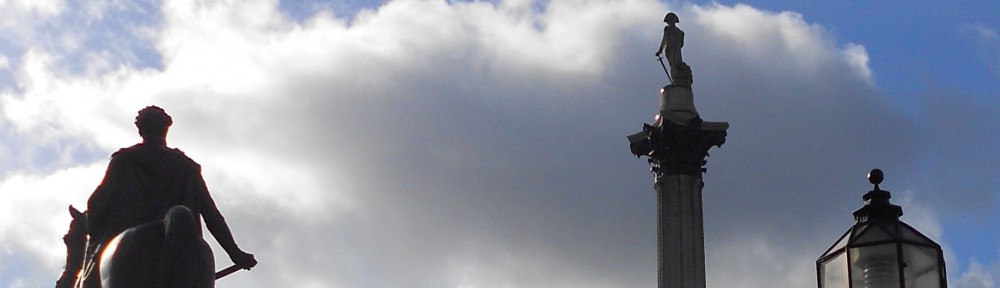
January’s bucket list

I’m not one for New Year’s resolutions. My resolve tends to scatter across the year and is generally underpinned by my penchant for exploration and variety. However I do love moments, snatches of time when I am completely caught up – and sometimes out – by intense feeling, largely a mixture of delight, wonder, melancholy, outrage and curiosity. I carry this image of a bucket in my mind and I often imagine putting a particular moment into it. Somehow they all combine into a life that inspires me.

I was checking something in my calendar earlier and it occurred to me that while I share about particular experiences, I don’t often reflect on all of the things I’ve done. Fellow blogger, author and longtime Gidday follower Jack Scott commented recently “you do get about” so I thought that it would be interesting – for me anyway – to end each month this year by checking out what’s ended up ‘in the bucket’.

So here goes.

This month it all started with a new chapter in an old story and I absolutely loved Star Wars: The Force Awakens. I then moved into a Kenneth Brannagh double bill: All On Her Own, a maudlin 25 minute 3-stars-from-me soliloquy, and the hilarious 4-stars-from-me farce, Harlequinade.

A trip back in time with the Museum of London and a tour of an old Roman fort inspired my historic sensibilities so much that the Museum became a new Friend. Five days later I joined hundreds of women at the Central Methodist Hall in Westminster to listen to the Women’s Equality Party and left non-plussed and suprisingly uninspired: lots of valid and important messages but the whole thing was a bit ‘rah rah’ for me.

A decidedly French tone emerged in the second half of the month with the NY MET’s performance of Bizet’s opera The Pearl Fishers and the National Theatre’s production of Les Liaisons Dangereuses (Dangerous Liaisons) being live streamed at the Phoenix Cinema just a ten minute bus ride away. When I was raving about the latter in the office the next day, I was informed by a young French colleague that the book continues to be part of the literature curriculum in French schools and is considered “a classic”. By the way, both productions were ‘magnifique’.

I’ve also read six books this month and rated three of them a mighty 5-stars, an excellent 50% hit rate. March Violets by Philip Kerr and A Town Like Alice by Nevil Shute were my first dip into these respective writers and my return to Stephen King (and introduction to his criminal mastermind Mr Mercedes) was the recommendation of another Gidday follower, author Charlie Wade. (Thanks Charlie!)

In between all of this I embarked on some new cooking adventures with a foray into pastry (albeit frozen) as well as ‘cooking with beetroot’ and I managed catch up dinners with three different friends, one long overdue.

I also inadvertently fell across London’s Lumiere Festival on the face of the Abbey…

IMAG4146

…and delighted in the lighter mornings on my walk to work.
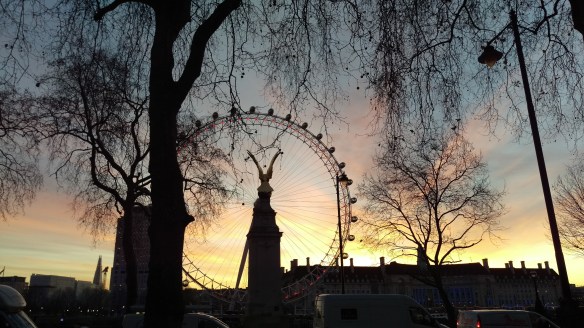
IMAG4130

Speaking of commuting, this gem really lifted my tube ride home one night.
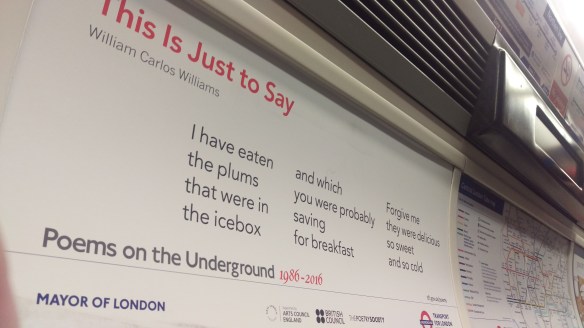
IMAG4157

It also snowed…

IMAG4150

…and I celebrated twelve years in London.

So Jack was right and January was full to the brim with moments that were both planned and completely surprising. (And that’s doesn’t include what happens in my job.)

In any case, I’ve quite enjoyed this retrospective approach to bucket list-ing and am curious to see what reflecting on February might bring.

What would a look back at your January moments yield?
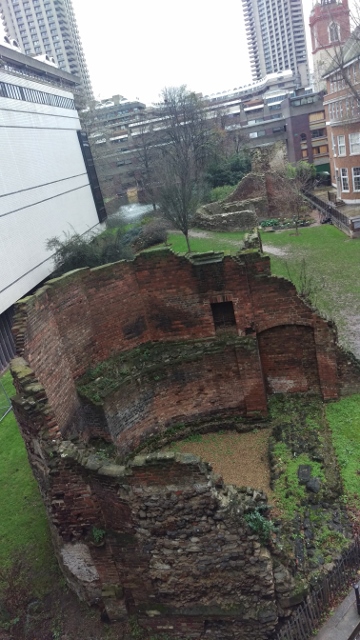
The wall

Last September I ventured below London’s bustling surface to visit the site of a 4th century Roman bath and house. Back then the Museum of London were opening these archaeological sites as a trial to see if there as enough interest from the public in  getting up close and somewhat personal with London’s history.

There are now a whole raft of opportunities listed on the museum’s website so it would appear that the answer was yes.

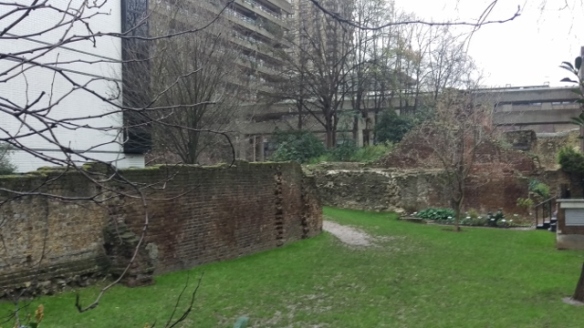
Yesterday I spent an hour visiting another site from Roman London, the ruins of the fort lying underneath the busy city street of London Wall that runs outside the museum itself. I had seen this view from Bastion High Walk on previous museum visits…

IMAG4091 (360x640)

IMAG4095 (640x360)

…but had never dreamed that there was any more to see. After spending an hour with Museum of London guide Mike, I was proved wrong.

Here’s what happened.

We started up on Bastion High Walk just near the museum entrance with an overview of the site. This is Mike…IMAG4093 (360x640)

…and here are a couple of pictures from our handout. The left-hand picture shows the fort at the top left within the wall surrounding the City of London. The right-hand picture is the layout of the fort itself – the area we explored is in the middle of the outside left wall.

We headed down the stairs and along the slip road to examine things more closely. I love how these old sites are tucked in between London’s more modern buildings. IMAG4096 (640x360)

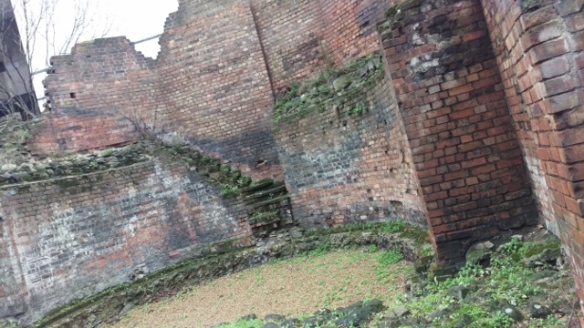
Up close we could see more of the detail – the soot blackened walls, the wear on the steps from the boots of the soldiers.IMAG4097 (640x360)

Mike pointed out this line of Kentish ragstone running along the front. This is the oldest part of the structure dating from the 4th century AD.
IMAG4099 (640x360)

Can you see the two parts of the ragstone wall? The lighter-coloured part at the front would have been built first with the darker grey section added afterwards for additional fortification.

The rest of the site dates from about the 14th century when, in typical London fashion, new buildings were simply built over the top of what was already there, the previous city being abandoned at the beginning of the 5th century. I wonder what will be built on top of us?

We then headed through a non-descript door next to the London Wall car park to visit the fort remains that are kept under ‘lock and key’ by the museum. Here’s a model of what this site – the West Gate of the Roman fort – would have looked like in its ‘hey-day’.

IMAG4104 (640x320)

Mike explained that this gate was probably more administrative than military. Gates around the wall – Bishopsgate, Cripplegate, Aldgate to name a few – aside from being defensive usually served as revenue-raisers, collecting taxes from those passing through. That this gate was un-named suggests it was less likely to support such functions.

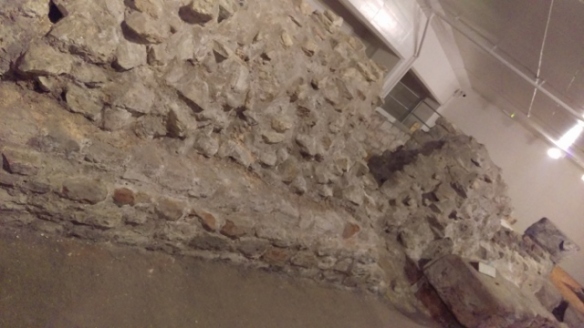
Here are a couple of photos of the site discovered by William Grimes in 1956.

IMAG4102 (640x360)

North turret and guard room.

IMAG4105 (360x640)

The north gate

The area we visited covered only the left-hand section of model I showed previously – the guardroom and north turret, and the north gate – from the 14th century. Mike spent about 15 minutes helping us visualise the way the site would have looked, pointing out various details which archaeologists have used as the basis of their assumptions about life at the fort hundreds of years ago.

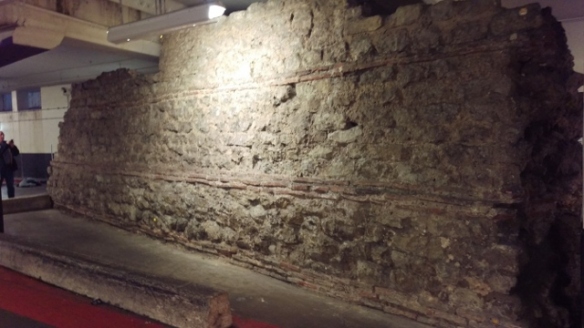
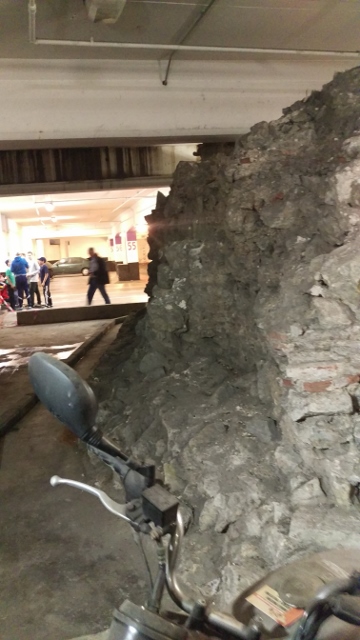
The official tour drew to a close after about 40 minutes but there was more to come. Mike mentioned that there was a piece of 4th century wall in the public car park next door that we could take a look at. I envisaged something quite small but after a brisk 10 minute walk, I was absolutely astonished to see this.

IMAG4116 (640x360)

The detail was extraordinary. You can see in the photo how the wall has been constructed for strength, stepping inwards with each row of levelling tiles (these tiles are the red lines you can see). You can also see the difference between the dressed stone on the outside and the rougher packed stone behind it.

IMAG4114 (640x360)

IMAG4113 (360x640)

In London, archaeological sites are the responsibility of the land owner. Rather than being owned (and looked after) by the Museum of London, the car park is owned by the Corporation of London. It is a public space and so this historic site is at the mercy of exhaust fumes, human hands and unsympathetic modern additions.

I was really delighted to be able to see such an amazing piece of history up close (although at Mike’s request, we did not touch it – after all it is 1600 years old). But I felt irritated by its casual treatment.

A group of young skateboarders were gathered right next to it and several times I saw them lean on the wall, with some actually running into the wall itself. Granted they probably don’t understand the historical importance of this pile of stones or even if they do, appreciate it. When I think about my fascination with history, I realise that I’ve become more awestruck and humbled by it – in equal meaures – over the years. This is probably a result of my own ‘maturing’ in combination with moving to London from Australia (with its relatively shallow roots in European history) over a decade ago.

However, there was no excuse for the rubbish strewn around it by car park users and seeing the steel girder that had been inserted left me both sad and horrified.

To this end, I posted…okay, had a little rant on Instagram as I was reflecting over a post-tour coffee back at the museum. Paying for the tour itself (£5 is pretty amazing value given the expertise people like Mike provide), buying a book at the museum shop afterwards and even my new Friend membership feels like a tiny drop in an enormous ocean. Hopefully as I continue to explore what the museum offers, I will find more ways to support their work.

In the meantime, all I can think to do is to encourage you to visit these extraordinary sites – if not in London then wherever you are – to reflect on the history of humanity, how our society has evolved and perhaps consider how the story of our time might appear to the future generations.

Cruising London: Photo tour

Last Saturday I spent a leisurely three hours on the Museum of London‘s Frost Fairs cruise along the River Thames.

Frost Fairs are a rare occurrence in the pages of London’s history. They were held when a combination of winter-y elements meant that the River Thames froze over and created a lot of excitement for Londoners. Our Museum of London host told us that the earliest Frost Fair was likely to have occurred in 1114-1115 between Westminster and London Bridges when all sorts of activities  – shopping, drinking and eating, and games like skittles and ice-skating – were at the disposal of those who dared to venture out onto the river’s icy surface.

But it was a double-edged sword as while many entrepreneurs and well-to-do celebrated this rarity, a third of Londoners depended on the river for their livelihood and so were left destitute when they could no longer ply their many trades.

The last Frost Fair occurred in 1814-1815: Once the old London Bridge was demolished and the new bridge – constructed by John Rennie and opening in 1831 – was in place, a more free-flowing river was created, giving little opportunity for ice to “dam up”.

London Bridge (640x333)

Cruising under Rennie’s London Bridge

So last weekend I made my way along the embankment to Westminster Pier, boarded the Pride of London and took my place on the upper deck. It was one of those grey London days – not as pretty as a crisp blue-sky day but it did lend something quite atmospheric to the usual view. Here’s a little photo tour of my time on board.

Big Ben vs Boudicca

Boudicca vs Big Ben – looking up from Westminster Pier gives you this great perspective.

Blackfriars Bridge (640x360)

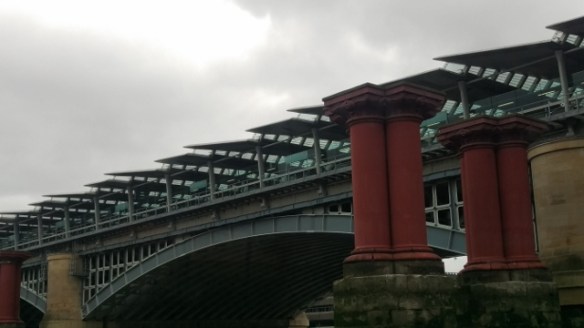
Blackfriars Bridge – trains stopping at Blackfriars Station actually stop on the bridge.

Tower Bridge (360x640)

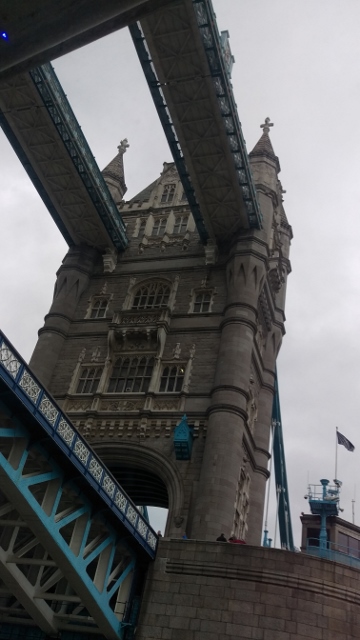
No Thames cruise photo tour would be complete without a shot of Tower Bridge

Thames-side houses 1 (640x360)

I loved this row of old bankside houses – the two building to the left of the row stand like sentries at the entrance to one of the many channels that branch off the river.

O2 Arena (640x360)

The cruise took us all way downstream to the Isle of Dogs and the Greenwich Peninsula, the latter being home to the Millenium Dome (or as it’s now known, the O2 Arena). It does look like some sort of alien ship has landed.

Greenwich 1

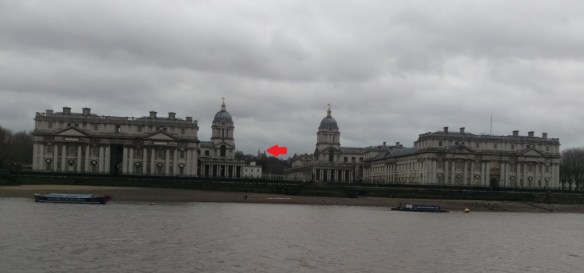
This is the Royal Naval College in Greenwich – you can see the Royal Observatory in the background (which by the way is a great place to visit.)

Cutty Sark (640x358)

And this is the famous Cutty Sark, just a hop step and jump away from the Naval College

Along the route back, the daylight had started to fade and I spent most of the time just watching the bank glide by, the wake from the various river craft creating foamy ripples along the shore. Before long, we were cruising past the modern shapes of London’s City Hall and The Shard…

City Hall etc (640x359)

London’s City Hall is the curved building on the left and look how the tiny white-lit Christmas tree mirrors The Shard that overshadows it.

…and London’s lights glowed in the dusk as we continued to cruise back towards Westminster.

IMAG3907 (640x360)

Southwark Bridge

IMAG3916 (640x360)

The London Eye

Victoria Tower, Westminste Palace (640x360)

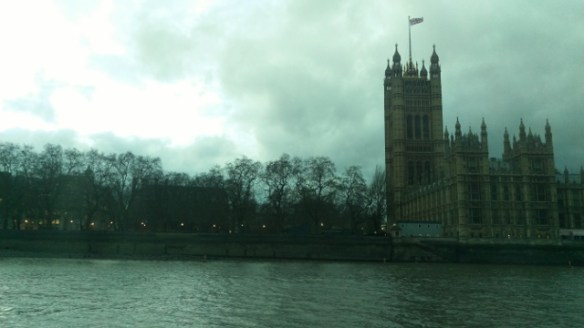
Passing under Westminster Bridge gave me this atmospheric view of the Houses of Parliament’s Victoria Tower

Soon it was a quick under and back again with Westminster Bridge, a gentle drift towards Westminster Pier and with my head full of what I’d seen and heard, I disembarked and headed home.

I am a big fan of the events put on by the Museum of London and this was such a great way to spend a few grey and blustery hours on a Saturday afternoon. So I hope you enjoyed this little photo tour a fraction as much as I enjoyed for real.

Around The Globe…

You know I love London. And you know I love a walking tour. So you may not be surprised that last Sunday I was up and out early-ish to join one. 

This is my third walking tour with Blue Badge guide Paula Cooze, the first being a wander through the City in Shardlake’s Shoes last September and the second exploring the City’s architecture from the Barbican to Bishopsgate in January this year. This time there was a wander around the globe to look forward to…Shakespeare’s Globe that is…so I trundled tube-style down to London Bridge Station and ambled over to our meeting point at the theatre. This is what followed…

You are right. This is not the Globe theatre but it’s right outside The Anchor pub on the river bank. As I was waiting for the appointed start time to approach, I found myself quite taken by this quaint, quasi-seaside scene with The Shard looming in the background.

This is the Globe theatre built in 1997 after the first was destroyed by fire in 1613 and the second pulled down in 1644 (after being shut down by the Puritans in 1642). 


It is said to be a faithful reproduction of the original – while no plans were ever available to study, local archaeological sites have revealed clues which have been used to make this version as authentic as possible.  

This is the original site of the theatre: Old Theatre Court in Park Street, about 230m away from the current replica. You can pay close to £2,000/month to live in a 71 square metre, one bedroom apartment here.


Speaking of money, the rebuilding of Shakespeare’s Globe would not have been possible without Sam Wanamaker, an American actor and director who set up the Shakespeare Globe Trust in 1970 to rebuild the theatre. The contributions of those who made this possible are celebrated in the paving stones in the theatre courtyard whilst the candlelit theatre that opened next door last year – the Sam Wanamaker Playhouse – honours the man himself.

Clockwise from top left:  Prunella Scales (Sybil Fawlty in Fawlty Towers); Nigel Hawthorne (Sir Humphrey Appleby in Yes Minister); Zoe Wanamaker (My Family, Harry Potter and the Sorcerer’s Stone and Agatha Christie Poirot series as Ariadne Oliver)

Our next stop was the former site of the Anchor Brewery further along Park Street.


Built in 1616 by James Monger, the brewery grew to be the largest in the world in the early nineteenth century. After a succession of owners and a merge with Courage in 1955, the brewery itself was pulled down in 1981 to be be replaced by council estate housing (top right). 

The Anchor Tavern (bottom right) still stands in its Bankside location nearby and history marks this site as having had a public house on it for 800 years. Aside from some reputedly excellent fish and chips, it has played host to Tom Cruise and Ving Rhames in the closing scenes of the movie, Mission Impossible.  And if you turn around and look across the river, you’ll see just why Samuel Pepys wrote of sitting at ‘this alehouse’ watching the great fire of London…

The golden orb of the Monument stands amidst the geometry of the modern city. Laying the column down brings the tip to the site of the bakery in Pudding Lane where the Great Fire of London began in 1666.

Around the corner and though the arch we walked to stop outside The Clink.

Left – Clink Prison Museum;
Right – a Dickensian view from the corner of Redcross Way and Park St.

The Clink was a notorious prison in London and operated from twelfth century through to 1780. It was part of the estate of the Bishop of Winchester (you can see the remains of his palace a little further down the lane) and originally housed prisoners who held views opposing those of the clergy. Profiteering was rife amongst the wardens who sold food and ‘better’ lodgings to those who would pay and to facilitate this industry, prisoners were released to beg during the day and earn ‘their keep’ at night. It later became a debtors prison – thus the reference to Dickens’ tale of Little Dorrit above. It is now the site of The Clink Prison Museum so you can still pay for the privilege of a visit.

At the end of Clink Street, past the remains of Winchester Palace, stands the replica of Frances Drake’s Golden Hinde.


I have blogged about both the palace and the ship before so if you’d like some Gidday witterings on these, you can click here. What I really want to share with you is the legend of Mary Overie (Mary over the river).

Long before there were any bridges to get you across the Thames, ferryman John Overs made his fortune by monopolising the shipment of cargo and people from river bank to river bank. Being incredibly tight-fisted, he had refused to pay the dowry for his daughter Mary to be married to the man she loved. In fact he decided that if he pretended to be dead for the day, his family and servants would mourn and their fasting would save him the cost of food. Wrapped in a burial shroud and lying silently in a coffin, he was dismayed to find that instead of going to plan, his servants were delighted by his demise and celebrated by unlocking and helping themselves to the pantry. Finally he could lie still no more and arose ready to admonish his staff – but one such servant, thinking him to be a ghost, struck him over the head with an oar and killed him.

Mary wrote to her beloved that they were free to marry but tragedy struck when his horse stumbled and threw him en route to her, killing him. Mary refused all other offers and instead formed the priory of St Mary Overie where she lived until her death. 

Always something new for me to learn on Paula’s tours.

Anyway, on to the next stop just around the corner – Southwark Cathedral.


Some have placed the foundations of the building as far back as 606 but the more commonly held view is that it has been in existence since the conversion of Wessex in 886. The site has undergone many iterations over the centuries with the photo to the right showing the different levels of pavements and thoroughfares (as well as a coffin). Southwark Cathedral was even named in the Domesday Book of 1086. 

We dived into Borough market next, ghostly quiet without the hustle and bustle of its Wednesday-to-Saturday trading. 

As we emerged from the labyrinth of empty stalls, we came across yet another famous Globe but from the modern era.

This is, in fact, the window of Bridget Jones, (yes she of the diary) from which she peers out into the snowy night in the final scenes of the film to see Mark Darcy striding away. Yes it’s true. The movie was on a few days after this walk so I checked it out for myself.

Leaving the market behind us, we walked down Southwark Street past the Hops Exchange…


…and crossed into Redcross Way to our next stop, the Crossbones Graveyard.

This site started out as a medieval burial ground for the area’s prostitutes and by the 18th century had become a paupers’ graveyard which was then closed in 1853. There were excavations on this site during the 1990s, carried out as part of the extensions to the Jubilee Underground line which unearthed the bones of the dead in 148 graves. The local community in campaigning to create a permanent memorial garden, continues to add to the poignant memorial created along the fence and holds a memorial vigil at the gates at dusk on the 23rd of each month.

Turning back we crossed back over Southwark Street and rejoined Park Street, coming to our penultimate stop…


This plaque shows two draymen beating Julius Jacob von Haynau, an Austrian general who was well-known for his brutality in suppressing insurrection. This particular incident happened following several narrow escapes of mob violence when von Haynau was High Command of Hungary, with the two men setting upon him during his visit to the Barclay and Perkins Brewery (previously the Anchor brewery). Let’s just say that the protagonists were very much lauded for their ‘chivalric’ pursuit of justice in the realm.

And then we wandered around the corner to find ourselves back at The Anchor and the end of our tour. It was such an interesting two hours, full of fun stories and historical titbits that, despite having explored this area before, I did not know about – and you know how I like discovering London like this. The really amazing thing is that when I look back on where we walked, it wasn’t a large area and I was left in awe of how historically rich this city is. 


So if this inspires you and you’d like to know more, visit Paula’s website –www.crossingthecity.co.uk – and find out where next she might take us.

But I have first ‘dibs’ okay?

My backyard…B is for Brixton

Having returned from playing away in Abu Dhabi for a week, it was time to play a little closer to home again so this morning I was up and on the way to Brixton for another ‘backyard’ walking tour. 

Brixton is in South London and being most notable for the Brixton Riots in 1981, it’s an area of London that it’s fair to say has been somewhat tainted by its turbulent past. But the area is also one of those ‘up-and-coming’ parts of London as home buyers seeking lower property prices move outwards from the city while still remaining in commuting range. In fact it’s one of the things that surprised me today – how near Brixton is to central London. (I thought it was much further out!) 

Anyway our small group met at the Ritzy Cinema at 11am and headed down Coldharbour Lane to the frontline of the 1981 Riots at the intersection of Atlantic Avenue.


After a bit of background on the Riots from our guide Angela, we continued down Coldharbour Lane a little further to see Nuclear DawnThis extraordinary mural was painted by Brian Barnes and finished in 1981. It features a large skeleton swathed in the flags of nations who had nuclear weapons at the time and paints a grimly powerful portrait of politics and the Cold War during the late 70s/early 80s. 


Turning away from the mural, we faced Southwyck House – also known as Brixton’s Barrier Block – an unusual building featuring the Brutalist architectural style common of the period in which it was built. 


The Barrier Block has played a controversial role in Brixton’s history. The other side of the building features large windows and balconies and has been home to one of the world’s most famous artists, Damien Hirst. Ex Prime Minister John Major lived briefly in Brixton and his support for the demolition of the block later in his career was more than a little undermined by the fact his Planning Committee had approved its construction. Oops!

Our next stop was Brixton Village, a series of markets accessed through an entrance across Coldharbour Lane from the Nuclear Dawn mural. Fascinatingly enough, our short dash across the road was peppered with more art from the locals…

French street artist Space Invader leaves his mark at the corner of Coldharbour Lane and Atlantic Avenue.
Bee (top left) can be found at the intersection of Coldharbour Lane and Atlantic Avenue as can the image bottom right. The image top right was right near Nuclear Dawn and ‘B Our Guest’ adorns the railway bridge over Brixton Hill.
Lucy’ Casson’s Foxes and Cherries sculpture (top left) adorns the roof on the corner of Electric Lane and Electric Avenue; bottom left – collaborative mural near the intersection of Atlantic Avenue and Coldharbour Lane; right – an homage to Brixton-born David Bowie (or David Robert Jones as he was christened) painted by Australian street artist James Cochrane.

Brixton Village was traditionally a food market where the local Caribbean community would buy fresh produce, particularly specialities like ackee, plantain, yams and salt fish.

On our little tour, I got a bit of an education about Caribbean cuisine, also finding flying fish (top left) – which I saw flying several years ago on a trip to Tobago – and breadfruit (bottom left). The biggest surprise came when I was introduced to chow chow, which I knew as choko growing up in Australia! We also laughed at the ubiquity of Milo (a malted chocolate powder that we add to big glasses of milk) in both the Caribbean and Australia – how strange that such similarities exist between islands so far away from each other.

The produce stalls are far fewer and the markets have been taken over by restaurants and cafes. It was fairly quiet as we walked through but you could just imagine the little lanes buzzing with the energy and chatter of lunchtime or after work crowds.

Clockwise from top left: Traditional Caribbean fare from Fish, Wings and Tings; enjoy a tipple and nibble at Champagne and Fromage; tuck in to morsels from the sea at Etta’s Seafood Kitchen; beat the crowds for a cuppa at Federation Cafe, graced in the past by none other than Hollywood star, Will Smith.

Emerging from the markets it was a short walk down to Electric Avenue – yes the one made famous by the Eddy Grant song.

Electric Avenue, so named as it was the first market street to receive electric lighting. Bottom left: Healthy Eaters’ delivery vehicles feature the names of prominent locals.

Further down Electric Avenue, we found Brixton Speaks an installation on the wall of the Iceland store. Created by author Will Self, Brixton Speaks pays homage to the unique Caribbean patois of the area. Click here for a much better photo! This was also the site where a nail-bomb exploded in 1999 injuring 39 people.

Turning right onto Brixton Hill we walked under the railway bridges to visit our next point of interest, the Ricky Bishop Memorial TreeRicky Bishop was taken into police custody in 2001 and was later admitted to hospital with unexplained injuries. The tree serves as a poignant reminder of the still-fractious relationship between the community and the local police.

We crossed over Brixton Hill and spent about 20 minutes away from the cacophony of the high street.

Left: emergiing from Stockwell Avenue between the twin buildings of Bon Marche, London’s first purpose built department store; top right: the Grade II listed Brixton Academy which started life as the Astoria Theatre in 1929; bottom right: Trinity House on Acre Lane, Georgian architecture preserved since 1822.
Life in a leafy Brixton Square: a two bedroom (top right) will set you back at least £750,000 but you can always drown your sorrows at the Trinity Arms (bottom right).

With that we headed out onto Acre Lane and wandered back to the Ritzy Cinema. 

Nursing my hot chocolate on the tube ride home, I felt like I’d barely scratched the surface of this colourful neighbourhood, so different from my own yet discovering so many unexpected similarities in our cultures. And I mused once again at how utterly fascinating this big backyard of mine called London truly is.

My Backyard… Building Blocks

Today I was reading an interesting piece on Fevered Mutterings on what constitutes ‘travel’ and the premise that we tend to think about the packing of a suitcase, backpack or even overnight bag as an activity inextricably linked to travelling. 

When I think of travel, I think of going from point A to point B (which is the definition that comes to my mind given the Transport for London website exhorts me to ‘travel by foot’ for a portion of most of my journeys) but this is not a vision that will keep me going in the depths of winter darkness. Thank goodness Mike Sowden suggested that redefining travelling as ‘venturing somewhere new’ means it is right under our noses – that ‘travel *is* our own backyard’.

And last Sunday it was my own ‘backyard’ that I ventured out into to have a gander around Old London Town. I’m not sure that under normal circumstances, I would be up for an architecturally themed stroll on a wintery Sunday morning but I enjoyed Blue Badge Guide Paula’s trek around Shardlake’s London so much last September that it was an easy and enthusiastic ‘yes’ when the flyer came through for her guided walk through Post-War City Architecture

So we started at Barbican tube station and followed Paula – and her post-war story – through the City of London. Here’s what we saw…

Standing outside Barbican station on a crisp January morning

Following the bombing raid on London on 29th December 1940, much of Greater London was flattened. But contrary to wider plans, the City took its own view of its rebuilding and commissioned architects Chamberlin, Powell and Bon to create urban villages for the working class…


The Golden Lane Estate was originally positioned outside the City boundaries until ‘re-zoning’ brought it into the fold – perhaps that explains why a 2 bedroom apartment here goes for around £680,000.
…and the more affluent inhabitants of the City.
The Barbican Estate was opened in 1969 (that makes it as old as me) and stretches over a 40 acre site. It contains more than 2,000 flats, of which a 2 bedroom version will set you back about £900,000. Oh and check out the upside looking windows top right.

We then ambled around the back of the Museum of London, took a quick peek at the Pedway System (a scheme based on raised pedestrian walkways which never really took hold) then crossed London Wall to Wood Street.

Traditional building blocks adorn the home of the City’s Police Force (yes, a separate force from that of Greater London). Standing with your back against the wall will give you a great view of the tower reflected in the building opposite.
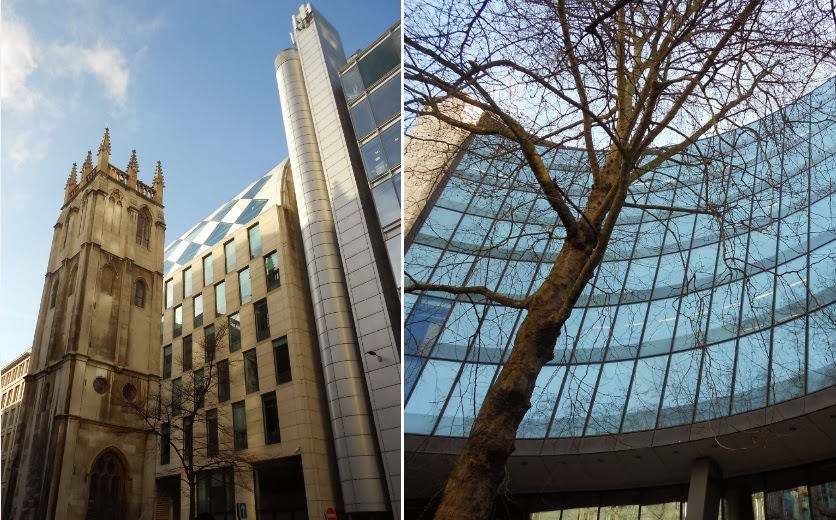
The tower of St Alban stands in the centre of the street in stark contrast to the architecture around it and here the Norman Foster designed 100 Wood Street forms a geometric backdrop to Christopher Wren’s deft touch. But walk through its checkerboard frontage and you’ll find a veritable oasis. Soaring windows angled outwards bring light into the old churchyard and provide space for the old plane tree’s leafy boughs.
Next it was a trot down Gutter Lane to emerge on Cheapside – crossing the road, we found ourselves standing in One New Change with this rather spectacular view…
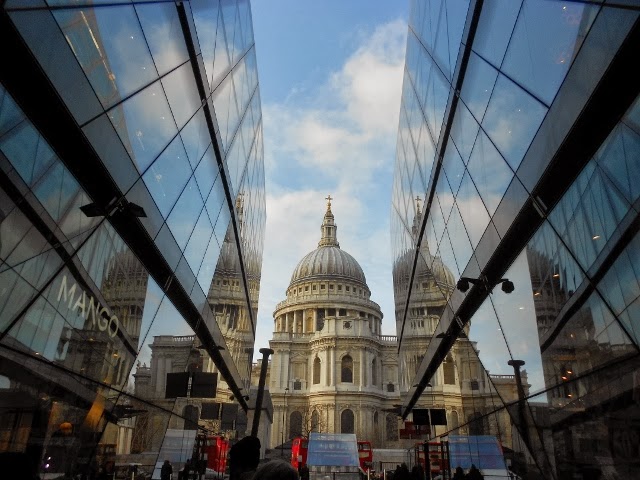
The dome of St Paul’s pierces the sky right opposite One New Change. Thirteen ‘views’ of the cathedral are protected by the London View Management Framework which prevents the construction of any buildings which may impinge on the view. There’s even a protected view from Richmond Park’s King Henry’s Mound several miles away.

We headed out of One New Change and down to Bank Junction where the architectural contrasts abounded again.


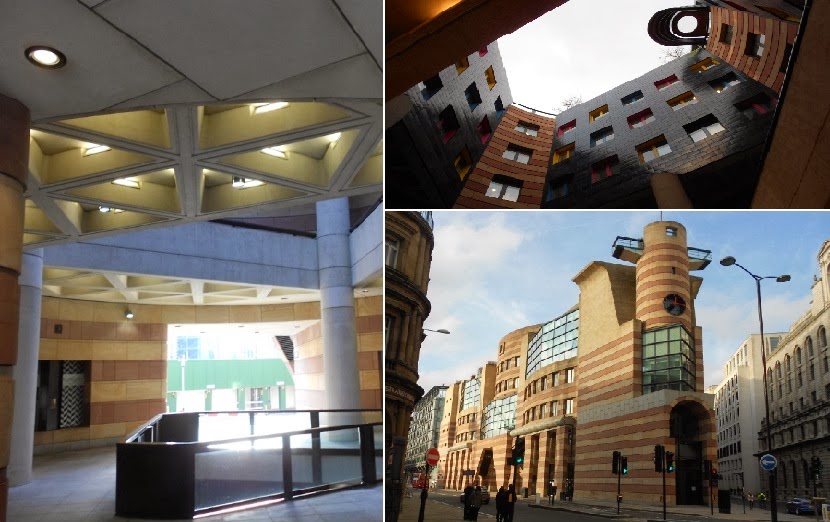
This is No 1 Poultry: the street, like those around it (Milk Street, Bread Street) named after the market produce originally sold here. The building, designed by James Stirling for Peter Palumbo, carves a ship-like post modern silhouette against the sky and has caused much outcry from those – including Prince Charles – whose more conservative sensibilities it offends.
Turning from the post-modernist perspective, we found more traditional architecture clustered around the junction with the Royal Exchange (top left) and the Bank of England (bottom left) dominating the view.

We headed up Cornhill, our guide Paula setting a brisk pace…

The Leadenhall Building (the ‘Cheesegrater’) looms above the stone buildings along Cornhill while St Michael’s doors (right) are tucked a few neat steps back from the street.

…and came to a stop on the corner of Leadenhall Street and St Mary Axe, finding ourselves both surrounded and dwarfed by edifices of steel and glass…

The famous Lloyd’s of London ‘inside out’ building (right) was designed by Richard Rogers (who also designed the Pompidou Centre in Paris with Renzo Piano) on the site of both the previous Lloyd’s building and before that, East India House. The construction style (called Bowellism) is notable for having its interiors – stairwells (spirals), restrooms – the boxes behind the piping which contain electrical and water conduits –  and air conditioning ducts easily accessible to ensure that building never need close due to any malfunction of its ‘essential’ services. This 1986 building was Grade I listed in 2011 much to the chagrin of Lloyd’s (the listing means that the building cannot be changed in any way) so the insurance company’s ‘overflow’ will be moved right across the road to…
…the Cheesegrater (official name The Leadenhall Building). Situated at 122 Leadenhall Street, this building is nearing completion and is expected to open in Spring this year.

And not to be outdone, just a stone’s throw away stands The Gherkin.

The Gherkin‘s official name is the Swiss Re Building – or that’s what previous owners Swiss Re insisted on. Another Norman Foster design and completed in 2003, 30 St Mary Axe was built on the site of the former Baltic Exchange which was damaged in a Provisional IRA bombing in 1992. I thought it seemed rather fitting that The Cheesegrater is within arms reach of The Gherkin…

And with that, it was a short walk to Bishopsgate and the end of our tour. Almost 3 hours (including what Paula likes to call a ‘warming coffee break’ at the Costa Coffee halfway point).

I strolled back towards Moorgate tube station filled with excitement at what a dynamic and fascinating city I live in. The time had flown by and I was so glad that I had dragged myself out of bed and braved the chill to explore this amazing ‘backyard’ of mine. I kept gazing around, wondering about the stories of the buildings that loomed over me and as I reached the intersection of London Wall and Moorgate again, I couldn’t help but take just one last parting shot.


The old and the new right next to each other again.

I don’t know their story. But I am sure it’s fascinating.

The Information Super Highway…

I’m reading a book by Niall Ferguson called Empire: How Britain Made The Modern World. It’s a fascinating read and already – I am just under halfway through – we’ve explored piracy, banking and borrowing (a system borrowed from the Dutch no less), colonisation and slavery. And we’ve even been to deepest darkest Africa for one of the most famous salutations in history, “Dr Livingstone, I presume“. 

The latest chapter covers the Victorian Empire and I’ve just finished reading about India and Queen Victoria’s increased interest in foreign affairs following the Indian Mutiny in 1857. What is interesting about this particular time in history is that the ‘world’ is shrinking. The far reaches of the imperial fold are becoming more accessible with steam power and advances in iron being used to industrialise the empire. Travelling by steamer is reducing journey times and technology is driving industry and commerce to the point where consumerism is no longer restricted to the ruling classes.

In our modern day lives, the world is literally at our fingertips with news from across the globe available in a matter of minutes. But did you ever think about where it all started?

Francis Ronalds offered his idea of the telegraph to the Navy in 1816. The Admiralty turned it down and it took the private sector to see – and develop – its possibilities for overland communication. However, it wasn’t until the adoption of a rubber-like substance from Malaya called gutta-percha that durable undersea cables could be manufactured, opening up the potential of Ronalds’ brainchild to expansion on a global scale.

And so it was that in 1851 the first cross-channel cable was laid with the first transatlantic cable to follow in 1866. By 1880 over 97,000 miles of cable criss-crossed the world, joining continent with continent and creating the world’s first global communications network.

So as we log on, read emails, surf for news and opinions and tap-tap-tap away to cast our particular version of word-smithery out into the digital ether, let’s give a nod to the acquisitive ambition of the British Empire.

And to the miracle of gutta-percha…

…the original information super highway.