Having Reservations…

Yesterday I went out with some friends of mine to see a show followed by some drinks and dinner. 

We had a great time. Handbagged was witty, topical and a lot of fun and with a few drinks under our belts (there may have been three grapefruit Cosmopolitans involved…for me), we expected that dinner at American-eatery-in-Soho, Jackson and Rye, would contribute some worthy state-side vittels to finish off our evening. 

And the verdict? My inaugural grits (a kind of polenta porridge) were weird, pleasant-ish but not right with shrimps, my sea bass with apple and fennel slaw was light and lovely and the pecan pie was mmm…mmm scrumptious!

But I digress. You see, Jackson and Rye don’t take reservations which is a pet peeve of mine. And I am coming across this situation in London with greater and greater frequency. 

A catch-up dinner with a friend at no-bookings Italian ‘tapas’ joint Polpo last year was planned around being there just before 7pm to ensure we got a table rather than when we were actually hungry or what was convenient for us. And looking for somewhere to eat after the theatre with Lil Chicky last October was fraught with queue after queue.


(We eventually found a table at Tuttons right on Covent Garden which was lovely…and for future reference, book-able.)

I remember when Jamie Oliver opened his sans booking restaurant chain Jamie’s Italian in 2008 and we thought we’d head down to the one in Kingston to give it a try. We queued outside – no room inside for waiting – for a barely acceptable 15 minutes. I’ve been to Jamie’s Italian once since when we were lucky to have only a five minute wait. 

To say I was put off is putting it mildly. I accept that if I haven’t booked then I have to take what I can get but this we-don’t-take-bookings nonsense is all getting a bit much for me. I don’t want to have to trawl Soho post-show because of this growing ‘no booking’ policy. What ever happened to looking after the customer? Couldn’t they at least allow some tables to be booked, leaving some free for these apparently all-important walk-ins?

Polpo’s website offers an explanation of sorts, saying that their casual Venetian ‘bacaros‘ are designed to encourage the locals to pop in for a bite to eat and to build a sense of community amongst their regulars. There are 3 Polpos and 1 Polpetto in Central London, none of which take bookings. Who are these ‘locals’ I wonder?

In any case it would appear these places are doing rather well and that the standing in line has become a badge of honour – after all, if you’ve queued (or waited in the bar) for at least an hour, the food had better be rave-worthy, or at least good enough for you to tell everyone about. I don’t know about you but after an hour, my palate becomes a little less discerning, swamped by a-drink-(or two)-while-I-waited or the sounds of my stomach growling with hunger…or both.

Luckily last night’s drinks were at one of our favourite drinking holes, the Freedom Bar, just two doors down from Jackson and Rye so The Umpire kindly did a recce before we gave up our pre-dinner perch. And the meal was delicious.

But if I’m really honest, I have my reservations as to how long I really would have waited for it.

Literary London…

For those of you who keep an eye on my literary forays – whether through The Book Nook or on Good Reads – you’ll know that my Year in Books has gotten off to somewhat of a prolific start. Having set my yearly target at 54 books (that’s one a week then bumped up to match last year’s tally), I am already reading #24. That’s right – three shy of the halfway mark and only 25% of the year gone. 

So I was walking up to North Finchley last week and noticed this street poster for CityRead London.


Intrigued I came home, googled and found out about this wonderful initiative.

Launched in 2012, CityRead London is an annual literary festival held in April each year which is designed to have us read a little something about London…together. Then throughout the month, the book is brought to life with literary events and talks in borough libraries all over the capital. This year it’s Louisa Young’s My Dear, I Wanted To Tell You, a love story set during the first World War. Released early in 2011, this book was short-listed for the Wellcome Prize, the Costa Novel Award and The National Book Awards that same year.

There has been a plethora of authors eager to showcase London and all of its charms over the centuries (think back to Charles Dickens in the 1800s who actually wrote part of Martin Chuzzlewit just up the road here in Finchley). So the choice must have been a challenging one with so much to choose from but for all its accolades, I had not heard of Young or this particular book.

I love reading about this wonderful city: its history, its place in the modern world or simply as a backdrop to a cracking story. One of my very favourite books of the last few years is John Lanchester’s Capital so with all of this London literary love in mind, I have Amazon One-Click-ed Young’s war tale to Audrey‘s lovely e-pages. 

What an inspired and clever way to promote reading (and to get me to download yet another book to my kindle this week).

My backyard…B is for Brixton

Having returned from playing away in Abu Dhabi for a week, it was time to play a little closer to home again so this morning I was up and on the way to Brixton for another ‘backyard’ walking tour. 

Brixton is in South London and being most notable for the Brixton Riots in 1981, it’s an area of London that it’s fair to say has been somewhat tainted by its turbulent past. But the area is also one of those ‘up-and-coming’ parts of London as home buyers seeking lower property prices move outwards from the city while still remaining in commuting range. In fact it’s one of the things that surprised me today – how near Brixton is to central London. (I thought it was much further out!) 

Anyway our small group met at the Ritzy Cinema at 11am and headed down Coldharbour Lane to the frontline of the 1981 Riots at the intersection of Atlantic Avenue.


After a bit of background on the Riots from our guide Angela, we continued down Coldharbour Lane a little further to see Nuclear DawnThis extraordinary mural was painted by Brian Barnes and finished in 1981. It features a large skeleton swathed in the flags of nations who had nuclear weapons at the time and paints a grimly powerful portrait of politics and the Cold War during the late 70s/early 80s. 


Turning away from the mural, we faced Southwyck House – also known as Brixton’s Barrier Block – an unusual building featuring the Brutalist architectural style common of the period in which it was built. 


The Barrier Block has played a controversial role in Brixton’s history. The other side of the building features large windows and balconies and has been home to one of the world’s most famous artists, Damien Hirst. Ex Prime Minister John Major lived briefly in Brixton and his support for the demolition of the block later in his career was more than a little undermined by the fact his Planning Committee had approved its construction. Oops!

Our next stop was Brixton Village, a series of markets accessed through an entrance across Coldharbour Lane from the Nuclear Dawn mural. Fascinatingly enough, our short dash across the road was peppered with more art from the locals…

French street artist Space Invader leaves his mark at the corner of Coldharbour Lane and Atlantic Avenue.
Bee (top left) can be found at the intersection of Coldharbour Lane and Atlantic Avenue as can the image bottom right. The image top right was right near Nuclear Dawn and ‘B Our Guest’ adorns the railway bridge over Brixton Hill.
Lucy’ Casson’s Foxes and Cherries sculpture (top left) adorns the roof on the corner of Electric Lane and Electric Avenue; bottom left – collaborative mural near the intersection of Atlantic Avenue and Coldharbour Lane; right – an homage to Brixton-born David Bowie (or David Robert Jones as he was christened) painted by Australian street artist James Cochrane.

Brixton Village was traditionally a food market where the local Caribbean community would buy fresh produce, particularly specialities like ackee, plantain, yams and salt fish.

On our little tour, I got a bit of an education about Caribbean cuisine, also finding flying fish (top left) – which I saw flying several years ago on a trip to Tobago – and breadfruit (bottom left). The biggest surprise came when I was introduced to chow chow, which I knew as choko growing up in Australia! We also laughed at the ubiquity of Milo (a malted chocolate powder that we add to big glasses of milk) in both the Caribbean and Australia – how strange that such similarities exist between islands so far away from each other.

The produce stalls are far fewer and the markets have been taken over by restaurants and cafes. It was fairly quiet as we walked through but you could just imagine the little lanes buzzing with the energy and chatter of lunchtime or after work crowds.

Clockwise from top left: Traditional Caribbean fare from Fish, Wings and Tings; enjoy a tipple and nibble at Champagne and Fromage; tuck in to morsels from the sea at Etta’s Seafood Kitchen; beat the crowds for a cuppa at Federation Cafe, graced in the past by none other than Hollywood star, Will Smith.

Emerging from the markets it was a short walk down to Electric Avenue – yes the one made famous by the Eddy Grant song.

Electric Avenue, so named as it was the first market street to receive electric lighting. Bottom left: Healthy Eaters’ delivery vehicles feature the names of prominent locals.

Further down Electric Avenue, we found Brixton Speaks an installation on the wall of the Iceland store. Created by author Will Self, Brixton Speaks pays homage to the unique Caribbean patois of the area. Click here for a much better photo! This was also the site where a nail-bomb exploded in 1999 injuring 39 people.

Turning right onto Brixton Hill we walked under the railway bridges to visit our next point of interest, the Ricky Bishop Memorial TreeRicky Bishop was taken into police custody in 2001 and was later admitted to hospital with unexplained injuries. The tree serves as a poignant reminder of the still-fractious relationship between the community and the local police.

We crossed over Brixton Hill and spent about 20 minutes away from the cacophony of the high street.

Left: emergiing from Stockwell Avenue between the twin buildings of Bon Marche, London’s first purpose built department store; top right: the Grade II listed Brixton Academy which started life as the Astoria Theatre in 1929; bottom right: Trinity House on Acre Lane, Georgian architecture preserved since 1822.
Life in a leafy Brixton Square: a two bedroom (top right) will set you back at least £750,000 but you can always drown your sorrows at the Trinity Arms (bottom right).

With that we headed out onto Acre Lane and wandered back to the Ritzy Cinema. 

Nursing my hot chocolate on the tube ride home, I felt like I’d barely scratched the surface of this colourful neighbourhood, so different from my own yet discovering so many unexpected similarities in our cultures. And I mused once again at how utterly fascinating this big backyard of mine called London truly is.

Water water everywhere

It’s the first of March and Spring has sprung. In the last week, our mild winter has melded softly into more blue sky days and some double digit temperatures. Bunches of green pointed leaves have broken through the soil and the anticipation of bright bursts of yellow daffodils lies hopefully in parks and gardens. It would appear that unusually, the heralding of Spring has corresponded with its calendar counterpart.

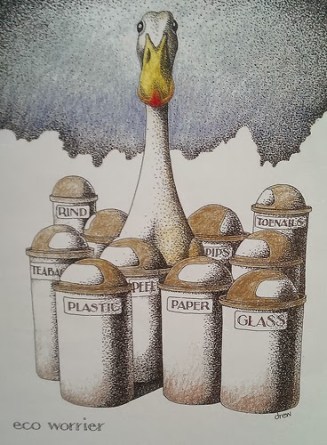
It’s come after months of storms and torrential rain which has put something of a dampener on the start of 2014 for many in the UK. And waging a watery war with this, one of the harbingers of climate change, brings us to this month’s Calendar Challenge from Simon DrewI was reading an article about the impact on rising sea levels this week. A report from the Institute of Mechanical Engineers released five years ago suggests that areas like London and the Norfolk Broads could be consigned to a watery grave if society’s impact on the environment continues unchecked. Images source: http://www.carbonmanagers.com

Ecologically speaking, one could argue that this small island nation has good reason to worry.  And yet on the other hand, a large – or certainly larger than it should be – proportion of the world’s population has no access to water.

A recent campaign by Water Aid UK shows a young girl walking more than two hours to draw ‘life-giving’ water from a muddy pool, dirty water that could kill her or her family. How often each day do we simply turn on the tap – to fill the kettle, brush our teeth or even take a drink of cool, clear, safe water?  Even with all of our efforts at limiting water waste, we live in our Western ‘bubble’ where having no access to a flushing toilet or a morning shower occurs not as a part of everyday life but rather as a short term immersive ‘experience’ in the realms of adventure travel.

So this year, I’ve started donating to Water Aid UK – as little as £10 per month is enough to fund a well to reach clean water far underground.

There are a myriad of ways to contribute more to the world we live in and this is my small step into this battle alongside the elements. But every journey starts by putting one foot in front of the other and along with my monetary contributions, I’m also hoping that tuning my environmental antenna to such a cause will lead to more opportunities to educate myself and understand how I can make a difference.

Oh and I’ve also resolved to stop grumbling about the rain.


Calendar Challenge 2014 – Back Catalogue

Keep calm and carry on

Sour grapes


Commuting Gems…Private Eyes

I have been travelling again this week and with today being first day back in the office, I felt too tired to do my regular walk back up to Charing Cross station, choosing instead to duck into Westminster tube and change at Monument station for the right coloured line to get me home.

Day-dreaming about the event free weekend ahead of me, I wandered onto the platform at Bank station – it’s connected with the aforesaid Monument station via a short walk underground – and stood in my regular place, the one that means I get off at the right spot on my destination platform for an expeditious exit ahead of the hordes.

Checking the overhead screen to my left, I was pleased to note I had only two minutes to wait so I turned back to face patiently forward (boy I am getting ‘British!’) and found myself rewarded with a couple of commuting gems…


Commuting just got a whole lot more interesting. 

Shame I don’t subscribe to Sky really…

Sour grapes

It’s the 1st of February. Where did January go for heavens sake? It’s only just begun and the year is already whizzing by.

As promised, with the heralding of the new month comes the next instalment of the 2014 Calendar Challenge and February’s funny finds inspiration in the language of our childhood…

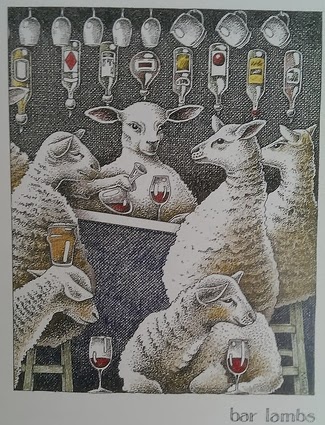
Image Source: Simon Drew’s Famous Phrases Calendar 2014

Now come on admit it. Your pre-school world was full of moo-cows and baa-lambs wasn’t it…

Anyway the sketch of these woolly warmers gassing over a vino or two reminds me that today is National Pisco Sour Day.

I know. Who knew?

Pisco is a powerful grape brandy created by both the Peruvians and the Chileans and forms the basis of the potent Pisco Sour cocktail. Each nation has a slightly different recipe but Peru pay homage to their national tipple on the first Saturday in February – today. And if you are in London, the kind folk at Londonist have published a list where you can sample the best/most authentic manifestations of this South American delight – just click here. If not, you’ll have to google your own list.

I first discovered the joys of pisco during a girls night out at the then newly opened Ceviche Peruvian Bar and Kitchen in London about 18 months ago but rather than sour grapes, it was passion that I found at the bar. Or rather Pasion de Ceviche: A delicious blend of ginger-infused pisco, passionfruit juice, prickly pear liqueur and honey that was so smooth and delicious I had four that night, firstly transferring from an early allegiance to Toro Mata (a cocktail combo of coffee, pisco and sugar syrup) and then duly convincing my three cocktail-ing compatriots to join me.

Unsurprisingly sour grapes were in short supply at our table that night.

Note to self: Must go back. Soon.

In other alcoholic news, just yesterday Lil Chicky posted this on Facebook…

It’s chocolate port…in a glass shoe-boot.

*Excited squealing*

What’s a girl to do? It’s just leading this ‘sweet’ Aussie lamb to alcoholic slaughter.

Baaa-mmer hey…


My Backyard… Building Blocks

Today I was reading an interesting piece on Fevered Mutterings on what constitutes ‘travel’ and the premise that we tend to think about the packing of a suitcase, backpack or even overnight bag as an activity inextricably linked to travelling. 

When I think of travel, I think of going from point A to point B (which is the definition that comes to my mind given the Transport for London website exhorts me to ‘travel by foot’ for a portion of most of my journeys) but this is not a vision that will keep me going in the depths of winter darkness. Thank goodness Mike Sowden suggested that redefining travelling as ‘venturing somewhere new’ means it is right under our noses – that ‘travel *is* our own backyard’.

And last Sunday it was my own ‘backyard’ that I ventured out into to have a gander around Old London Town. I’m not sure that under normal circumstances, I would be up for an architecturally themed stroll on a wintery Sunday morning but I enjoyed Blue Badge Guide Paula’s trek around Shardlake’s London so much last September that it was an easy and enthusiastic ‘yes’ when the flyer came through for her guided walk through Post-War City Architecture

So we started at Barbican tube station and followed Paula – and her post-war story – through the City of London. Here’s what we saw…

Standing outside Barbican station on a crisp January morning

Following the bombing raid on London on 29th December 1940, much of Greater London was flattened. But contrary to wider plans, the City took its own view of its rebuilding and commissioned architects Chamberlin, Powell and Bon to create urban villages for the working class…


The Golden Lane Estate was originally positioned outside the City boundaries until ‘re-zoning’ brought it into the fold – perhaps that explains why a 2 bedroom apartment here goes for around £680,000.
…and the more affluent inhabitants of the City.
The Barbican Estate was opened in 1969 (that makes it as old as me) and stretches over a 40 acre site. It contains more than 2,000 flats, of which a 2 bedroom version will set you back about £900,000. Oh and check out the upside looking windows top right.

We then ambled around the back of the Museum of London, took a quick peek at the Pedway System (a scheme based on raised pedestrian walkways which never really took hold) then crossed London Wall to Wood Street.

Traditional building blocks adorn the home of the City’s Police Force (yes, a separate force from that of Greater London). Standing with your back against the wall will give you a great view of the tower reflected in the building opposite.
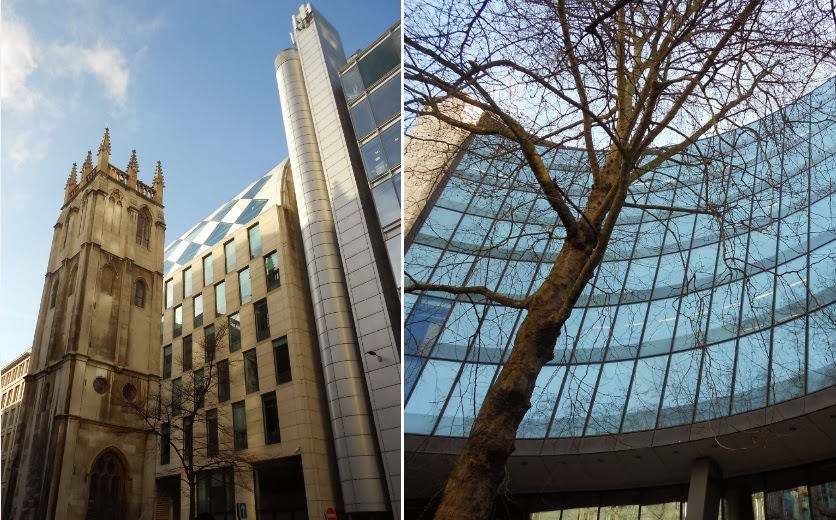
The tower of St Alban stands in the centre of the street in stark contrast to the architecture around it and here the Norman Foster designed 100 Wood Street forms a geometric backdrop to Christopher Wren’s deft touch. But walk through its checkerboard frontage and you’ll find a veritable oasis. Soaring windows angled outwards bring light into the old churchyard and provide space for the old plane tree’s leafy boughs.
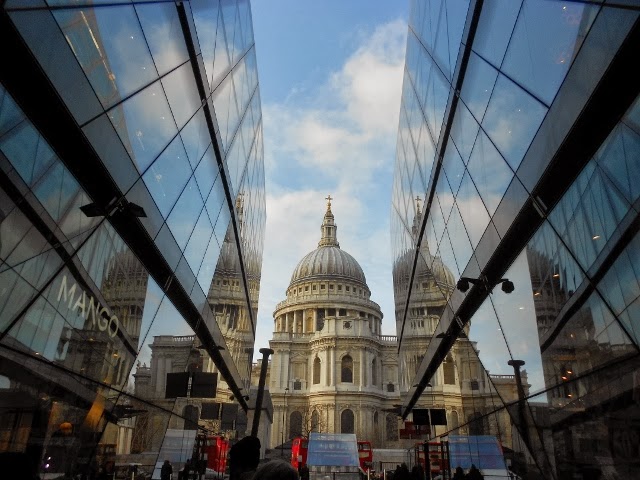
Next it was a trot down Gutter Lane to emerge on Cheapside – crossing the road, we found ourselves standing in One New Change with this rather spectacular view…
The dome of St Paul’s pierces the sky right opposite One New Change. Thirteen ‘views’ of the cathedral are protected by the London View Management Framework which prevents the construction of any buildings which may impinge on the view. There’s even a protected view from Richmond Park’s King Henry’s Mound several miles away.

We headed out of One New Change and down to Bank Junction where the architectural contrasts abounded again.


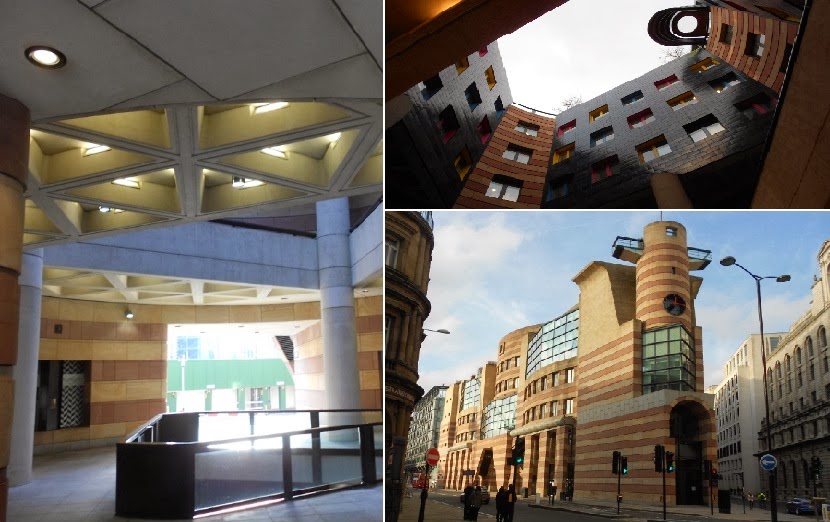
This is No 1 Poultry: the street, like those around it (Milk Street, Bread Street) named after the market produce originally sold here. The building, designed by James Stirling for Peter Palumbo, carves a ship-like post modern silhouette against the sky and has caused much outcry from those – including Prince Charles – whose more conservative sensibilities it offends.
Turning from the post-modernist perspective, we found more traditional architecture clustered around the junction with the Royal Exchange (top left) and the Bank of England (bottom left) dominating the view.

We headed up Cornhill, our guide Paula setting a brisk pace…

The Leadenhall Building (the ‘Cheesegrater’) looms above the stone buildings along Cornhill while St Michael’s doors (right) are tucked a few neat steps back from the street.

…and came to a stop on the corner of Leadenhall Street and St Mary Axe, finding ourselves both surrounded and dwarfed by edifices of steel and glass…

The famous Lloyd’s of London ‘inside out’ building (right) was designed by Richard Rogers (who also designed the Pompidou Centre in Paris with Renzo Piano) on the site of both the previous Lloyd’s building and before that, East India House. The construction style (called Bowellism) is notable for having its interiors – stairwells (spirals), restrooms – the boxes behind the piping which contain electrical and water conduits –  and air conditioning ducts easily accessible to ensure that building never need close due to any malfunction of its ‘essential’ services. This 1986 building was Grade I listed in 2011 much to the chagrin of Lloyd’s (the listing means that the building cannot be changed in any way) so the insurance company’s ‘overflow’ will be moved right across the road to…
…the Cheesegrater (official name The Leadenhall Building). Situated at 122 Leadenhall Street, this building is nearing completion and is expected to open in Spring this year.

And not to be outdone, just a stone’s throw away stands The Gherkin.

The Gherkin‘s official name is the Swiss Re Building – or that’s what previous owners Swiss Re insisted on. Another Norman Foster design and completed in 2003, 30 St Mary Axe was built on the site of the former Baltic Exchange which was damaged in a Provisional IRA bombing in 1992. I thought it seemed rather fitting that The Cheesegrater is within arms reach of The Gherkin…

And with that, it was a short walk to Bishopsgate and the end of our tour. Almost 3 hours (including what Paula likes to call a ‘warming coffee break’ at the Costa Coffee halfway point).

I strolled back towards Moorgate tube station filled with excitement at what a dynamic and fascinating city I live in. The time had flown by and I was so glad that I had dragged myself out of bed and braved the chill to explore this amazing ‘backyard’ of mine. I kept gazing around, wondering about the stories of the buildings that loomed over me and as I reached the intersection of London Wall and Moorgate again, I couldn’t help but take just one last parting shot.


The old and the new right next to each other again.

I don’t know their story. But I am sure it’s fascinating.

Keep calm and carry on

Gidday peeps and welcome to 2014. I hope you found something to celebrate and be inspired by as one year ended and another began.

In between getting out and about, I’ve been sorting stuff at Gidday HQ over a restorative nine days off before facing my first day back at work on January 2nd. And life’s bright shiny distractions meant that a further two days passed before my first 2014 post.

So here I am at last –  better late than never – four days in.

Today has been a bit of a personal maintenance day (the ladies out there will know exactly what I mean – looking good takes a little effort) but the other important thing on my to-do list was to find Gidday HQ’s 2014 calendar. I had ventured out a couple of times over the Christmas period in an effort to have something ready to go come January 1st but had not found anything sufficiently inspiring, heart-warming or engaging to take pride of place on my fridge…

…until today. 

This is part of the front cover of the Simon Drew‘s Famous Phrases calendar.  You can probably see why I was drawn to it…hic!

Anyway, each of his sketches is accompanied by a particularly witty twist on a well-known phrase. This one was also on the cover…

Core Jets / courgettes…geddit?

Anyway, it made me laugh in the shop so I bought it and brought it home, filled in all of the important dates and events I already know about and stuck it on the side of the fridge. And to celebrate its comic contribution here at Gidday HQ, I thought I’d take on the Calendar Challenge again, last seen in 2012 and featuring the irreverent bunch from Violent Veg.

The Calendar Challenge means publishing a post on the first day of each month using the corresponding calendar page from that month as my theme / inspiration. And look at this, it’s the 4th and I’m late already. But January has some good advice…

…although I’m not sure who ‘Ron’ is.

Anyway, I reckon there’s only one thing left to do – let’s get stuck in to 2014 and see what happens.

Hope you enjoy the ride.


Bourne again

I’ve been enjoying a little staycation for this ‘week between’ Christmas and the start of the New Year. It’s been a week of pottering about at Gidday HQ: literary lie-ins (aka indulgent reading in bed until somewhere around 10am), comfy couch sessions and bouts of cleaning with a few dips into some local delights – a trip to the Phoenix Cinema to see Gone With The Wind (all 4 hours of it – at last) and a fab girly catch up over cocktails & lunch at Skylon – in between.

After a couple of brisk, blue-sky days, the weather is wet and a bit dismal today so amid continued bursts of cleaning up, I’m aiming to tick a few more movies off the I-haven’t-seen-it-yet list with Gentlemen Prefer Blondes already under my belt this morning.

Speaking of ticking things off my list, I want to tell you about my Boxing Day. You see, I went to Sadler’s Wells to see Matthew Bourne’s Swan Lake as a Christmas present to myself. Yes peeps, Happy Christmas to me.

I first saw Matthew Bourne‘s work in July last year. Play Without Words left me thrilled and awestruck and his take on Sleeping Beauty was clever and fun and brilliant. His Swan Lake, which premiered in 1995 with an all-male ‘swan ensemble’, has something of a reputation. So even though my previous experiences of Swan Lake had left me bored and wondering what the point was, I took my seat just before 2.30pm feeling quite excited.

The first familiar notes of Tchaikovsky’s score swelled from the orchestra pit soon after, the curtain rose and I was riveted.

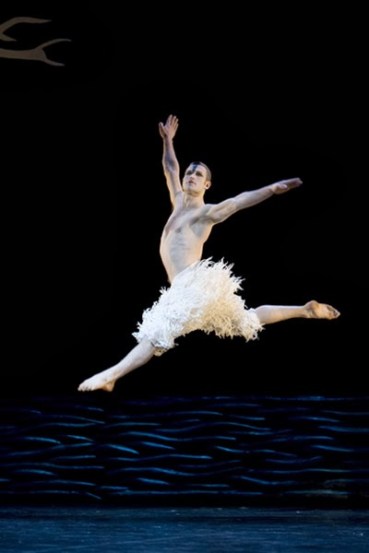
It was theatrical and dramatic and witty, filled with light and shadow and the most extraordinary dancing I’ve ever seen. And for the first time I really felt the story. It was visceral – I could feel the fear and liberation in the prince, the reined-in majesty of his mother and the sycophantic expectation of his subjects. But most of all I felt the magnetism and menace of the swans. Their flapping fury, their drooping necks and piercing eyes, the muscular ebb and flow of sweeping, swooping limbs that were, it seemed, inseparable from the music.

Images sourced from http://www.sadlerswells.com

It was an amazing show and for me, it was if Tchaikovsky’s powerful score had finally met its match in the powerful movement on the stage. I felt incredibly emotional and as the cast took their final curtain call, I was on my feet applauding furiously.

Thinking back, I can still feel the moment that the final note evaporated into the air and the curtain fell. The slight prickling of my skin, the full feeling welling in my chest and the profound sense of being touched by something extraordinary.